
Lesson 12 - Control of Fluid Flow 3
This lesson will consider valve technology, which is used to control fluid flow. It will cover the control functions of on-off, and modulating flow control, together with a description of the various valve types which can achieve these functions. The lesson will conclude with thoughts on the issue of managing valve leakage to avoid cross-stream contamination.
Pressure Relief Valve
Pressure relief valves (also known as a relief or vent valves) ensure that overpressure is relieved or vented from a pipeline or vessel. This ensures that an overpressure situation does not cause what is known as a ‘catastrophic failure’ of the pipe or vessel.
A catastrophic failure would be one where the pipe or vessel would deform, rupture, or explode – not a situation that we would want or wish to be around. Pressure relief valves are safety critical and the sizing/design/installation of them and their associated piping should be referred to specialist engineers.
These valves work by opening at a set pressure. They create an alternative path for the pressurised fluid to exit the pipe or vessel. This latter aspect is particularly important as it means that the pressurised fluid, which was contained in the pipe/vessel, is typically vented into the surroundings. Careful consideration has to be given to the location and direction of the vented stream, e.g. a pressure relief valve for a steam system would typically be located outside a building rather than inside. This would allow the vented steam to safely escape as we do not want a brewhouse full of vented steam.
The valve relieves excess pressure when the pressure lifts a weight or a spring allowing the pressurised fluid access to the alternative path. A spring-loaded pressure relief valve is shown in the figure below.
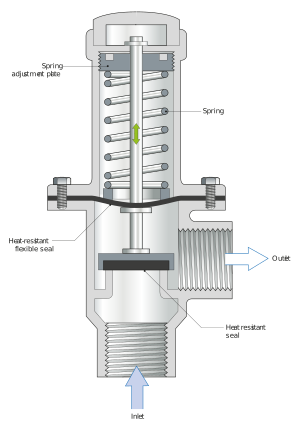
Figure: Pressure relief valve
An alternative pressure relief system, which is not technically a valve, is a bursting disc. This consists of a weakened disc of metal which catastrophically fails at a set pressure. This is a disc of metal that is certified to fail at a pre-set pressure.