
Lesson 12 - Control of Fluid Flow 3
This lesson will consider valve technology, which is used to control fluid flow. It will cover the control functions of on-off, and modulating flow control, together with a description of the various valve types which can achieve these functions. The lesson will conclude with thoughts on the issue of managing valve leakage to avoid cross-stream contamination.
Globe Valve
Unlike all of the previous valves we have considered, which were named after the shape of their valve control element, the globe valve is named after the external shape of the valve body.
A globe valve body is shaped like a globe or sphere and is internally separated into an upper and lower hemisphere by an internal horizontal baffle. A hole is present in the baffle, termed a port, and a plug is moved vertically into and out of the port to block the flow completely. If the plug sits fully in the port on top of the valve seat, then the flow is shut off. Conversely, if the plug is moved vertically off the seat, it will partially obstruct the port and will modulate the flow. The valve plug is moved (actuated) vertically either by the rotation of a threaded hand-wheel or the linear displacement of an automated actuator. The valve details are shown in the figure below.
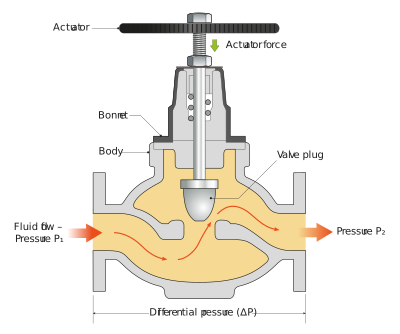
Figure: Globe valve
The globe valve is well suited to the majority of low/medium pressure operations found in the brewery. If tight shut off is required (no leakage across the valve from upstream to downstream) then a soft valve seating can be used.
It is also particularly well suited to a variety of flow control duties, both on-off and modulating; the latter also with a variety of flow rate characteristics to control flow with a high degree of precision over narrow or wide flow rate ranges, by use of different valve plug geometries. Some examples of this are shown in the figure below.
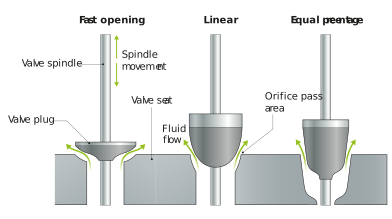
Figure: Globe valve seats for different characteristics
An intriguing version of the globe valve, termed a needle valve, utilises a small port and an elongated plug, in the shape of a needle. Insertion of the needle, in and out of the port, allows precise modulating control of the flow rate. Such valves are often seen in laboratory equipment, e.g. small-scale rotameters for flow regulation and measurement.
Globe valves can also have more than one port, and the three-way mixing or blending valve is a classic example of this. In this valve function, two streams are mixed together across a range of controllable ratios through the movement of a plug between two ports. This is shown in the figure below.
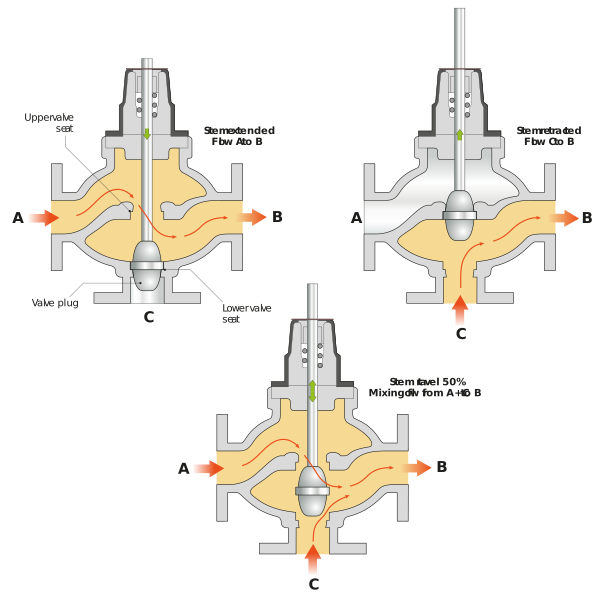
Figure: Three-way mixing globe valve
An example of such a blending operation common in many breweries is the production of temperature-controlled water streams from recovered hot water. This is blended with cold brewing water for use as mashing-in water, CIP water and other general hot water uses. These different uses all require different temperatures, hence the need to change the blending ratio of the hot and cold water streams.
Due to the variety of characteristics available with a globe valve, care should be taken when selecting a particular valve for an application. It is definitely one of those occasions when the mindful brewer would rely heavily on a friendly process control engineer. Also, bear in mind that the globe valve is not considered a hygienic design for wort, beer or other sanitary applications.