
Lesson 12 - Control of Fluid Flow 3
This lesson will consider valve technology, which is used to control fluid flow. It will cover the control functions of on-off, and modulating flow control, together with a description of the various valve types which can achieve these functions. The lesson will conclude with thoughts on the issue of managing valve leakage to avoid cross-stream contamination.
Point of Reflection – Reconvene
Welcome back. So, what were your thoughts?
This is quite an open-ended topic to reflect upon, but the following might give you something to consider.
Would we like on-off control? Well, we would certainly like to be able to turn the water on and off, but not with on-off flow control as we now know it to be. Imagine trying to fill a glass with water. If we turn the tap a fraction, and you would likely get the full stream of water which might knock the glass out of your hand. Hardly ideal flow control for the function we need. So, what would be ideal flow control?
Well, we would rather have smooth control of the flow, from flow shut off to full flow rate with a turn or two of the tap. So, a couple of turns of the tap, which opens the valve fully, would be desirable, but not too many as we would spend forever turning the tap to get increasingly more or less flow rate. Such behaviour might be suitable for precise control of flow rate, but for your general kitchen sink duties, it would be unnecessary. You would probably like the following:
-
A degree of precise control over small flow rates (e.g. 0% to 25% of full flow), by being able to slowly increase flow rate with a full rotation of the tap. This would allow us to fill glasses, etc. safely,
-
Beyond 25%, we might want to rapidly increase the flow rate to its maximum with another full rotation of the tap. This would allow us to quickly increase the flow rate to fill the sink with water, etc.
As simple as a sink tap (or water control valve) might appear, it is not. Hopefully, you are starting to see that there is more to it than first appears; whether it is the suitability of an on-off control function or the sensitivity of the flow rate to a change in the degree of opening of the valve. We will consider this last aspect in more detail in the next section.
Characteristics of flow rate control
The flow rate characteristic of a valve is simply the relationship between the extent that the valve is open with the percentage of the maximum flow which the valve will pass. Examples of three types of valve characteristics are shown in the figure below.
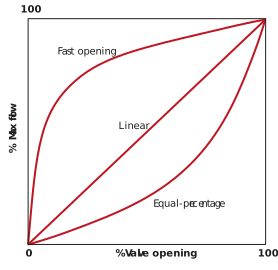
Figure: Three common valve characteristics: fast-opening, linear and equal percentage
The three most common characteristics encountered are:
-
Linear – in which the flow rate increases linearly with the percentage of valve opening, e.g. if the valve is halfway open, then the flow rate through the valve is half of the maximum. Linear control valves are well suited to liquid duties.
-
Fast opening – in which a rapid increase in flow rate is achieved by a small change in valve opening. Conversely, if the valve is fully open, then a large reduction in valve opening yields a very small decrease in flow rate. This type of characteristic is not suitable for modulating flow control; however, it is ideal for on-off flow control. Care must be taken as it is very effective at rapidly opening a flow, but not so effective at rapidly shutting off the flow.
-
Equal percentage – in which flow rate increases exponentially with valve opening. Full understanding of this valve characteristic is quite mathematical and requires some prior knowledge of control theory. At this stage, think of it as a characteristic where the rate of flow increases. This results in equal percentage changes in % flow rate with equal changes in valve opening. An equal percentage valve is well suited to gas duties.