
Lesson 6 - Maintenance
This lesson discusses the necessary components of a successful brewery maintenance programme and provides details on approach, implementation, execution, and business-level relationships.
Point of Reflection - Reconvene
Welcome back. So, what were your thoughts? Below are some examples you might have considered.
Maintenance communication could take the simple form of a white board, a mention at a staff meeting, or an email. In smaller facilities, this may be all that is necessary for successful maintenance execution.
Larger or more complex breweries may require more sophistication in their maintenance programme, such as records of maintenance history or formal work orders. For example, an electronic log of past work could take the form of a spreadsheet. Or an integrated approach may be necessary that seamlessly handles work requests, preventative work orders, spare parts inventory, and ordering as well as backlog and labour hours tracking. In this instance, a Computerised Maintenance Management System (CMMS) would be a suitable solution.
Facility
Physically how will maintenance take place in your brewery? In other words, will you have a dedicated workshop to house equipment, tools, and spare parts – or will these items be distributed throughout your facility? A formal maintenance department will likely necessitate a formal maintenance workshop. This space can take any number of forms, but you should consider a few key elements. The table below explains some of these in more detail.
Table: Maintenance workshop zones
|
Maintenance Workshop Element
|
Element Description |
|
Sanitary / |
This is an area that is in an isolated section of the workshop, free from unnecessary personnel traffic, well-lit, and ideally climate controlled (at minimum has filtered room air).
The purpose of this area is to disassemble, clean, inspect, and rebuild all of the critical sanitary elements of the brewery, including instrumentation, valves (butterfly, mixproof, pressure relief), and filler/keg line components.
Here, only a minimum of hand tools are required along with a sturdy workbench and vice. Less is more in this space and cleanliness is of the utmost importance.
|
|
Machining zone |
This area is dedicated to repair and fabrication work that generates metal chips but not sparks or grinding dust. Such a zone should be isolated from other work areas, well lit, and ventilated to protect staff and equipment.
Equipment such as lathes, mills, band saws and drills are best suited for this location. It is important to note that when working with both carbon steel and stainless steel, absolute care should be taken to prevent cross-contamination of the stainless materials.
|
|
Welding/fabricating zone |
This area is dedicated to repair and fabrication work that generates dust, grit, and fumes. Similar to the machining zone, it should be isolated from other work areas. Additionally, this space should be well lit and ventilated to protect staff and equipment.
Equipment such as angle/bench grinders, welders and sand blasters are best suited for this location. It is important to note that when working with both carbon steel and stainless steel, absolute care should be taken to prevent cross-contamination of the stainless materials. In some cases, as with a sandblasting station and grinders, breweries should strongly consider purchase two like tools to eliminate this risk.
|
|
Parts room |
This area houses the spare parts inventory and possibly a consignment inventory – items such as nuts, bolts, o-rings, gaskets, oils, lubricants, and sealants – that are stocked by a third-party vendor and held at your facility. You only pay for inventory that is used.
This section of the workshop ideally has restricted access to aid in keeping it orderly and to ensure an accurate spare parts inventory.
|
|
Library/computer access |
As a minimum, this includes a desk, a computer, and bookshelves. It is a dedicated space to house and organise equipment manuals, software programmes, and service SOPs. Here, maintenance personnel can access email, work requests, and online vendor information.
|
|
Waste/recycling |
Optimally located near the machining/welding/fabricating area, this section of the workshop is intended to keep order and reduce the environmental impact of the brewery.
Ideally it has dedicated labelled bins to separate metals for recycling, and drums for waste oils to recycle or sell.
|
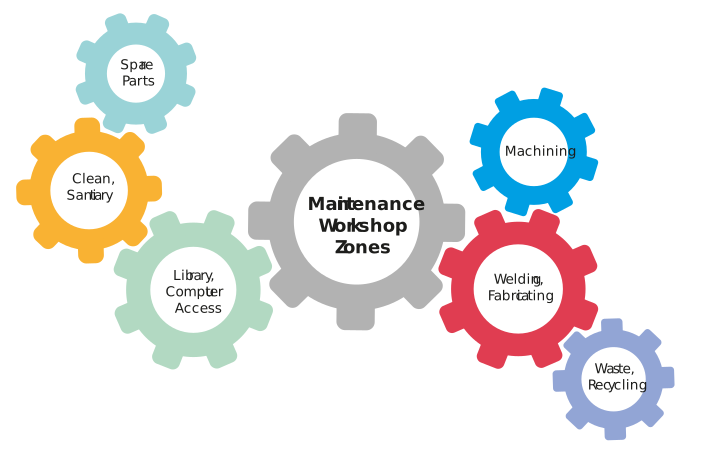
Figure: The physical elements of a maintenance workshop