
Lesson 6 - Maintenance
This lesson discusses the necessary components of a successful brewery maintenance programme and provides details on approach, implementation, execution, and business-level relationships.
Maintenance Approach: Preventative Maintenance (PM)
Preventive maintenance is scheduled maintenance, based on time or usage, that is routinely performed on equipment regardless of its condition to reduce the probability of failure. It is based on the concept that unforeseen breakdowns are much less likely to occur by being proactive. Planned maintenance can vary from daily lubrication, a mini overhaul every few days, a weekly inspection and oil top-up, to a complete line or major overhaul lasting several days.
The two triggers for Preventative Maintenance are time and usage. An example of a time-based trigger is performing a full boiler blow-down after an interval recommended by the equipment manufacturer. An example of a usage trigger is a full teardown, inspection, and rebuild of a sanitary mixproof valve after a defined number of actuation cycles.
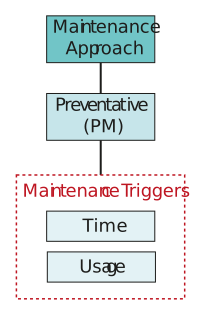
Figure: Triggers for the Preventative Maintenance approach
Preventative Maintenance is appropriate for:
- Critical brewery operations, such as mash separation, where downtime is expensive and impactful to the business
- Systems that have well-understood failures, which can be prevented through proactive maintenance, e.g. removal and replacement of carbon filter media for incoming municipal water well in advance of its known degradation
- Equipment that experiences breakdowns as a function of time or use, e.g. centrifugal pump seals
There are several advantages of Preventative Maintenance:
- It is proactive and allows one to plan. This means that, prior to equipment being scheduled to be out of service, the maintenance team can order enough stock of the necessary repair parts and book skilled staff or contractors. This translates into a reduction in downtime.
- Enhanced safety. Machines that continually fail can cause frustration and, coupled with the pressure of production, may result in shortcuts being taken and unsafe practices. Being able to plan system maintenance gives technicians and operators time to prepare, to read and review equipment drawings and instructions, and to practise proper Lock Out Tag Out (LOTO) – equipment de-energisation.
- If we have equipment that runs consistently well, we can ensure a consistently high quality product. Systems that perform as designed will yield product with minimal variation and are less prone to being out of specification. Infrequent machine starts/stops allow operators to fine-tune the equipment, saving time and materials.
- Staying ahead of repairs and general upkeep benefits the maintenance budget and brewery finances. Due to the combination of lost production time, inefficient use of labour, and the cost of expediting spare parts, emergency maintenance can quickly erode the maintenance budget.
There are also disadvantages, however.
- Preventative maintenance requires investment.
- It necessitates a resource (person) to coordinate and schedule with the brewing departments and the personnel performing the work. In smaller breweries, this person could be the production scheduler operating in both capacities. Larger facilities would likely have a dedicated resource for this job.
There are also risks involved, e.g. servicing equipment and interrupting production at a frequency greater than necessary. With the desire to prevent breakdowns, systems are serviced more often than necessary, which is not an efficient use of labour. With time and experience, these service intervals can be tuned and optimised.
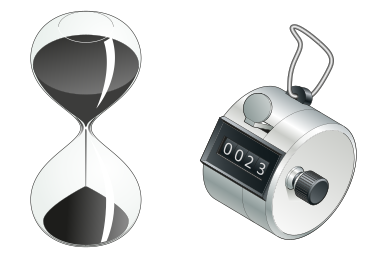
Figure: Time and usage trigger Preventative Maintenance activities