
Lesson 6 - Maintenance
This lesson discusses the necessary components of a successful brewery maintenance programme and provides details on approach, implementation, execution, and business-level relationships.
Maintenance Approach: No Maintenance
No Maintenance is not what its name implies – if it were, companies adopting this philosophy would eventually have all equipment within a facility rendered inoperable.
The No Maintenance approach is sometimes suitable for small facilities with either very basic or non-critical equipment. This categorisation may more accurately be described as a No Structured Maintenance or No Formal Maintenance Plan.
The ideology of no maintenance can be quite involved. It uses all five maintenance triggers (breakdown, time, usage, event, and condition) but in a casual, ad hoc fashion. For example:
-
Breakdown – when something breaks, it is clearly evident and is repaired.
-
Time – someone remembers that it has been several months since the filters on the incoming municipal water have been changed. Therefore, the filters are changed.
-
Event – a forklift backs into a grain rack, bending a structural support. While the rack still looks acceptable, the support is replaced.
-
Usage – after several regeneration cycles, the boiler make-up water ion exchange salt cylinder will become empty. An operator remembers this and checks. If empty, the system is refilled with salt.
-
Condition – a bearing on the malt auger has started to squeak during use. As their time permits, the shift brewer applies grease, which quiets the bearing.
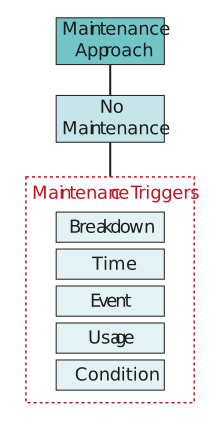
Figure: Triggers for the No Maintenance approach
The advantages of a No Maintenance approach include:
-
Ease of implementation
-
Low initial cost to the company
Disadvantages include:
-
Stress to the organisation due to the unpredictability of failures and negative impact to operations
-
The long-term costs are quite high, resulting from reduced operational efficiency, the need for numerous spare parts in stock, and probable reduced equipment lifespan

Figure: A No Maintenance approach can lead you down a challenging path