
Lesson 6 - Maintenance
This lesson discusses the necessary components of a successful brewery maintenance programme and provides details on approach, implementation, execution, and business-level relationships.
Maintenance Approach Summary: Putting It All Together
The table below allows you to compare the maintenance approaches.
Table: Maintenance approach summary
|
|
No Maintenance
|
Run-To-Failure |
Preventive |
Predictive |
|
Summary |
No formal maintenance programme
Work occurs ad hoc
|
Repair or replace only upon equipment failure |
Maintenance performed based on intervals |
Maintenance requests based on real-time (or nearly) process conditions |
|
Cost |
Low – variable
|
Low – variable |
Moderate |
High |
|
Pros |
Simple to implement |
Simple to implement
|
A proactive approach can reduce unplanned downtime and costs (labour, spare parts) |
High degree of process insight |
|
Cons |
No structure |
Repair/replacement costs can be high |
Requires planning, scheduling, and coordination with production |
Most expensive approach to establish
|
The approaches and their triggers are shown in the below figure.
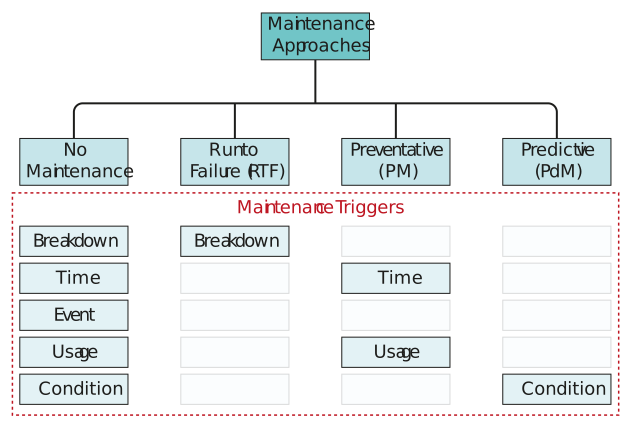
Figure: Maintenance approaches and their associated triggers
Looking at the figure above, you can quickly see that no one maintenance approach can cover all situations. This is why a balanced approach between Reactive (Run-to-Failure), Preventative, Predictive (as appropriate), and even at times No Maintenance should be adopted.
For maintenance in general, an idealised model of these approaches might resemble the figure below.
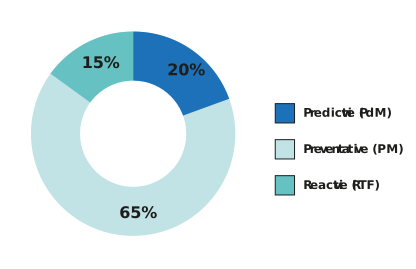
Figure: Idealised maintenance approach mix
In this model, the bulk of time and resources (85%) is based on proactive maintenance comprised of both preventative and predictive approaches. Only 15% of issues are addressed through reactive measures. This model represents an idealised state for a mature process with a high degree of inline automation and controls, as well as the ability to easily filter incoming process data in order to provide a prompt and focused response.
In general, for most companies, the maintenance approaches used have a different distribution (see below figure) that may reflect what you see at your facility.
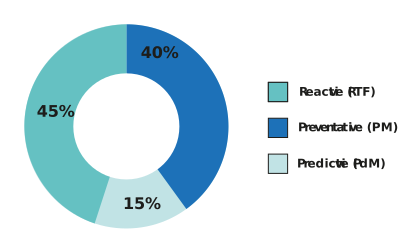
Figure: Typical maintenance approach mix
Here, the reactive maintenance response accounts for the majority of the three approaches. It may more realistically represent your brewery’s current state.
While this may be acceptable, (and indeed it may be all that your brewery can manage), examine the below figure and see how evolving towards a more balanced approach between reactive, preventative, and predictive maintenance can save production time while lowering the total cost of repairs and maintenance support.
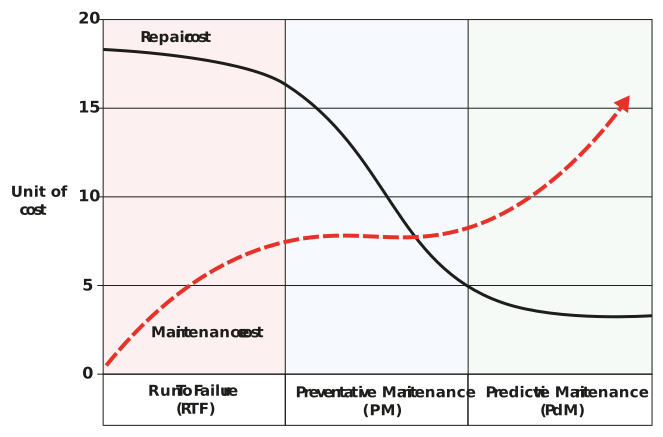
Figure: Striking a balance between maintenance approach and total cost
Each brewery and situation is unique, meaning that the maintenance approaches you select (and also in what proportion) must suit your particular needs. Remember, as a brewery evolves, so should its approach to maintenance. This leads us directly into our next topic, where we will learn how we can establish a brewery maintenance programme and how it can evolve.