
Lesson 6 - Maintenance
This lesson discusses the necessary components of a successful brewery maintenance programme and provides details on approach, implementation, execution, and business-level relationships.
Establishment and Evolution of a Brewery Maintenance Programme
Periodically, the direction and approach to fundamental business elements such as maintenance will need to be clearly defined or revisited. In the case of maintenance, several critical questions must be asked and answered prior to continuing an investment of time and resources into the support of the brewery.
Let us look at this in relation to the maintenance approach taken and the brewery’s capability, capacity, skills, and organisation of resources.
Maintenance approach
There should be a periodic review of the brewery’s current maintenance approach to ensure it reflects the needs and objectives of the business. A balance needs to be struck between achieving zero downtime and saving money on maintenance. As this is a business-wide decision, input from finance, operations, and commercial business functions is needed.
Capability, capacity, and skills
Our industry covers a wide range of facility sizes, from a single hectolitre to millions. The maintenance demands and required skills for a nano brewery are entirely different from those of a multi wort stream macro brewery.
Smaller breweries may find it more appropriate to have one internal resource to cover most maintenance (and likely brewing, sales, marketing, and merchandising as well) and use specialist contractors as required. This person handles all the facility’s needs, from equipment service and utilities support to ordering parts and scheduling repairs. The maintenance costs in such an arrangement are essentially lost in the noise of all the other duties being performed.
Larger breweries, due to their size, complexity, and around-the-clock operation, benefit from a larger and dedicated pool of maintenance resources. Maintenance requires technically trained staff to perform the plant service, as well as supporting resources such as a manager, admin, and planner/scheduler. This comes at a cost, as higher skill levels are required. Maintenance at this scale operates as a true business cost centre and is a major part of brewery finance, planning, and operation.
Organisation of resources
It is important to define exactly how maintenance will be organised and deployed in your brewery. There are three main types of brewery maintenance resource – distributed/local, centralised, and contract. The type of resource best suited to your needs depends on the nature of your brewery and the maintenance approach you employ. Let us look more closely at each of these options.
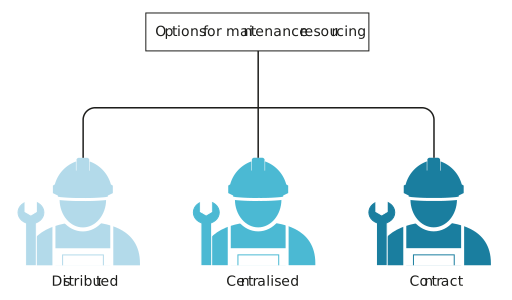
Figure: Three options for maintenance resourcing
Distributed/local resource
This is maintenance performed at the equipment/operations level and typically executed by trained operators. It is often referred to as ‘autonomous maintenance’.
Examples include daily work outlined in Standard Operating Procedures (SOPs) that contain instructions on performing cleaning, inspecting, and lubrication (CILs), and basic equipment troubleshooting.
Benefits include reducing the number of unnecessary calls for simple machine and process issues, faster resolution of larger process issues, and an embedded means to execute preventative maintenance.
Disadvantages are due to the availability of operators and their technical skill. When your primary responsibility is to produce or package beer, maintenance often takes a backseat in terms of time. A busy day can turn into a busy week, resulting in even simple preventative maintenance work being neglected or forgotten. Those directly working in brewing or packaging are generally hired for their skills that pertain to their primary job responsibility. They may be taught some basic maintenance, but complicated system and machine maintenance may not be a realistic expectation.
A distributed form of maintenance is often found within small breweries due to their basic needs and limited resources. Additionally, distributed maintenance is becoming an important and growing element of larger companies as retirements increase and skilled tradespeople are more difficult to find.
Centralised resource
This refers to a dedicated set of trained and skilled resources whose only responsibility to the brewery is to service its equipment and systems.
An example is a formally defined department comprised of vocationally trained team members with specific skills needed throughout the brewery such as machining, welding, electrical, refrigeration, boiler engineering, controls and heating, ventilation, and air conditioning (HVAC).
Benefits include having specific and deep knowledge of the critical areas and elements in brewery operation. Furthermore, these resources are solely dedicated to brewery service and have no other conflicting responsibilities that prevent maintenance from being their focus. This means timely and more proactive maintenance practices.
The disadvantages to having centralised maintenance resources mostly pertain to higher staff and equipment cost. More highly skilled resources will likely command a higher salary. A formal maintenance shop space and its associated tools also require capital investment.
Organisations with centralised maintenance may be found at all sizes of breweries but are most common at mid- and large-scale companies when the demands of operations can no longer solely support distributed/local maintenance activities.
Contracted resource
This is maintenance performed specifically by individuals and companies external to your brewery with dedicated resources, skills, and equipment in a targeted vocation. While contract maintenance may be sourced in times of need – breakdowns or projects – it can also play an important role in the daily function and operation of your brewery.
Examples include a portable rig welder team to assist in a cleaning in place (CIP) system installation for equipment setting and piping connections, or someone to monitor and maintain critical assets such as chillers, boilers, and air compressors.
Benefits are similar to those for centralised maintenance resource, but not having these resources as direct employees also allows your brewery to closely manage its staffing levels and optimise salary costs.
Contractor costs can be significant due to their specialised skills, tools, and company overhead. Therefore, their use is generally limited.