
Lesson 6 - Maintenance
This lesson discusses the necessary components of a successful brewery maintenance programme and provides details on approach, implementation, execution, and business-level relationships.
Maintenance Approach: Predictive Maintenance (PdM)
This is the most sophisticated maintenance approach. PdM uses data from equipment monitoring the plant and process to predict when a piece of equipment is about to fail. Also known as condition monitoring, it can be quite powerful but also quite costly in terms of infrastructure requirements.
With a wealth of process data available to it, Predictive Maintenance can reduce maintenance intervals to their lowest levels without sacrificing equipment reliability. The goal of this approach is to schedule work only as needed and as close as possible to impending equipment failure. This is accomplished by only triggering maintenance based on defined process conditions.
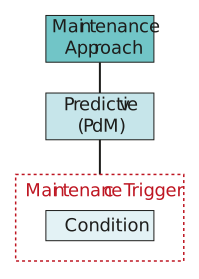
Figure: Triggers for the Predictive Maintenance approach
Predictive Maintenance is well suited for:
- Mature, well-understood processes where the failure modes are repeatable and predictable
- Equipment or processes that are well instrumented (temperature, pressure, level, vibration, etc.) and are constantly monitored through a centralised control system or through routine checks by personnel
It provides one main advantage over less complex approaches – being able to keep equipment in service as long as possible prior to repair. This can be a tremendous advantage to the operational efficiency of the brewery.
An element of Predictive Maintenance that is increasingly practised is risk-based inspection (RBI). This tool aids the quantification of risk and occurrence to help focus maintenance resources towards the most critical and impactful assets to reduce downtime. If RBI is practiced it is generally used for major items of utility plant such as boilers, refrigeration and air compressors, large distribution pumps, etc.
An introduction to the concept of RBI may be found at: https://www.cortemgroup.com/en/about-ex/technical-articles/depth-analysis-risk-based-inspection. Note, this is for illustrative purposes only and is not a recommendation or endorsement of the supplier.
Based on what you have already learned about the various other maintenance approaches, what advantages to labour do you think are provided by predictive maintenance? Give yourself 5–10 minutes to think about this, and then click ’Next’ to continue with this lesson.