
Lesson 6 - Maintenance
This lesson discusses the necessary components of a successful brewery maintenance programme and provides details on approach, implementation, execution, and business-level relationships.
Maintenance Approach: Run-To-Failure (RTF)
In this instance, equipment is only attended to when it breaks down. Thus, there is an elevated risk of production loss, as breakdowns are unpredictable and can often occur at undesirable times.
Run-To-Failure maintenance is appropriate for systems or equipment that are:
- Easy to service, e.g. a ventilation fan belt
- Electronic based, e.g. a temperature controller or variable frequency drive (VFD)
- Less expensive to let fail than to perform preventative or predictive maintenance on, such as non-critical or infrequently used equipment
- No risk to safety of personnel or surrounding equipment
Additionally, this type of maintenance approach may be well-suited to low criticality equipment or for situations where built-in spares or duplicate equipment are available.
The trigger for the Run-to-Failure maintenance approach is a breakdown.
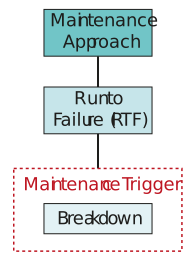
Figure: Trigger for the Run-To-Failure maintenance approach
Advantages of Run-To-Failure maintenance include:
- Minimal planning/scheduling – this form of maintenance is reactionary; work occurs only after a failure is detected
- Simplicity – the trigger for repair is easy to explain and understand
- Low initial cost of implementation
Disadvantages include:
- Higher costs – long term, it is the most expensive approach. Costs are for increased spare parts inventory, expedited shipping fees, and higher technician labour time and travel costs. Other costs result from lost production, potentially late orders, and inefficient use of labour.
- Reduced asset life – as with the No Maintenance approach, there is a reduced asset life expectancy, resulting from only attending to systems when they are not functioning. This degrades the equipment faster than its intended rate of depreciation.
- Safety issues – an increased risk to safety results from the reactive and pressure-filled nature of emergency repairs. In such scenarios, safety procedures can be overlooked, and unnecessary risks may be taken to quickly return the asset to operations.
- Maintenance backlog – when used in conjunction with other approaches, Run-To-Failure maintenance can inhibit existing, planned preventative maintenance by always prioritising resources towards failed equipment rather than working to a planned maintenance schedule.
- Reduced sustainability metrics – equipment that is not in top condition operates less efficiently, has higher energy costs, and may be prone to oil, coolant, water, or product leaks.
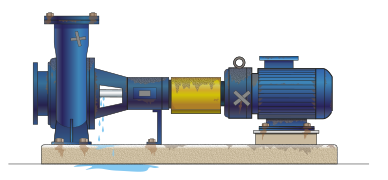
Figure: This pump has become victim to the Run-To-Failure approach