
Lesson 6 - Maintenance
This lesson discusses the necessary components of a successful brewery maintenance programme and provides details on approach, implementation, execution, and business-level relationships.
Successful Maintenance Approaches
The mindset of how maintenance is performed in your brewery sets a clear tone for its operation and its perception, both internally and externally. This in turn directly affects how people work, the facility’s appearance, safety, and ultimately, the quality of our end product.
Figure: Maintenance requires careful planning and forethought
Just as in a game of chess, staying two or three moves ahead of equipment, process, and system demands, is part of any successful maintenance programme.
There are numerous takes on the categorisation and definition of maintenance. The spectrum ranges from having no defined maintenance approach (which is not the same as performing no maintenance – more on that in a bit) to adopting a more sophisticated, predictive approach. For this discussion, we will outline the four most common approaches in detail. These approaches are: No Maintenance, Run-To-Failure (RTF), Preventative (PM), and Predictive (PdM).
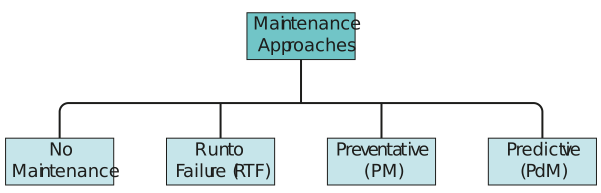
Figure: Maintenance approaches
We will discuss each maintenance approach in detail shortly, but let us first familiarise ourselves with the factors that can trigger maintenance work, such as breakdown, time, usage, event, and condition. See the table below for more on this.
Table: Maintenance triggers
|
Trigger |
Description |
Example |
|
Breakdown |
Maintenance is initiated upon equipment or component failure. |
A chilled water pump coupler breaks.
Circuit board on a VFD blows a capacitor.
|
|
Time |
Maintenance occurs upon a time-based interval (e.g. weekly, monthly, quarterly, annually).
|
Lubricate malt mill roller bearings monthly. |
|
Usage |
Maintenance is deployed after a threshold of use has been reached. |
Perform a boiler blow-down based on run hours.
Rebuild mixproof valve based on number of actuation cycles.
|
|
Event |
Maintenance takes place after abnormal circumstances have occurred.
|
Boiler shutdown, drain, and internal inspection after water pre-treatment system failure. |
|
Condition |
Maintenance is scheduled upon detection of an abnormal or deviating process condition. |
Elevated pump vibration.
Increased variation in steam header pressure.
|
Take a moment to think about these triggers and how they would apply to your life outside of work. See if you can create an example of each trigger. Give yourself 5–10 minutes to think about this, and then click ’Next’ to continue with this lesson.