
Lesson 6 - Design of Fermentation Vessels
This unit began with the principles that underpin fermentation. This lesson now explores how these are put into practice. It covers how fermentation vessels must be designed to suit the behaviour of the yeast strain being used, as well as the nature, scale, and sophistication of the processes available.
Immobilised Yeast
A major problem of conventional continuous fermentation systems is the need to separate the yeast that washes out with the beer. We can reduce this problem by using immobilised yeast; this is where the cells are either physically attached to a support material or trapped so that they cannot leave the fermenting vessel.
The scientific definition of cell immobilisation is ‘cells confined in a localised space where they retain their catalytic activities which can be used continuously and repeatedly’. We can break this down to pick out the essential features, looking especially at how this approach compares to conventional continuous culture. The key difference is that the cells cannot, in theory, leave the reactor; in other words, it is a closed system. If cells cannot leave, we can use much higher cell concentrations than are found in an open continuous system, and in theory much faster rates of reaction should be possible. Providing the cells do not die (or, if they do, are replaced by new ones), the reactor can, in theory, be used indefinitely. Since the cells cannot leave the reactor there should be none present in the outflowing beer and so no need for costly post-process separations.
This explanation describes a best-case scenario. However, there are some downsides. The key problem is making sure all cells have access to the medium. There needs to be an efficient mass transfer of nutrients, including gases such as oxygen, into the cells and, subsequently, an efficient exit of metabolic by-products. Where the cell density is very high, this is likely to be a problem. There is also the question of growth. Yeast cells have a natural lifespan; they are not immortal and will eventually die. When this happens, we have to replace them with new ones or the whole population will age and eventually die.
Assuming that we replace dead cells with new ones, we have to retain them within the reactor. Here, the method of immobilisation is important, so we now consider the options. There are three basic methods available:
● Cells bound to a surface. Yeast cells carry a negative charge and so they can stick to surfaces which have a positive charge.
● Cells trapped within a porous matrix. There are several ways to do this but, thinking of an agar medium, if we add yeast cells to cooled molten agar then leave it to set, the cells become trapped within it. They still have access to nutrients and the medium is permeable to gases so they can grow under these conditions.
● Cells enclosed in a permeable membrane. In this approach, the cells are freely suspended but cannot exit the reactor because they are surrounded by a membrane which contains pores that allow nutrients to pass but are smaller than the cells.
There is a fourth method which is not quite immobilisation. This is the use of very flocculant yeast strains, as in the tower fermenter described in the previous section.
The following table lists some methods for immobilising yeast cells, together with their advantages and disadvantages.
Table: Methods of immobilisation, their advantages and disadvantages.
|
Method |
Carrier |
Advantages |
Disadvantages |
|
Flocculation |
None |
No special support medium needed |
Flocculent yeast strains only Difficult to avoid some cell wash-out |
|
Entrapment |
Permeable membrane |
No special support medium needed Any yeast strain |
Membrane is a big barrier to mass transfer |
|
Entrapment |
Calcium alginate beads Chitosan beads κ-Carrageenan beads |
Any yeast strain Can carry very high yeast loadings Inexpensive |
Restricted mass transfer if beads too large CO2 breakout can disrupt beads Cell outgrowth can be a problem Can be quite fragile and compressible |
|
Attachment |
DEAE-cellulose Diatomaceous earth Glass beads |
Very robust Excellent mass transfer Not compressible |
Generally lower cell loadings compared with other methods Cells can shear off at high flow rates |
As we can see, there is no such thing as a perfect method of immobilisation since all have their particular strengths and weaknesses. However, all have significant advantages compared with conventional continuous fermenters.
Immobilised yeast reactors
Once immobilised, cells are placed in reactors. These reactors come in several forms, based on the method of immobilisation. They usually take the form of a tower, with the flow moving from bottom to top so that the bed does not compact. This is especially important if we use a compressible support medium, such as alginate beads. Upwards flow also makes sure that the vessel is completely filled, which ensures good contact between yeast cells and the process liquid. Where a non-compressible support is used, the flow can be in a down direction. In other designs, an external loop is fitted which incorporates a heat exchanger for temperature control. The following figure shows the design of a typical tank using upward flow.
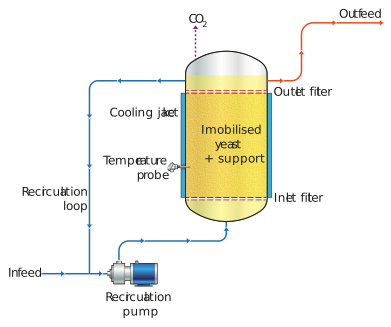
Figure: Design of an immobilised yeast reactor using a compressible support medium such as calcium alginate
All reactor designs and support media have significant shortcomings. These are mainly to do with mass transfer. Membrane-based entrapment is by far the worst performer and, for this reason, these types have never been scaled-up for commercial use. Solid supports work best but yeast cells are easily lost, either because of shear forces breaking the comparatively weak electrostatic bonding or as a result of growth where there are no available binding sites for the new cells to attach to the support; excessive build-up of freely suspended cells can then cause blockages to occur. Mass transfer to cells entrapped in beads is a problem and for this reason it is necessary to control the bead size. Usually a range of 0.3-3.0 mm has proven to be the best compromise between compressibility and efficiency of mass transfer.
The conditions to which entrapped cells are exposed have an effect on physiology, though this area is still very poorly researched. Generally, it has been found that rates of cell multiplication are quite low but catalytic rates are increased. For example, it has been shown that, when applied to primary fermentation, alcohol yields per unit of extract used are higher than would be seen in a conventional batch fermentation. The reasons for this are unknown but it has been suggested that the immobilised cells’ protected environment is preferred to free suspension. This makes some sense in that many organisms, including yeasts, prefer to exist in films where the cell concentration is comparatively high. An example would be yeast cells growing on the surface of rotting fruits such as grapes. This sounds like good news for brewers but it alters the balance between the formation of alcohol and yeast-derived beer flavour compounds. This makes flavour matching very difficult to achieve.
Commercial applications of immobilised yeast
The use of immobilised yeast reactors in brewing undoubtedly offers new opportunities for processes that could not be easily achieved using conventional batch methods. As with all new technology, it takes time for the implications to sink in and there has to be a compelling reason to replace an existing process. It is more likely, therefore, that it will be used in new processes.
Three applications have been proposed and, in some cases, brought to commercial scale:
1. Primary fermentation
2. Low/zero alcohol beer production
3. Continuous beer maturation
We now consider each of these in turn.
Primary fermentation
Several processes and plant designs have been proposed for primary fermentation but none has yet been used at commercial scale. We have already mentioned problems with flavour matching but it is likely that the main reason is simply a perceived lack of commercial need. The arguments for and against batch versus continuous were set out earlier in this lesson; at present, the batch approach is winning, largely because of flexibility and lack of technical complexity. This may change.
Low and zero alcohol beers
Two processes are used for production of these beers. In one, a full-strength beer is made and later the alcohol removed by a process such as vacuum distillation. In the second method, called the cold contact process, wort is briefly exposed to yeast at low temperature. The conditions do not allow yeast growth and alcohol production but the cells are still able to remove the aldehydes which are generally considered to have an undesirable flavour and aroma.
Immobilised yeast reactors are ideally suited to this type of rapid transformation. In one commercial system, wort with low fermentability is acidified with lactic acid to bring the pH down to beer values and also to deter potential contaminants. The wort is then filtered and cooled to 0-1 °C before passing through the reactor. In the treatment, the aldehydes (2-methylpropanal and 3-methylpropanal) are reduced by approximately half. Some sucrose and glucose is utilised but less than 100 µg/L alcohol is produced. The remaining glucose is sufficient to repress the genes that regulate uptake of maltose and maltotriose. Strictly anaerobic conditions are maintained during the process to prevent wort oxidation.
The following figure shows some detail of the plant.
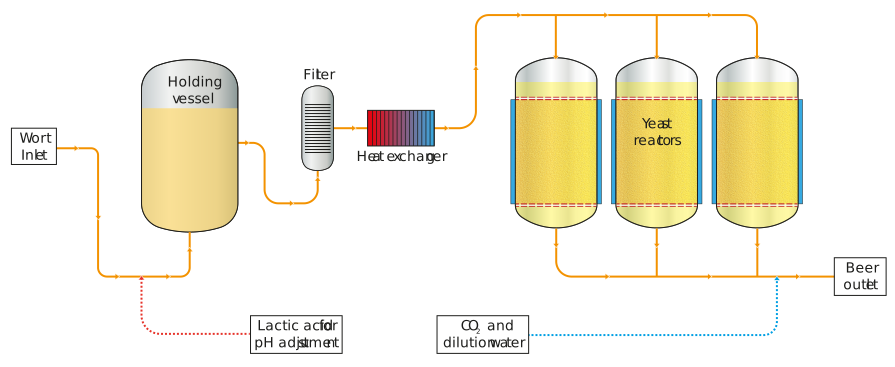
Figure: Schematic showing the layout of plant for zero alcohol beer production using immobilised yeast reactors
Multiple reactor tanks are used to allow regeneration without needing to stop the process. A regeneration plant (not shown here) involves treatment of the carrier with hot NaOH solution; the washed carrier is then returned to the reactor and inoculated with a fresh yeast culture, through which aerated wort is circulated at a temperature of 12°C. After 24 hours, the cell count increases to around 50 million cells per gram. When flow commences, the cell count doubles in an initial stabilisation phase. Growth continues during use until flow rates are impeded and this triggers a new regeneration cycle.
Using this system, a tank containing 400 kg of carrier produced 20 hL of beer per hour.
Continuous beer maturation
Immobilised yeast reactors have been used at commercial scale for the removal of diacetyl. The plant is similar to that used for zero alcohol beer production but in this case beer taken from primary fermentation immediately after attenuation gravity has been reached is used as the in-feed. The details of this operation will be covered in the Beer Maturation and Finishing unit.