
Lesson 6 - Design of Fermentation Vessels
This unit began with the principles that underpin fermentation. This lesson now explores how these are put into practice. It covers how fermentation vessels must be designed to suit the behaviour of the yeast strain being used, as well as the nature, scale, and sophistication of the processes available.
High Gravity Brewing
Many brewers adopt high gravity brewing as a strategy for increasing beer output without the need to increase fermentation capacity. Although the practice has minimal impact on the choice of fermentation system, some are more suitable than others.
High gravity brewing is the process where highly concentrated worts are fermented, and the strong beers produced are then diluted to sales strength either immediately before or after filtration. The result is that fermentation capacity can be greatly increased with a very small capital spend.
The process is shown in the following figure:
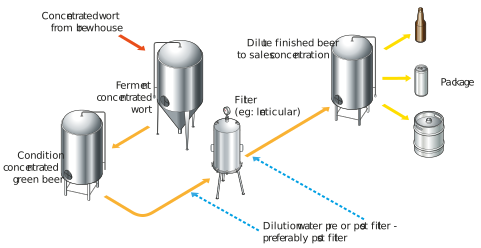
Figure: Process for high gravity brewing
Theoretically, any fermentation system can be used. Strong beers have been produced for a long time – for example, barley wines with alcohol concentrations of up to 12% by volume were fermented using traditional open squares – but the yeast was not recovered for re-pitching. This is because the process is very stressful for yeast.
Current extreme processes use worts of 20-25 °Plato, often with very large batch sizes, in tall vertical vessels with a big hydrostatic head and at quite warm temperatures. The yeast will be bottom cropping. All of these factors markedly increase yeast stress levels. In order to be able to re-use the cropped yeast, we need to take precautions to ensure yeast health remains satisfactory.
The key is to manage the timing of bottom crop formation and its removal from the cone of the fermenter. When in the cone, it is exposed to maximum stress and should be removed as quickly as possible.
Vessels are best fitted with a method for mechanically stirring the contents. This should give a gentle mixing action to keep yeast cells in suspension without subjecting them or the beer to excessive shear forces. Depending on the cropping behaviour of the particular yeast strain being used, mixing ends when flocculation is triggered. Usually this is close to the time when wort is fully attenuated. At this point, crop formation occurs very rapidly, over a few hours, and the yeast can be removed. It is not necessary to cool the vessel. If these practices are adopted, the health of the yeast crop, based on viability (typically 90-95%), is assured.