
Lesson 6 - Design of Fermentation Vessels
This unit began with the principles that underpin fermentation. This lesson now explores how these are put into practice. It covers how fermentation vessels must be designed to suit the behaviour of the yeast strain being used, as well as the nature, scale, and sophistication of the processes available.
Point of Reflection – Reconvene:
Welcome back. So, what were your thoughts?
Theoretically, if you need to make a lot of beer with relatively small changes in demand throughout the year it is a really attractive idea.
When working properly:
● A continuous stream of green beer should be coming out of the fermenter.
● Yeast cells are growing all the time at a constant rate.
● If the system is stable and under control, the consistency should be excellent.
● Yeast handling is greatly simplified because there would be no need for pitching, propagation, and storage of cropped yeast except at start-up.
● There would be no need for lots of individual fermenters.
● There would be no need for continual emptying, cleaning, and filling of individual fermentations.
However, there a lot of disadvantages as well.
● Fermenters are technically complex and need constant supervision by skilled operatives.
● Start-up times are slow as are times to stabilise to give consistent beer.
● If a batch fermentation fails the problem is often restricted to that batch. If continuous fermenters fail all production is lost until a new fermentation is set up.
● Not very good if you need to brew a lot of different beer qualities.
● Flow rates can be varied but not by much so it does not fit very well into a brewery where production demand is very seasonal.
● The rest of the brewery needs to be in step with the productivity of fermentation.
● It needs a continuous supply of unpitched oxygenated wort which is a big risk factor.
As we can see, there are a lot of hurdles to overcome!
Continuous fermentation theory
The process is based on a type of growth vessel called a chemostat, literally ‘constant chemistry’ (see figure below).
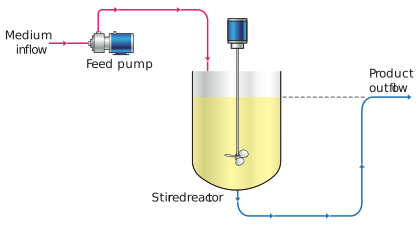
Figure: Key features of a chemostat
A chemostat consists of a growth vessel which is controlled at a constant volume by matching the flow rates of incoming growth medium and outflowing culture.
Providing all conditions are kept constant, such as temperature and composition of the growth medium, the rate at which cells grow (known as µ) is controlled by the rate at which fresh medium is added.
At least, this is true within certain limits. Under any set of conditions all organisms have a maximum rate at which they can grow. This is a genetic function and is called µmax.
The rate at which new medium is added is called the dilution rate (D). Chemostats reach an equilibrium state at which µ = D.
If D is increased to the point where growth rates cannot increase any further (µmax) the culture will gradually wash-out.
As long as D is less than µmax, a steady state is reached.
Real-world brewing in continuous fermenters
Continuous beer fermenters are based on the principles of the chemostat, but a few modifications simulate the conditions that occur in a conventional batch fermentation.
The major problem comes back to the issue that we have touched on several times already. Brewery fermentations are linear processes where wort nutrients are taken up by yeast in order. If you have a single well-mixed growth vessel to which you are continuously adding fresh medium this sequence is disrupted.
The way round this problem is to separate the different stages of fermentation into different spaces. There are two ways this can be done. The principle is called plug-flow. If we think of a long tube into which we feed pitched wort at one end, the wort will be transformed into beer as it proceeds down the tube (as long as there is no back-mixing) as it would be in a conventional batch fermentation.
This is difficult to make in a practical form and so there are two compromise versions: tower fermenters and multi-tank systems.
Tower fermenter: In this version, wort is pumped upwards through a vertical vessel. A highly flocculent yeast strain is used which helps to retain the cells. As the wort proceeds up through a mass of yeast it is transformed into beer in a way that mimics what would happen in a true plug fermenter. The following figure shows the features of a commercial tower fermentation system used in the UK in the late twentieth century.
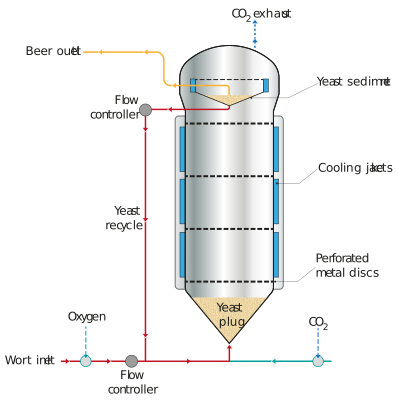
Figure: Tower fermenter used for continuous primary fermentation
The design and operation of the fermentation system formed a gradient from base to top, in which the time-based features of a batch fermentation were duplicated spatially. In one commercial system, wort (clarified by centrifugation and taken from sterile storage tanks) was sterilised before entry using a heat exchanger, then oxygenated. CO2 was also injected, to improve mixing and to prevent the yeast plug, which was a very flocculant strain, from blocking flow.
Yeast concentration at the base was very high, (300-400 g/L wet weight), which produced very rapid fermentation rates. The tendency for back-mixing was reduced by the decrease in density caused by conversion of wort into beer throughout the height of the vessel. A number of perforated metal discs, mounted within the tower, also discouraged back-mixing. Yeast carried up with the beer was collected at the top in a reservoir from where it was returned to the base. CO2 was collected at the top and released or recovered.
This system completely attenuated wort within 3-4 hours and the beer quality was claimed to be a good match to that made by batch fermentation. Plus, use of several towers in parallel allowed some flexibility in flow rates. However, the towers stopped being used mainly because of the continual micro-management needed to prevent failures and the lack of flexibility in choice of yeast strain.
Multi-tank systems: These use the same logic but, in this case, different stages of fermentation are separated into a series of tanks through which the wort passes.
The Coutts system is a multi-tank continuous fermentation plant which is still used by the Dominion Brewing group in New Zealand. The key features are shown in the next figure.
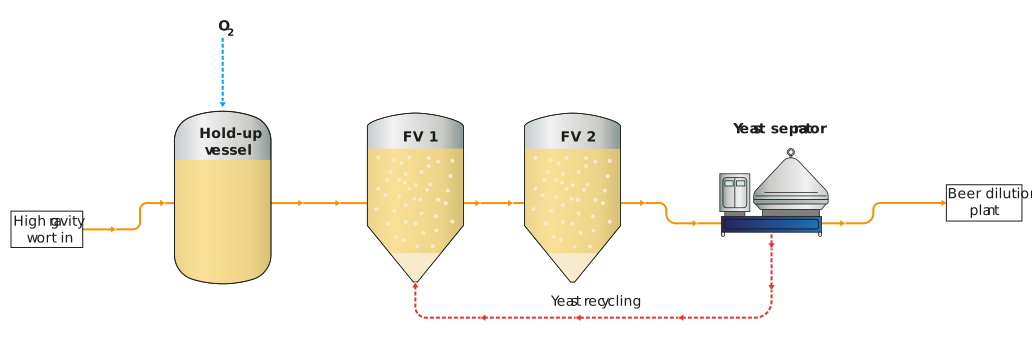
Figure: Coutts continuous fermentation system
The system uses two principal fermentation vessels. These are fed with high gravity wort which is oxygenated in a hold-up tank. Yeast is recycled from a separator located after the second fermenter. Part of the volume of the second fermenter is also recycled into the first one to introduce some alcohol in order to reduce the risk of contamination. After the yeast has been separated, the green beer is sent to a dilution plant for finishing.
This plant has been in successful operation since 1955. In 1960 it produced 85% of total New Zealand beer production. Not only that, the beer has won prizes in international competitions.