
Lesson 6 - Design of Fermentation Vessels
This unit began with the principles that underpin fermentation. This lesson now explores how these are put into practice. It covers how fermentation vessels must be designed to suit the behaviour of the yeast strain being used, as well as the nature, scale, and sophistication of the processes available.
Controlling Fermentation Progression
Many fermentation industries use feedback methods to control the process; this involves monitoring a suitable parameter and then using this to regulate fermentation progression. However, this approach has not been adopted in brewing, though it is feasible. This section explains how fermentation progression control could be automated in breweries and then looks at how we can determine the end-point of fermentation.
We have already seen that fermentation progression is typically monitored via periodic sampling and off-line analysis of wort concentration. The results are plotted on a graph and progress is judged by comparing the results to an expected profile.
It would be possible to automate this process by using an in-tank method for the measurement of wort concentration. This approach has the advantage that it would not only remove the need for sampling and off-line analysis but would also provide a means of automatic control, in which the output could be linked to the cooling system and the temperature adjusted to regulate the fermemtation rate. The next figure illustrates the basic elements of such a system.
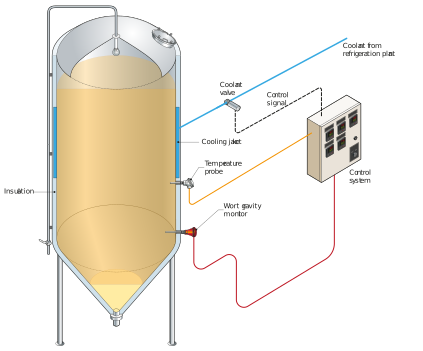
Figure: Outline of a system for automatic control of fermentation rate. Wort concentration is monitored continuously using an in-tank gravity meter. The results are compared with a stored ideal profile. Fermentation rate is controlled by the automatic regulation of the coolant supply to ensure the profile matches the standard profile.
At-line automatic gravity meters are used widely in the brewing industry and could be adapted for in-line applications. A few systems for automatic in-line analysis have been developed but as yet with little commercial take-up. Currently, in the majority of cases, fermentation control relies on careful control of initial conditions.
Once the fermentation has started, we control progress by attemperation. The higher the temperature, the faster the fermentation. Temperature affects only yeast growth rate and metabolism, not how much yeast is grown.
Usually we use a constant temperature profile but occasionally this is ramped or stepped as a means of controlling beer flavour (as explained in the Fermentation and Beer Flavour lesson).
At the end of fermentation, we often chill the green beer to slow down yeast metabolism and to encourage crop formation, as shown in the next figure.
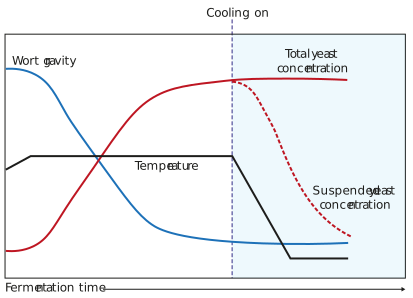
Figure: Idealised fermentation profile showing the effect of the application of cooling on the suspended yeast concentration
End of fermentation
There are several options depending on the beer style and process being used, as set out in the table below.
Table: Controlling and marking the end-point of fermentation
|
Beer Style |
End of Fermentation |
|
Brewery conditioned ale |
Usually when target attenuation gravity reached |
|
Brewery conditioned lager |
Typically when VDK specification reached |
|
Cask ale |
Stop fermentation early by cooling to leave fermentable sugar + low yeast count |
|
Traditional lager |
Stop fermentation early by cooling to leave fermentation sugar + low yeast count |
The traditional processes, which require a residue of fermentable sugar viable yeast cells, are much more difficult to manage.
The aim is to stop the fermentation with around one million viable cells / mL and 0.5-2.5 degrees of gravity (0.125-0.625 °P).
This is difficult to achieve just by cooling and many brewers choose more controlled processes.
For ales it is much easier to let the fermentation become fully attenuated and then add back a measured amount of sugar. This process is called priming. Controlling the yeast count is a bit easier because a low count of cells always remains at the end of fermentation. However, some brewers choose to filter and add back a controlled yeast count.
This provides an opportunity to choose a different yeast for the cask secondary fermentation. The argument for filtration and re-seeding for bottle conditioned beers is even stronger because only a low count is needed, a few thousand cells / mL.
Yeast counts and fermentability for secondary fermentations of traditional lagers are commonly controlled in the process called, in German, krausening. This is when a small amount of actively fermenting wort is added to green beer.