
Lesson 6 - Design of Fermentation Vessels
This unit began with the principles that underpin fermentation. This lesson now explores how these are put into practice. It covers how fermentation vessels must be designed to suit the behaviour of the yeast strain being used, as well as the nature, scale, and sophistication of the processes available.
Vessels for Bottom Cropping Yeast
These closed fermenting vessels are designed to be used with yeast strains that flocculate during the course of fermentation and drop out to form a sediment at the base.
The advantages of closed vessels are that they greatly reduce the risk of contamination, fitting automatic cleaning systems is much easier, and collecting CO2 (and removing it from the atmosphere of the fermenting room) is simpler. A disadvantage is that it is much more difficult to clean yeast for re-pitching.
Bottom cropping vessels are not only for use with lager yeast. Cylindroconicals, for example, were originally resisted in the UK. It was felt, wrongly as it turned out, that top-cropping ale yeasts would not perform satisfactorily in vessels designed for bottom cropping. Trials quickly showed that this was not true and, in fact, ale strains will form satisfactory bottom crops.
Closed fermenting vessels have a long history. Some early designs were simply coopered casks, widely used for traditional lager brewing, but many designs have been introduced to brewing over the years. Cylindroconicals are now the dominant choice and so this lesson focuses on this type.
Before we study cylindroconical fermenters in more detail, we look briefly at the features of some of the other designs (see table below).
Table: Properties of some closed design fermenting vessels
|
Type |
Comments |
|
Closed box |
● Inexpensive to build ● Can be stacked on separate floors of a building ● Yeast crop retained by upstand but difficult to remove ● Poor draining properties |
|
Horizontal cylinder |
● Relatively inexpensive ● Avoids tall hydrostatic head ● Difficult to empty and remove yeast crop ● Can be stacked to minimise footprint |
|
Vertical cylinder |
● Relatively inexpensive ● Easily arranged in tank farms ● Efficient cleaning ● Good draining properties but care needed to avoid ponding in dish, especially during cip. ● Cropping not as efficient as coned vessels |
|
Spheroconicals |
● Excellent mixing ● Most efficient design for external cooling ● Efficient cropping ● Very expensive to build |
Cylindroconical fermenters
These vessels are now fairly ubiquitous in large-scale commercial brewing. Although they are quite expensive, they overcome most of the disadvantages highlighted in the last table. The next figure illustrates their principal features.
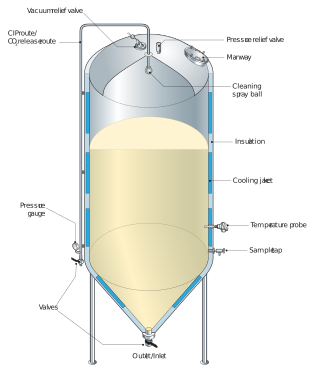
Figure: Principal features of a cylindroconical fermenter
These vessels typically have a capacity of 1,000-5,000 hL but they can be much smaller or as big as 10,000 hL. There is no consensus on the optimum aspect ratio but values of around 1:3 are common.
Breweries arrange the vessels in tank farms, often with the cones enclosed in a building and the cylindrical parts projecting into the open air.
A probe measures the temperature close to the top of the cone, and the output is used to control the coolant supply.
Relief valves prevent a vacuum forming when vessels are emptied or cleaned with caustic soda.
Cylindroconical fermenters have several advantages:
● Single point for all filling and empyting operations.
● Suitable for uni-tanking (explained later in this lesson)
● Very well draining with low wetting losses.
● Cone angle and polished interior promote good crop separation.
● Efficient attemperation via external cooling jackets.
● Suitable for CO2 collection.
● Good hygienic design.
● Conveniently arranged in tank farms to give a small footprint.
Cooling requirements
Cyclindroconicals are occasionally cooled using an external loop fitted with an in-line chiller. These are rare and in most cases they have external jackets through which a coolant is circulated. The coolant must be capable of being chilled to a temperature low enough to ensure efficient attmperation. For relatively warm ale-type fermentations, chilled water may provide sufficient cooling; for colder lager-style fermentations, a refrigerant such as propylene glycol a lower freezing point may have to be used.
There are many proprietary jacket designs which aim to provide a large surface area for heat exchange. The actual area of the cooling jackets depends on the process that the vessel is used for, as shown in the following figure:
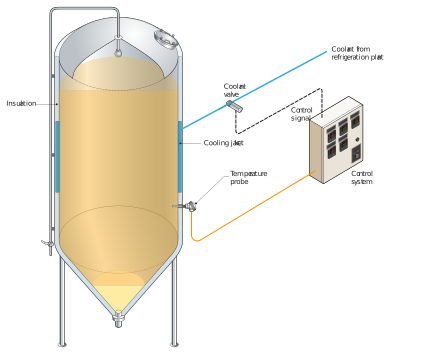
Figure: Location for cooling jackets and temperature probes - Primary fermentation
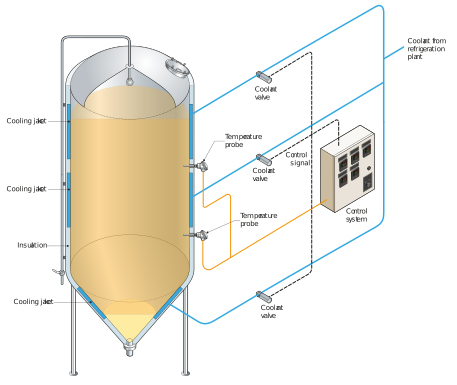
Figure: Location for cooling jackets and temperature probes - Fermentation and conditioning
We can see that for primary fermentation, a single jacket located at the top of the vessel (possibly with a second located slightly further down the straight side of the wall) is sufficient. We also need to be aware of the following points.
- Temperature is usually measured lower down near the cone. We should locate probes in the straight side, around 30% up from the base of the cone and about 500 mm from the wall so as to avoid the effects of cooled surfaces. Occasionally two or more probes are fitted, with an average reading calculated and used for control purposes. Measured temperature is linked to the coolant supply in a feedback control loop.
- Cooled beer at the top falls down the sides of the vessel and hits the cone, where natural convection currents then cause it to flow up the central core where it warms up slightly and is consequently forced outwards towards the cooling surfaces and the cycle is repeated. At least, this is the theory but in a moment we discuss in more detail the mixing that occurs.
Looking again at the figure above, we can see that to cool the beer down to 2-4°C for yeast separation, or even lower for cold conditioning, more cooling jackets are used, including possibly on the cone to protect uncropped yeast. Further points to note are:
- Cooling to very low temperaures in a large cyclindroconical using just external jackets is inefficient and can take 24 hours or more.
- The density of beer varies with temperature. Beers have a maximum density at a given temperature and for most this is around 2-4°C (the value most often chosen for crash cooling at the end of fementation).
- At both higher and lower temperatures, the density of the beer decreases. This is called the inversion point because it will reverse the direction of flow due to convection, the main factor governing mixing at the end of fermentation. This can cause stratification and, to avoid this, cylindroconical vesels are often fitted with a small mechanical stirrer which is switched on during cooling.
Mixing inside cylindroconical vessels
As it is not possible to see what is happening in these vessels, brewers have drawn, and relied on, certain assumptions. It has generally been assumed that natural mixing in cylindroconical vessels via CO2 release and convection is very efficient, and that the tall and relatively thin design should promote good mixing. Management of fermentations in these vessels has also been based on the assumptions that: vessel contents are more or less homogeneous during active fermentation; when primary fermentation is finished flocculation occurs; and that the lack of convection currents, encouraged by cooling, results in bottom crop formation.
However, studies – where viable yeast concentration has been measured throughout large cylindroconicals during fermentation – have cast doubt on these assumptions. They have shown that for almost all strains (except very non-flocculent ones) the bulk of yeast drops out quite early in fermentation, usually before primary fermentation is completed.
As a result, many brewers now remove crops early and warm, particularly those using high gravity brewing. It has been shown that crop viabilities increase when this is done.
Vessel mixing is improved by fitting mechanical stirrers. Trials at several breweries have shown that this both shortens fermentation cycle times and makes them more consistent. This finding tends to confirm that natural mixing is not efficient.
The following figure shows the effect on cycle time of using a mixing system; here, the mixing system is based on a pumped loop fitted with a low shear rotating jet head.
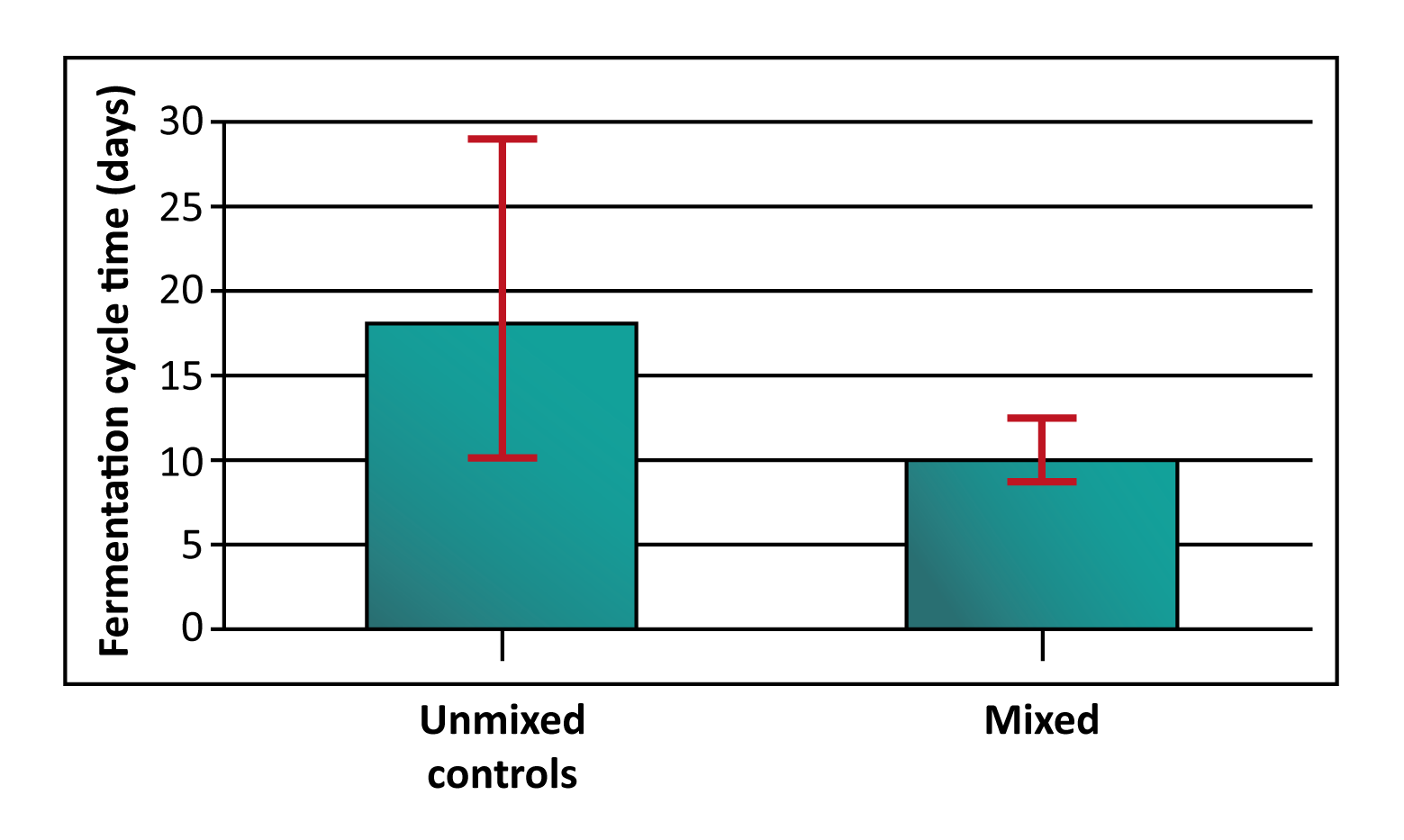
Figure: Effect on cycle time (time to cooling) for the mean of 18 mixed lager fermentations compared with the same number of unmixed (naturally mixed) controls. Fermentations were carried out in 5,000 hL cylindroconicals using 18.5 °P wort. The bars show the range of results. (Data courtesy of M. Nordkvist, Alfa Laval)
Tank farms
Apart from making good use of available space, whole tank farms can be serviced by a single system for wort oxygenation, pitching, vessel filling, yeast cropping, emptying, and cleaning.
This is convenient but automated systems need a lot of expensive and complex automatic valving systems.
If you were in charge of designing and installing a new tank farm of cylindroconical vessels for a large modern brewery it would need to be suitable for the volumes of beer you needed to brew.
What other factors would you need to take into consideration?
Give yourself 5-10 mins to think about this and then click Next and continue with this lesson.