
Lesson 6 - Design of Fermentation Vessels
This unit began with the principles that underpin fermentation. This lesson now explores how these are put into practice. It covers how fermentation vessels must be designed to suit the behaviour of the yeast strain being used, as well as the nature, scale, and sophistication of the processes available.
Vessels for Top Cropping Yeasts
These are fermenting vessels that are designed to be used with yeast strains that, during the course of fermentation, rise to the surface of the wort.
These particular vessels are associated with ale fermentations and, as the name indicates, they are fitted with a means of removing the yeast crop from the surface of fermenting wort. They are the most traditional of vessels, often made from materials such as wood with an inert liner, and shaped into open rounds or squares.
They are usually quite small, with a capacity of 50-150 hL. The ale fermentations carried out in them are quite warm; cooling demand is small, therefore, and internal attemperators fed with chilled water are common.
To understand how these vessels work, we consider two designs in more detail: a traditional open square and a Yorkshire slate square (see figure below).
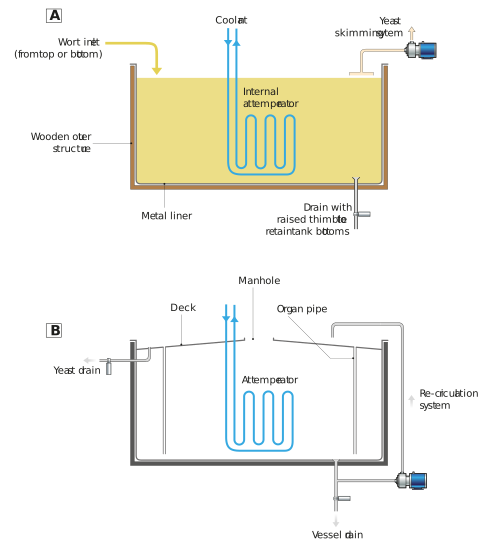
Figure: Key features of an open square (A) and a Yorkshire slate square (B) fermenter
There are other examples but these show very well how the design of the vessels is closely matched to the behaviour of the yeast strains used.
Open squares are usually quite shallow but with a large surface area to allow for formation of the yeast head. It includes a mechanism, either a skimming board or a suction pump (as shown in the figure above), for crop removal. This was described in more detail in the Yeast Management lesson (Yeast unit/Lesson 8).
These vessels often incorporate internal attemperators, as shown. Cleaning is often a manual operation; this requires proper safety procedures because of possible CO2 build-up. More modern versions may be made from stainless steel and often have a closed design with access via a manway door at the front. These can be cleaned automatically.
Traditional open squares do not work well with very flocculent ale strains because of inherently poor mixing. A way round this is to use the dropping system, in which the contents of a square is transferred, one to two days after pitching, to a second square. This mixes the actively fermenting wort and leaves much of the trub behind.
The Yorkshire slate square was designed to cope with flocculent yeast while using a single vessel. The key feature is a deck placed near the surface of the vessel; a manhole in the centre of it allows access for the internal attemperation system and for cleaning. Pitched wort is contained in the lower portion of the vessel and, during active growth, some of the yeast crop rises to the surface through the manhole with beer draining back from the deck via the organ pipes. This is helped by a circulation system, as shown in the figure above. When the brewer judges it to be the right time, the circulation is switched off and the crop drops onto the deck from where it can be removed by a drain. Green beer is removed via a bottom drain in the vessel.
Originally these vessels were made from slabs of slate. More modern versions are stainless steel and have wall-mounted cooling jackets.
One brewery that used a mixture of two strains of differing flocculence installed the new Yorkshire squares. It originally intended to install cylindroconical vessels but trials in these showed that one of the strains rapidly disappeared. Both strains happily co-existed in the new all-stainless steel Yorkshire squares, which demonstrates how important vessel design can be.
Traditional fermentation rooms
Open fermenters require high standards of hygiene in the surrounding environment, plus they bring safety hazards with regard to CO2. We therefore need to ensure that our fermentation rooms meet the following standards.
● Access to fermentation rooms should be restricted to essential personnel only.
● The interior surfaces of the room must be made of materials that are easily cleaned.
● The room should have a minimum of interior fittings to avoid sites where dirt and condensation may collect.
● Rooms should be air-conditioned, if possible, to prevent condensation.
● Doors should make a good seal.
● Devices should be fitted for controlling flying insects.
● Low level air extraction systems should be fitted, primarily for CO2 extraction, if possible.
● Low oxygen / high CO2 monitors and alarms are mandatory.
● Access to vessels should be carefully controlled and monitored.
● Walkways should be located above vessels to reduce the risk of exposure to heavier-than-air CO2.