
Lesson 2 - Yeast Morphology and Evaluation
This lesson explores what yeast cells are, how they grow and multiply, what internal organelles they contain, and the functions that these organelles perform. This knowledge will equip us well, so that we can examine some of the practical methods that we use to characterise and evaluate yeast in the brewery.
Yeast Flocculation
Flocculation is a process by which smaller particles clump together to form bigger aggregates. Many yeast species, including brewing strains, do this under certain conditions. Flocculation plays an important role in fermentation.
An important part of the fermentation process is to separate the yeast crop from green beer. A particular property of most brewing yeast cells is the ability of the cells to clump together in a process known as flocculation. Flocculence is defined as a non-sexual and reversible cell-to-cell adherence.
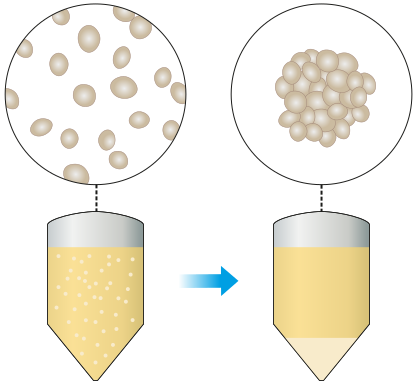
Figure: Flocculation of yeast cells
The reversibility part is important. When yeast flocculates, the larger cell aggregates separate more easily from the beer. Separation is quicker and cleaner, which results in more concentrated crops and lower beer loss rates. With flocculent lager strains, they drop out faster. With many ale strains, they rise to the surface. As the surfaces of these ale strain’s cells are more hydrophobic, the flocs trap bubbles of CO2, which makes them buoyant. This results in the ale strain’s behaviour.
You do not want flocculation to occur at the start of fermentation. In this early stage, you want all the yeast cells to be single and homogeneously suspended in the wort, so that they have equal access to nutrients.
Fortunately, simple fermentable sugars such as maltose bind to flocculins and therefore prevent flocculation from occurring in early fermentation and so the cells remain single and non-flocculated which makes it easier for them to stay in suspension where they have unrestricted access to wort nutrients.
Flocculation works and exhibits in a way that allows this to happen, generally without the brewer needing to do anything at all.
Flocculence is a genetic property. Some yeast cells will never flocculate because they lack the genes that produce the effect. There is much variation between strains; some are very flocculent whilst others are less so.
If cells flocculate too soon, this may slow fermentation down, or even make it stop. This is because there are insufficient cells available suspended in the wort. If flocculation does not occur, or is poor, green beer (immature beer at the end of fermentation) counts will be very high. This will adversely affect filtration. It might also mean that here is not enough yeast crop for re-pitching.
Flocculation is really important in brewing. However, we should ask ourselves why yeast cells have this property? If we have learned anything so far, it is that yeast cells do everything for their own selfish reasons. Luckily, many of their properties fit perfectly with our brewing needs, which is obviously why we use them. However, if only for the sake of interest, we should try to see things from their perspective.
There are a lot of FLO genes, which proves that it is an important property that evolution has conserved.
For the majority of the time, microbial cells are not growing. They sometimes have enough nutrients; however, this is uncommon. They must thus be able to survive these lean times. FLO genes allow cells to group together, either in flocs, or in some strains, attached to surfaces (e.g. biofilms in the brewery environment). These environments are protective. You can stain yeast flocs with the viability stain methylene blue; over time you will see that the flocs turn blue from the outside, slowly working inwards. In other words, the cells on the outside of the flocs die first, protecting the cells on the inside of the flocs.
If you are intrigued by this, and would like to find out more, take a look at:
Di Gianvito, P., Tesnière, C., Suzzi, G., Blondin, B. & Tofalo, R. (2017). FLO5 gene controls flocculation phenotype and adhesive properties in a Saccharomyces cerevisiae sparkling wine strain. Nature Scientific Reports. (https://www.nature.com/articles/s41598-017-09990-9)
The mechanism of flocculation
How does flocculation work? As you might have guessed, it needs cells to bind to each other. So, the cell’s surface is very important. Two groups are involved. The cell walls of all yeast cells contain chemical groups called mannans. These are the receptors and they are always present in both flocculent and non-flocculent types. Flocculent strains have genes that code for surface groups called flocculins. These are proteins, sometimes called zymolectins, which project from the cell’s surface.
Zymolectins bind to the mannans in an interaction that requires Ca2+ ions. This is another reason for making sure you have enough calcium in your brewing water. If you lose it all in the brewhouse, you might have reduced flocculation. Other divalent cations have also been shown to influence flocculation. In some cases, they inhibit the process, probably by occupying the same place that Ca2+ ions would inhabit when they bind to the lectins. Those that have been shown to do this are Ba2+, Sr2+ and Pb2+. Other cations have been found to assist with flocculation. These include Mn2+, Mg2+ and Zn2+. Work done with Zn2+ ions shows that they influence flocculation in ale strains but not lager strains. Wort sugars such as glucose and maltose can also bind to the zymolectins. This happens at the start of fermentation, so is good news as we definitely don’t want flocculation at that stage of the brewing process!
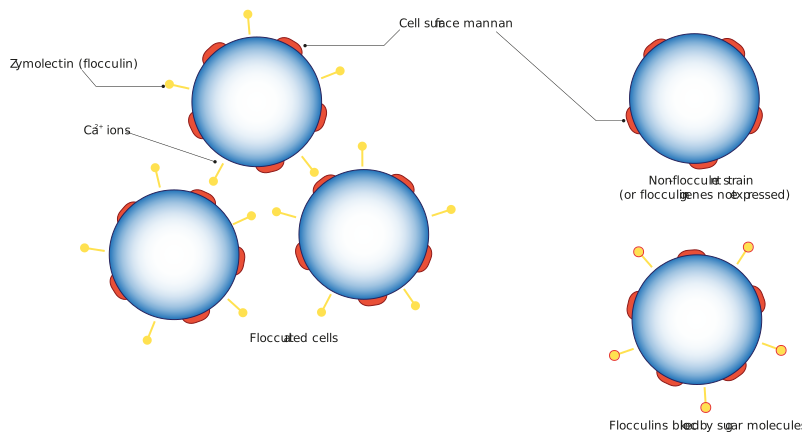
Figure: Mechanism of flocculation
The genetics of flocculation
Zymolectins are produced in response to the activation of FLO genes. They exist in abundance and many strains carry multiple copies. The most common phenotype is called NewFlo and is found in all lager strains, as well as many ale types. Mannose, glucose, and maltose inhibit flocculation in these types; it is only expressed in the stationary phase. The FLO1 phenotype is inhibited by mannose and is constitutive.
Flocculation genes have long intragenic repeats. These influence how strongly the gene is expressed. The longer these repeats last, the more strongly flocculent the yeast is. It is likely that they increase the length of the zymolectin. The number of repeats varies widely, which explains why the expression of flocculence also varies.
Expression of flocculence
Many factors affect flocculence. The presence of calcium is essential. Good stirring helps the cells to meet each other and bind. Very strong salt concentrations and low pH are inhibitory. This explains why flocs tend to break up during acid washing. Flocculation is generally a response to starvation as the cells inside the flocs are better protected.
Assessment of flocculence
We can assess flocculence using laboratory tests; for example, the Helms and Gilliland tests. We can test the yeast’s ability to form flocs by suspending washed yeast cells in a solution of calcium sulphate or chloride, and adjusting the mixture to pH 5.0. We can assess the degree of flocculation over a period by measuring the amount of sediment formed using a calibrated centrifuge tube. More commonly, we monitor the decrease in light scattering of the supernatant using a haze meter.