
Lesson 2 - Yeast Morphology and Evaluation
This lesson explores what yeast cells are, how they grow and multiply, what internal organelles they contain, and the functions that these organelles perform. This knowledge will equip us well, so that we can examine some of the practical methods that we use to characterise and evaluate yeast in the brewery.
Yeast Nutrition
All cells must generate energy to fuel cellular metabolism. They either obtain the building blocks for growth, ready-made from the surrounding medium or synthesise them from simpler nutrients. This section describes how yeast cells conduct this essential process.
For any organism to grow, it must balance itself between having a supply of suitable nutrients, and being able to survive in the physical environment that it finds itself in. This is a big set of factors, which are summarised in the figure below. The comments in red apply to brewing yeast strains:
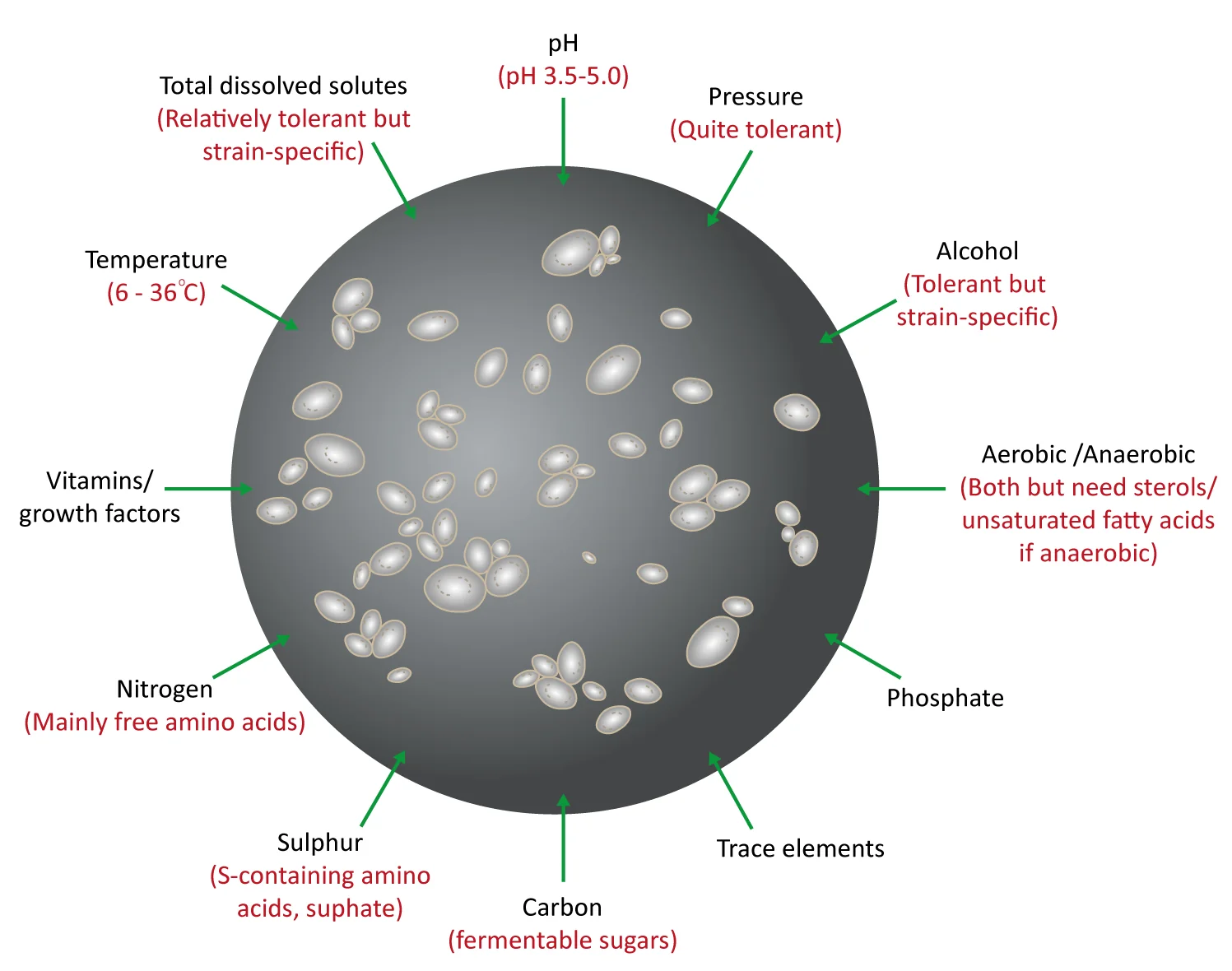
Figure: Factors that influence the growth of yeast cells
Before discussing nutrients, let us briefly explore how the physical environment affects the yeast. All organisms can cope with a particular range of physical conditions such as temperature, pressure, pH, and so on; yeast is no exception. Each of these conditions has an optimum value, where growth rates are highest. It also has a range of extremes that can be tolerated. Outside this range, growth is not possible.
Regarding temperature, brewing yeast is described as a mesophile. This is an organism that grows best in the range of 10-40°C. There are differences between ale and lager strains, which we have already hinted at when we discussed genetics.
Table: Response to temperature of brewing yeast
|
|
Ale |
Lager |
|
Optimum |
around 36°C |
< 30°C |
|
Maximum |
37-40°C |
30-34°C |
|
Fermentation temperature |
18-22°C |
7-15°C |
Brewing yeast is quite tolerant to changes in pH. Worts are slightly acidic, at around pH 5; during the course of fermentation, this falls to about pH 4. The optimum for growth is around pH 3.5-5.0. They can survive fairly acidic conditions for a limited period, for example, pH 2.2 for two hours at 2-4°C. These conditions are used as a treatment to kill bacteria when we acid wash the pitching yeast.
In order to grow and multiply, yeast must obtain all of its nutrients from the external medium, which is in our case, the oxygenated wort. This wort is usually made from malted barley, other cereal extracts both malted and un-malted, or relatively pure sugar syrups. They require an energy source and carbon skeletons, which they use to synthesise the new macromolecules that make up new cellular biomass.
Yeast are fairly flexible in terms of what they can grow on.
Scientifically they are:
-
Heterotrophic – able to use a wide variety of organic compounds.
-
Facultative anaerobes – able to generate energy via respiration under aerobic conditions but capable of growth under anaerobic conditions providing some nutrient requirements are satisfied. How brewing yeasts respond to oxygen is complicated and we will discuss it in detail in later lessons; however, in a brewery fermentation, as a general rule the more oxygen that is supplied the more yeast growth will occur.
This versatility gives them a selective advantage; they can adapt rapidly to grow under a variety of conditions, something that many potential competitors cannot do.
Yeast relies upon relatively simple sources of carbon and nitrogen, such as sugars and amino acids. The range of carbon compounds it can use is usually narrower under anaerobic conditions. Strain-specific differences are used in taxonomy. Brewing yeast can utilise mono-, di-, and tri-saccharides. There are differences between ale and lager strains:
Table: Sugar utilisation by ale and lager strains
|
Character |
Ale |
Lager |
|
Melibiose |
Not used |
Used |
|
Maltotriose |
Used relatively slowly |
Used more rapidly |
|
Galactose + maltose |
Maltose used preferentially |
Used simultaneously |
|
Dextrins |
Not used |
Not used |
|
Pentoses |
Not used |
Not used |
Regarding nitrogen, yeast cells can utilise ammonium and a range of organic nitrogenous compounds, including amino acids, short peptides, some amines, pyrimidines, and purines. Brewing yeast cannot utilise nitrate or nitrite, nor can they use proteins.
Sulphur compounds are provided either by sulphur-containing amino acids such as threonine, or methionine. They can also use inorganic sulphur in the form of sulphate or sulphite.
Yeast cells need smaller quantities of phosphate and other trace elements, as well as growth factors such as vitamins (which they are not able to synthesise themselves). All brewing strains require biotin and pantothenate, some require inositol and thiamine. Lager strains generally have a higher requirement for growth factors than ale strains.
As they can only make energy using respiration, some yeast strains require fully aerobic conditions in order to grow. Saccharomyces strains require oxygen, but not for respiration. They instead use it for synthesising some essential lipids, unsaturated fatty acids, and sterols. This is discussed fully in the Yeast Biochemistry lesson.