
Lesson 2 - Yeast Morphology and Evaluation
This lesson explores what yeast cells are, how they grow and multiply, what internal organelles they contain, and the functions that these organelles perform. This knowledge will equip us well, so that we can examine some of the practical methods that we use to characterise and evaluate yeast in the brewery.
Point of Reflection – Reconvene:
Welcome back. So, what were your thoughts?
The biggest problem is simply time. Aerobic organisms require incubation times of three to five days in order to grow. Anaerobes can take as long as five to ten days. This is ok for routine microbiological monitoring, however it is unhelpful if you want to verify that your pitching yeast is the right strain and is pure.
There are some short-cuts. For example, if you want to check the microbiological makeup of a sample of bright beer or water (where the counts would probably be very low), you can concentrate any cells by passing a relatively large sample through a sterile membrane filter. This traps any cells and concentrates them on the surface. You could examine the cells directly or concentrate them even further via a short incubation.
There are several commercial test kits such as the API® (https://www.biomerieux-usa.com/clinical/api Note, this is for illustrative purposes only and is not a recommendation or endorsement of a particular supplier’s product.) system, which consists of a strip with a number of small chambers containing reagents for a range of biochemical tests. Samples are added to these. After a short incubation, colour changes allow us to identify organisms. Different kits can be supplied for various bacteria and yeasts.
A few systems are designed for on-line use. Typically, these systems remove samples and trap any cells on the membranes. These cells can then be counted and possibly identified using fluorescent dyes, attached to antibodies to specific species. These methods are costly. They might still require an enrichment step and only pharmaceutical companies are developing and using them. For these companies, the value of the product justifies their use. In time, the costs will fall and we might be able to use them in brewing; for example, to support a high speed small-pack line.
Genetic techniques
The genome of any cell type is unique. Therefore, if you can analyse it, this will give you a guaranteed method of identification. If the method is sensitive enough, you should be able to detect the presence of other contaminating genomes. If you have a data base to compare it with, you can identify it down to the level of strain, the smallest taxonomic unit. Even more, if you regularly monitor the genome of your yeast strains, you can check that it has not changed. Pretty impressive!
There are many methods available for doing this. They are grouped together under the term ‘genetic fingerprinting’. Historically, genetic fingerprinting was costly, time-consuming, and required skilled operators. However, this is changing and relatively low cost, automated methods are now available.
These methods do not analyse the whole of the genome. In a typical method, DNA is extracted and chosen sections are targeted. These fragments are copied 35 to 40 times, using a procedure called polymerase chain reaction (PCR). The fragments are separated on a gel, according to their size. This creates a set of bands that can be stained and visualised. They look a little like a barcode, which is unique to this particular organism.
The method depends on specific primers, which are short nucleotides, complementary to specific portions of the DNA being analysed. We can use delta sequences to differentiate brewing yeast strains. These portions of the DNA molecule flank the Ty elements, which are bits of DNA (similar to viral DNA) found in most yeast genomes. In the PCR reaction, the regions between each delta sequence are amplified. They are different for individual species. When separated on a gel, they give a unique barcode.
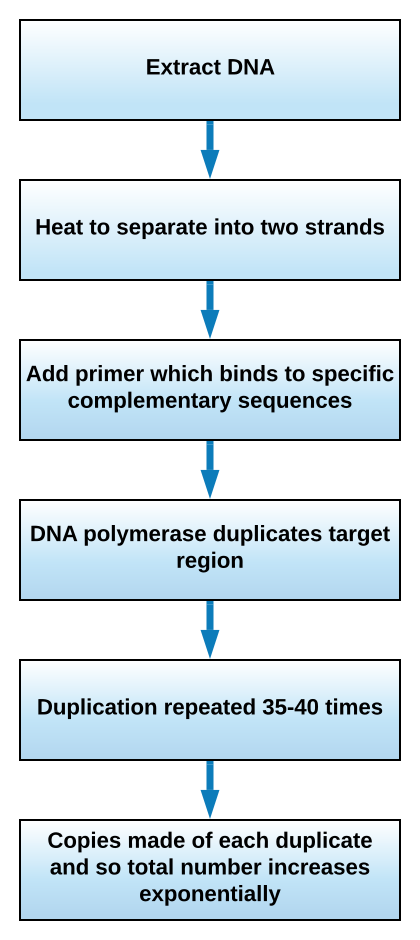
Figure: Steps in PCR reaction
Several different primers are available as the genomes of various cells have been sequenced. Using variations of this approach, it is possible to determine both strain identity and purity.