
Lesson 2 - Yeast Morphology and Evaluation
This lesson explores what yeast cells are, how they grow and multiply, what internal organelles they contain, and the functions that these organelles perform. This knowledge will equip us well, so that we can examine some of the practical methods that we use to characterise and evaluate yeast in the brewery.
Yeast Characterisation and Evaluation
We have already learned that there are many different yeast genera and species. Under a microscope, most appear very similar in size and form. We will now learn how yeast cells are handled in a laboratory, and explore the methods used both to identify them and differentiate them from other types of microbial cell.
Most brewers use pure yeast cultures to make beer. You can only do this if you are sure that you are using the correct strain. You must also be certain that it is free from any other contaminants, including yeast and bacteria.
Classical techniques
Commercial brewing, using a single pure yeast strain, was introduced by Emil Hansen in 1883. Working at the Carlsberg Institute, he developed Carlsberg bottom yeast no.1. Brewers have subsequently had over one hundred years to develop and refine methods for handling and characterising yeast cultures. The classical microbiological techniques used then, are still widely used today.
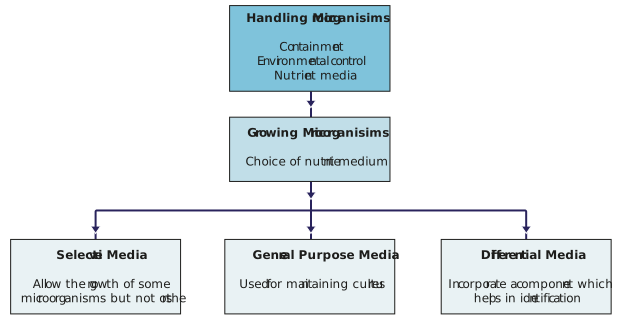
Figure: Classical microbiological methods
When applying these classical microbiological techniques to brewing yeasts, we need to consider the following:
-
Safe handling of microbial cultures in a lab needs special equipment in which to contain them and also to prevent anything else getting in. These receptacles are usually made of glass or plastic. They must be sterilised before use; we will also need to use an aseptic technique to move cells from one container to another.
-
We must be able to control the environment so that cells can either be stored safely, or so that we can give them the conditions they need to grow. Important environmental factors include temperature and the availability or absence of oxygen.
-
Growth of the organism needs a suitable nutrient medium. This might be a liquid medium, or often one that has been solidified with agar.
-
Selective media allows the growth of some organisms, but not others. There are too many types of selective media to mention here. They are really useful if you are trying to identify just a handful of contaminants amongst a huge amount of culture yeast cells. For example, many wild yeast strains tolerate copper, a metal that is toxic to most brewing strains. If you add copper to a yeast nutrient medium that is solidified with agar, then plate out a sample, this suppresses the growth of the culture yeast but not suppress growth of the wild yeast.
-
Differential media contain a component, such as a dye, that causes a colour change if a particular organism is present. A positive result allows tentative identification.
-
We can examine yeast and other microbial cultures by using solid media in Petri dishes. These are shallow glass or plastic plates, fitted with a loose lid to maintain sterility whilst still allowing the flow of gases. Place a drop of a dilute suspension of cells onto the surface of the medium, and then spread it out to separate them into separate cells. After a period of incubation, the cells grow to produce a clump known as a colony. Particular strains often have characteristic shapes. We can also incorporate dyes, which may be taken up by the cells in differing amounts; these dyes give a range of colours. They are a great help when deciding if the culture is pure or mixed. As each colony is derived from a single cell, they should all, hopefully, be identical (known as clones).
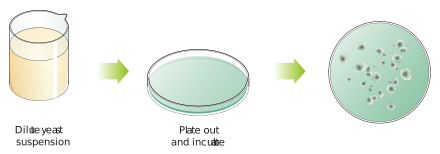
Figure: Colonies of brewing yeast, grown on a nutrient medium containing the dye, Bromocresol Green
Classical microbiological methods are very useful, but do come with disadvantages. What might some of these be?
Give yourself 5-10 min to think about this, and then click ‘Next’ to continue with this lesson.