
Lesson 2 - Yeast Morphology and Evaluation
This lesson explores what yeast cells are, how they grow and multiply, what internal organelles they contain, and the functions that these organelles perform. This knowledge will equip us well, so that we can examine some of the practical methods that we use to characterise and evaluate yeast in the brewery.
What is Yeast?
We will now explore what yeast is, and where it sits amongst all the other different types of organisms.
All organisms are classified into various groupings; this classification process is known as taxonomy. Taxonomic systems are useful because they inform us how related, or not, different groups of organisms are. This in turn gives us clues as to how they evolved, how advanced or primitive they might be, and so on. As with many other aspects of biology, it uses some technical terms, some of which are in Latin. This might at first make things seem a little complicated, however you will soon get used to this as you begin to ‘find your feet’.
Let us now distinguish the yeast from the bacteria and other types of organisms.
Systems of taxonomy have been subject to many changes as methods of analysis have become more precise. The current one groups all living things into three domains. These are called:
Archaea
Bacteria
Eukarya
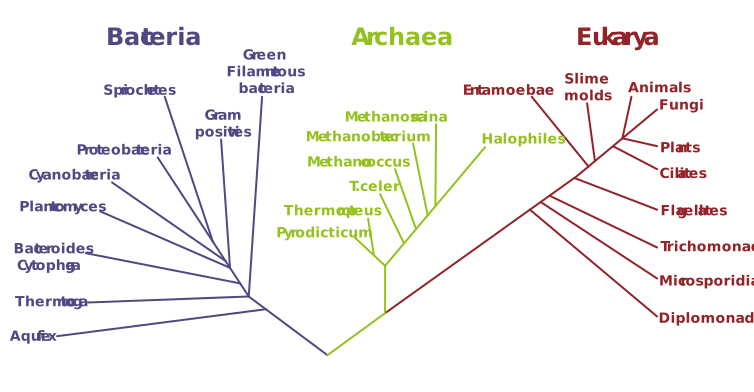
Figure: The three domains and kingdoms within Eukarya
The groupings are based on studies of ribosomal RNA (rRNA) as well as other characteristics such as cell membrane structure. rRNA carries out the same function in all cells and the sequence of nucleotides that make up its structure has changed little over time and so comparisons of these sequences allows us to see how related or not cells types are.
The Archaea and Bacteria (sometimes called Eubacteria (= “true bacteria”) are more primitive and called prokaryotes. The Eukarya are more advanced and are made up of eukaryotic cells. More about what these terms mean later.
Each of the domains are divided into groups called kingdoms. All members of a kingdom have common characteristics that make them different from members of other kingdoms. Each kingdom is divided into smaller groups, arranged in a hierarchy so that you can see how closely related each member is. The last two of these sub-groups are called genera (singular genus) and species.
What has this got to do with yeast? Well, yeast are members of the Fungi Kingdom. This group includes mushrooms, toadstools, and moulds. They differ from the other Kingdoms as they have features you might associate with both plants and animals. They are in some ways similar to bacteria, however the structure of a fungi cell is very different.
Characteristics of fungi:
-
Often multi-cellular, but many are uni-cellular (yeast)
-
Cells have a rigid wall (plants have these, but not animals)
-
Cell walls contain chitin, a polysaccharide polymer of n-acetylglucosamine (found only in fungal cell walls and the exoskeletons of some insects)
-
Not photosynthetic (plants are, but animals are not)
-
Require a source of nutrients for growth
-
Eukaryotic
There are no members from any of the other Kingdoms that share this particular set of characteristics.
You may be wondering what eukaryotic means? It comes from the Latin word Eukaryote, meaning “true nucleus”. It describes cell types that have a defined nucleus that is surrounded by a membrane and contains chromosomes and the cell’s genetic material. Eukaryotic cells contain defined organelles, which are also surrounded by membranes. Bacteria are prokaryotes, Latin for “before the nucleus”. Prokaryotes are more primitive cells, with a far less defined structure. So, fungi, including yeast, are much more advanced than bacteria. They are higher organisms, similar (but different) to plants and animals.
The figure below shows a mixture of yeast and bacterial cells, as viewed under a microscope. Note how much bigger the yeast cells are compared to the bacteria:
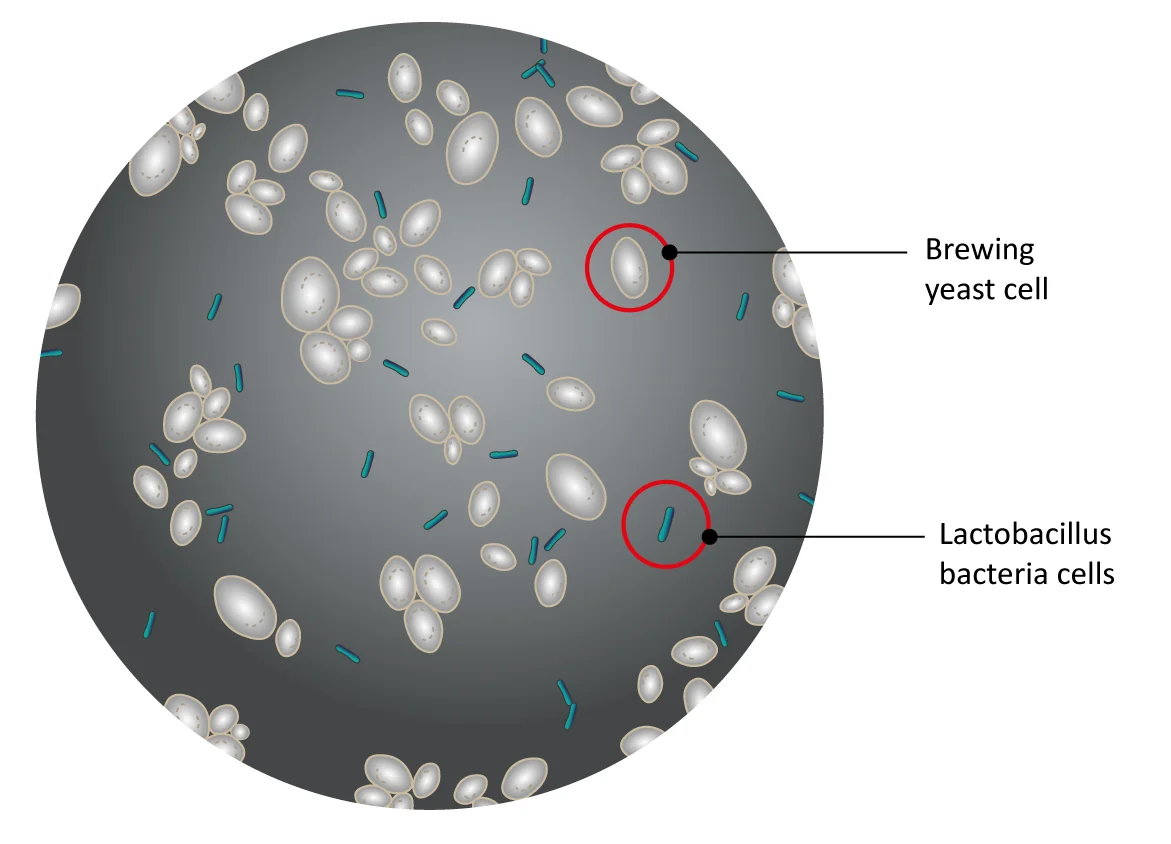
Figure: Image of a mixture of brewing yeast cells and bacteria (Lactobacillus).
Yeast are single-celled fungi. There are a lot of them, all of which are divided into various taxonomic groupings. We are largely interested in those belonging to the genus Saccharomyces (meaning “sugar fungus” – yeast are very good at taking up sugars). In brewing, we more specifically use the species Saccharomyces cerevisiae. Throughout this course, you will notice that Latin names are always written in italics, using a capital letter for the genus name and lower case for the species. This particular species is often written as S. cerevisiae. This species’ name derives from the Latin for “beer”, which again makes sense to us. It is slightly more compilcated than this. S. cerevisiae are ale yeasts. Lager strains belong to a different species called, S. pastorianus. More about this later.
There are an estimated 10,000 or more different genera of yeast, and some genera consist of almost half a million different species. They are found pretty much everywhere in nature; new species are discovered every year. We use yeast for making alcoholic beverages such as beer, cider, wines, and spirits. We also use yeast for baking bread. All of these uses come from just a single genus, Saccharomyces, and usually, just a single species, S. cerevisiae. We often use the words Saccharomyces and yeast to mean the same thing. However, as you now know, this is far from true. When making beer, S. cerevisiae is the yeast used to make ales. Lager beers use a different species, S. pastorianus, which used to be called S. carlsbergensis. More about that later in this lesson. Some other species, both Saccharomyces and non-Saccharomyces, are used directly in brewing to create specific desirable characteristics not normally produced by the usual brewing strains. A few others are beer spoilers.
The characteristics of yeast are:
-
Single-celled, sometimes in short chains or clumps
-
Cells bound by a rigid cell wall
-
Complex cell structures, containing defined internal organelles
-
Usually reproduce asexually using budding or fission, but can also reproduce sexually
- Cannot obtain energy from the sun and so must rely on chemicals for growth and energy