
Lesson 4 - Wort Boiling Technology and Process Control
This lesson explores the process of heat transfer during wort boiling, and how it can be controlled. It also considers the design principles of wort boiling systems and how energy use in the brewhouse can be minimised.
Vapour Condensing and Cooling
We saw earlier that to transform water into steam we must add energy. When steam is changed back to water this energy is released. A vapour condenser is a means to collect this energy.
A vapour condenser is almost a calandria in reverse. It is a shell and tube heat exchanger in which water flows through the tubes while vapour passes through the shell. The vapour leaving the kettle condenses on the surface of the cooler tubes, heating the water inside in the process. The water formed from the condensed vapour flows from the outlet and the heated water flows away to a hot water storage tank. The figure below shows a vapour condenser.
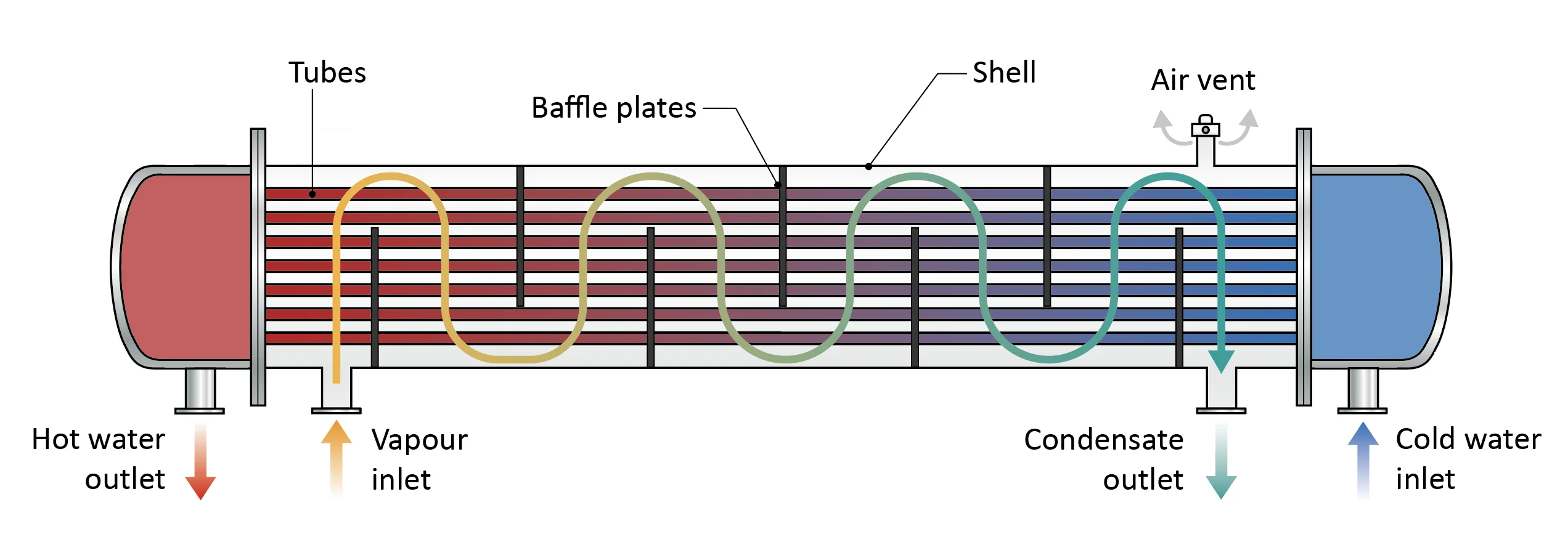
Figure: Vapour condenser
Most modern brewhouses have another stage of heat recovery after the vapour condenser. The condensed vapour is passed through a plate heat exchanger (sometimes called a subcooler) which reduces its temperature and produces more hot water in the process. The cooled, condensed vapour at about 40°C is usually sent to the effluent plant because it is not clean enough to use for CIP. We will cover the distribution and use of reclaimed heat later in the lesson.