
Lesson 4 - Wort Boiling Technology and Process Control
This lesson explores the process of heat transfer during wort boiling, and how it can be controlled. It also considers the design principles of wort boiling systems and how energy use in the brewhouse can be minimised.
Direct Fired Kettles
The term direct fired is a misnomer. Very few kettles have live flames playing on their surfaces. The temperature of a flame is about 1000°C so the ΔT is a minimum of 900°C and at that temperature the metal is unlikely to last very long. The heating is usually done by the combustion products passing over the base of the kettle or through coils running inside the vessel.
The oldest types of kettle that may still be in use somewhere, are made from copper with a slightly domed bottom. The domed bottom was used to increase the heating area and to help form the currents required for an effective boil.
Historically fire was usually made using wood, coal or peat burned under the vessel base. The fuels and hence fire was spread as widely in the combustion chamber as possible to provide even heating. A chimney at the back of the combustion chamber carried the products of combustion away. This may have also been in contact with the vessel surface. The figure below shows a typical design.
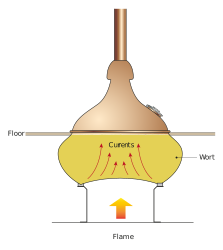
Figure: Traditional direct fired kettle
Today, oil or gas burners are used and are usually aspirated (provided with air) by fans. In older designs, burners were housed in a cast-iron combustion chamber directly underneath the kettle. The lack of movement of the wort makes heat transfer ineffective and as a result they can only process small volumes of wort. The high ΔT also means that fouling and all the problems associated with high thermal load/stress are more significant than in modern designs. Lack of wort movement also means foaming during the boil can be a problem.
Modern versions of direct fired kettles, typically have fan aspirated burners that blow the products of combustion through coils submerged in the wort. This gives a higher heat transfer area than bottom fired kettles but doesn’t do a lot to reduce ΔT. Unless an agitator or recirculation pump is fitted to the kettle, the vigour of the boil is also usually lower than in calandria systems. The figure below shows a kettle with a heating coil.
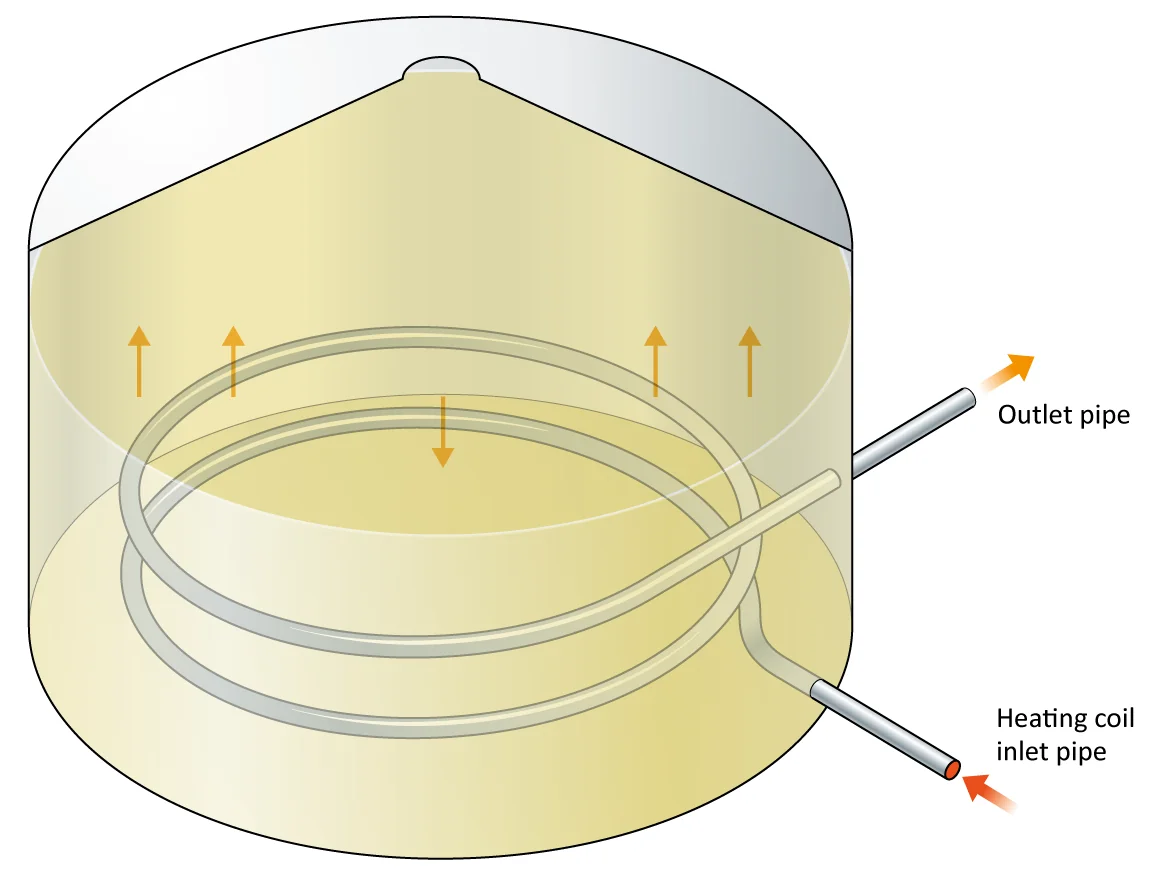
Figure: Kettle with heating coil
Coils are usually stainless steel and very difficult to clean with CIP unless the kettle is full of CIP solution (leading to high water use and effluent costs). An element of manual cleaning is usually required which brings with it the hazards associated with working in confined spaces. Direct fired kettles (or brewhouses using them) are however typically cheaper to buy because a boiler and steam distribution system is not required.