
Lesson 4 - Wort Boiling Technology and Process Control
This lesson explores the process of heat transfer during wort boiling, and how it can be controlled. It also considers the design principles of wort boiling systems and how energy use in the brewhouse can be minimised.
Heat Transfer and Boiling
Heat transfer might sound grand and perhaps even scary but it is a very simple concept. Energy (heat) flows from an area where there is a lot of it to one where there is less! In wort boiling this movement of heat is from the fluid (hot liquid or gas) heating the wort, to the wort itself.
Let’s start to get to know heat transfer by calculating how much energy (heat) it takes to heat wort to the boil and then to boil it.
The amount of energy required to raise the temperature of a mass of substance to a specific temperature is calculated using this equation:
q = M x Cp x (T2 - T1)
Where:
q = energy required kJ
M = mass of substance in kg
Cp = specific heat capacity in kJ/kg °C or K (energy required to heat 1 kg by 1°C or K)
T1 = starting temperature in °C or K
T2 = target temperature in °C or K
If we have 1000 hL of wort with a density of 1.032 kg/L. The specific heat capacity of wort is 4.0 kJ/kg °C. How much energy do we need to add to heat it from 75°C to 100°C?
As we have 1000 hL that means we have:
1000 x 100 L = 100,000 L
According to our density each of these L is 1.032 kg so the wort’s mass is:
100,000 L x 1.032 kg/L = 103,200 kg
We know that the specific heat capacity of wort is 4.0 kJ/kg °C. This means to heat each kg of wort by 1°C we need to add 4.0 kJ. We can now use our equation to calculate the energy required:
q = M x Cp x (T2 - T1)
q = 103,200 kg x 4.0 kJ/kg °C x (100°C - 75°C)
q = 103,200 kg x 4.0 kJ/kg °C x 25°C = 10,320,000 kJ or 10,320 MJ
If we use a heating rate of 1°C/min that means we take 25 minutes to heat the kettle, so apply heat at a rate (Q) of:

Q is normally given in kW which is kJ/s. If we are using 412.8 MJ/min we need to divide this by the 60 seconds in a minute to find out how many MJ we are using per second and multiply it by the 1000 kW in a MW to convert MW to kW:

The calculation for boiling is slightly different because we need to supply enough energy to vaporise the required amount of water. For this we use the specific heat of vaporisation hfg which is 2,257 kJ/kg of water. For every kg we need to evaporate we need to add 2,257 kJ.
If we want to achieve a 5% evaporation in our 1 hour boil we need to boil off:

And if we assume that 1 L of water is 1 kg, that means 5000 kg of water is evaporated.
So, if we use 2,275 kJ per kg of water evaporated, that means we just need to multiply our volume by hfg to work out how much heat energy we need to add:
5000 kg x 2,257 kJ/kg = 11,285,000 kJ or 11,285 MJ
This is over 60 min so we can work out Q as we did above:

As above Q is normally given in kW which is kJ/s. If we are using 188.08 MJ/min we need to divide this by the 60 seconds in a minute to find out how many MJ we are using per second and multiply it by the 1000 kW in a MW to convert MW to kW:

So during the boil, although we are adding more energy to boil the wort, we add it at just under half the rate of the energy we use to heat it to boiling point.
Now we know how much energy we need to add, let’s move on to find out what we need to consider when we deliver that energy.
With wort boiling, the rate of heat transfer (Q) by the wort heater depends upon:
- The surface area (A) that is in contact with the wort.
- The temperature difference (ΔT) between the heating medium and the boiling wort.
- The ease of heat flow from the heating medium to the boiling wort (overall heat transfer coefficient U).
Q = UAΔT
The units for the above terms are:
Q = kW
A = m2
ΔT = K
U = kW/m2K
So looking at this equation, heat flow is increased by increasing the heat transfer coefficient, the heating surface area and the difference in temperature between the heating medium and the wort. The greater the overall heat transfer coefficient (U) for the system, the more effective it is at transferring heat.
U is made up of the individual heat transfer coefficients for the elements of the heating process.
The figure below shows these individual coefficients.
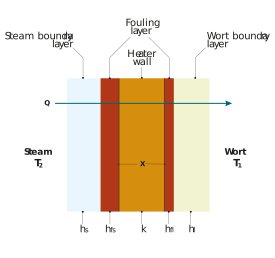
Figure: Cross section of a calandria tube wall showing heat transfer coefficients
Using the individual coefficients, the overall heat transfer coefficient (U) can be calculated as follows:

Where:
U = overall heat transfer coefficient
hs = film heat transfer coefficient of condensing steam
hfs = heat transfer coefficient of the fouling on the steam side of the calandria
x = the thickness of the tube in the calandria
k = the thermal conductivity of the calandria tube material
hfl = heat transfer coefficient of the fouling on the wort side of the calandria
hl = film heat transfer coefficient of the wort side of the calandria
You may remember from Darcy’s law that terms on the top line (numerator) increase the value of the subject of the equation while those in the bottom line (denominator) reduce it. This equation is complicated by the fact that it uses reciprocals of the terms. This means that terms have the opposite effect to the one they have if they were not reciprocals. U is how easily heat flows, so 1/U is the resistance to heat flow. So, the reciprocals of coefficients (1/hs 1/hfs 1/hfl and 1/hl) are their contribution to the resistance to heat flow. Or to put it another way, the values of the coefficients (hs hfs hfl and hl) are how good they are at transferring heat, while the reciprocal of the coefficient is how good they are at not transferring heat!
Thickness and thermal conductivity are not reciprocals so they act as you would expect. Increased thickness increases resistance to heat flow so is in the numerator of the equation. Increasing thermal conductivity increases heat flow so is in the denominator.
Let’s use the diagram above to examine these heat transfer coefficients in more detail.
The heating medium used in wort boiling is steam, or in rare cases, high temperature hot water or thermal fluid. High temperature hot water and thermal fluid transfers heat without changing state and the hot water temperature or thermal fluid temperature drops. However, steam releases its latent heat of vaporisation and forms a liquid condensate. The film coefficient of condensing steam is represented by hs and is usually high compared to the coefficient on the wort side.
On the steam side of the heater wall, there may be a layer of fouling. This is usually caused by scaling. This is a layer of resistance to the flow of heat from the steam. The coefficient for fouling on the steam side is represented by hfs.
The wall thickness is represented by x and the wall’s thermal conductivity is represented by k. The heater wall, which is usually a vertical tube, is normally made from stainless steel. It is relatively thin (typically 1.6 mm) to ensure that heat can be transferred easily. This minimises the effect of a low value of k (the heat transfer coefficient of the wall material). This means that we can use stainless steel tubes rather than copper. The thermal conductivity of copper is over 22 times greater than that of stainless steel so is a great material for heat transfer. However, copper is eroded in wort boiling and copper ions cause stale beer flavour and help form permanent haze, so we want to avoid it for brewing most beer types and to minimise maintenance costs.
As with the steam side, there is fouling on the wort side which has a heat transfer coefficient of hfl. Unless it is the first brew after CIP this is usually thicker than on the steam side and is caused by wort burning onto the heating surface. Fouling on this side increases with each brew after CIP, often until it is too thick for boiling to be effective.
The heat transfer coefficient on the wort side hl is determined by the mode of heat transfer. This can be film boiling, forced convection, or nucleate boiling.
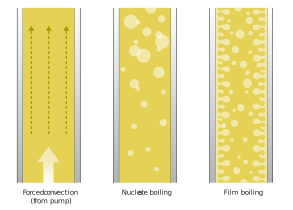
Figure: Modes of heat transfer
Film boiling should be avoided. It occurs when there is a high temperature difference and is exacerbated if the wall surface is poorly wettable. Wettability is how easy it is for water or aqueous solutions like wort to cling to a surface. A water droplet on a wettable surface spreads out into a thin pool of liquid while on a non-wettable surface it remains more spherical. Copper is a great deal more wettable than stainless steel.
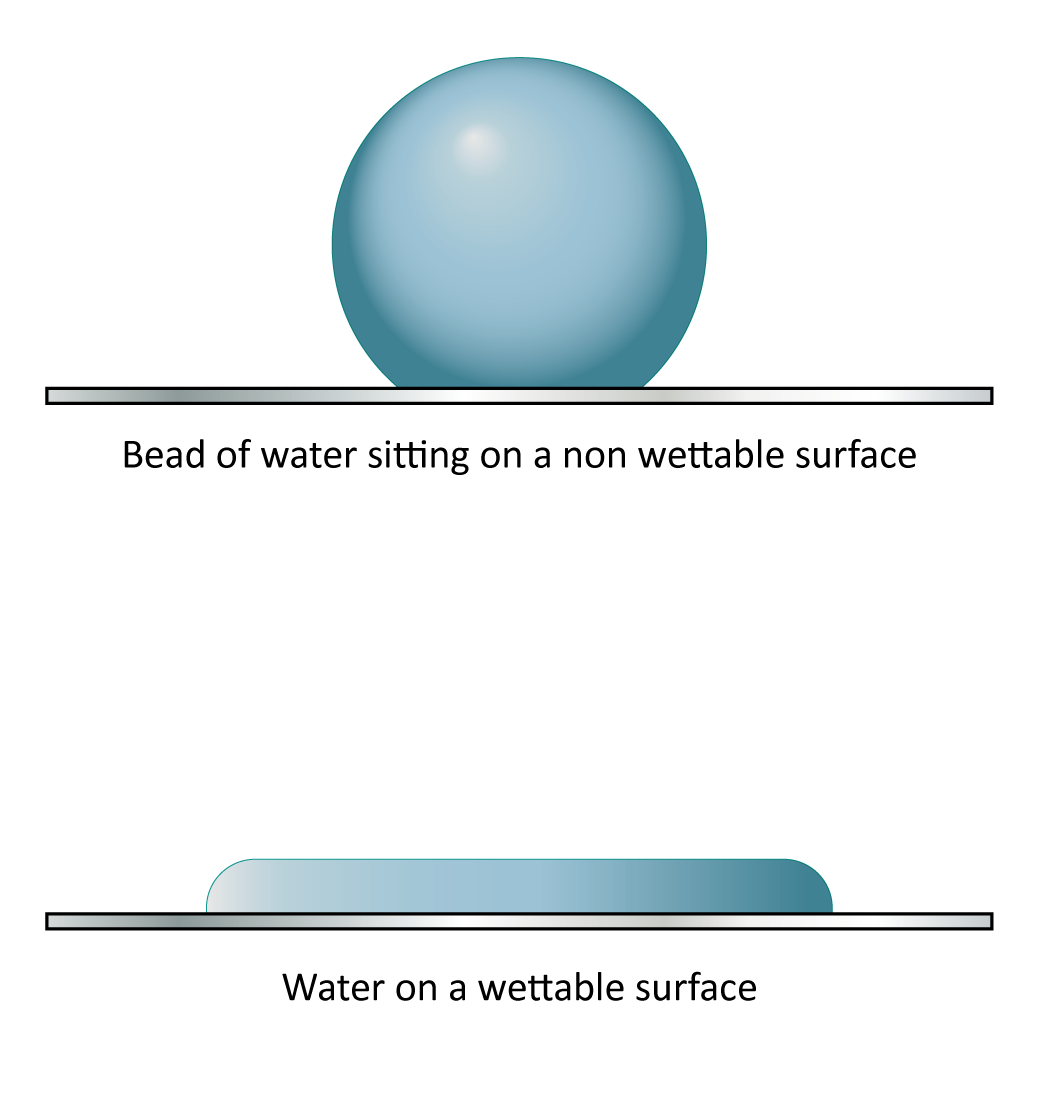
Figure: Wettable and non wettable surfaces
In film boiling steam bubbles cling to the surface and join together to blanket it with a vapour film. This film reduces the ease with which heat can transfer from the surface to the wort. It acts as an insulator. With film boiling, the rate of fouling is increased as heat is not transferred effectively and the wort that does come in contact with the surface receives so much heat that it sticks.
Film boiling is linked to heat flux (flow of thermal energy) and hence ΔT. The higher the ΔT the more likely film boiling is to occur.
Forced convection occurs at low temperature differences, when wort velocity across the heating surface is high or when vapour bubble formation is suppressed by applying a high back pressure. The high wort velocities cause turbulent flow over the heating surface which aids heat transfer. While it is an effective way to heat wort, forced convection does not produce many vapour bubbles in the calandria (some form as the wort leaves the calandria) and can also increase the level of shear on trub particles.
Nucleate boiling relies on steam bubble formation to create turbulence and improve heat transfer. The bubbles move away from the heating surface, taking heat with them. This allows unheated wort to come into contact with the heating surface and be heated. As we discovered in the last lesson, vapour bubbles aid trub formation, volatile removal and hop acid isomerisation.
Nucleate boiling is the most effective heat transfer mode for achieving the objectives of wort boiling.
The vapour bubbles are less dense than wort so rise rapidly in the calandria tube. The mixture of vapour bubbles and wort is called two-phase flow because it contains two phases, liquid (wort) and gas (vapour). This causes a thermosyphon which maintains the flow of wort through the calandria with no requirement for a pump.
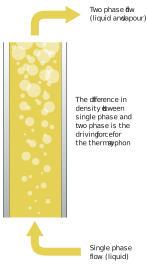
Figure: Principle of thermosyphon