
Lesson 4 - Wort Boiling Technology and Process Control
This lesson explores the process of heat transfer during wort boiling, and how it can be controlled. It also considers the design principles of wort boiling systems and how energy use in the brewhouse can be minimised.
Hot Water Heating (Hydroboiling)
As we learnt earlier, water boils at increasing temperatures as its pressure is increased. By heating water under high pressures, we can produce superheated water hot enough to boil wort.
Superheated water can be supplied to half pipe jackets on the kettle wall as shown in the figure below. Historically superheated water was used at 140-160°C but modern systems are being developed that can operate at around 120°C.
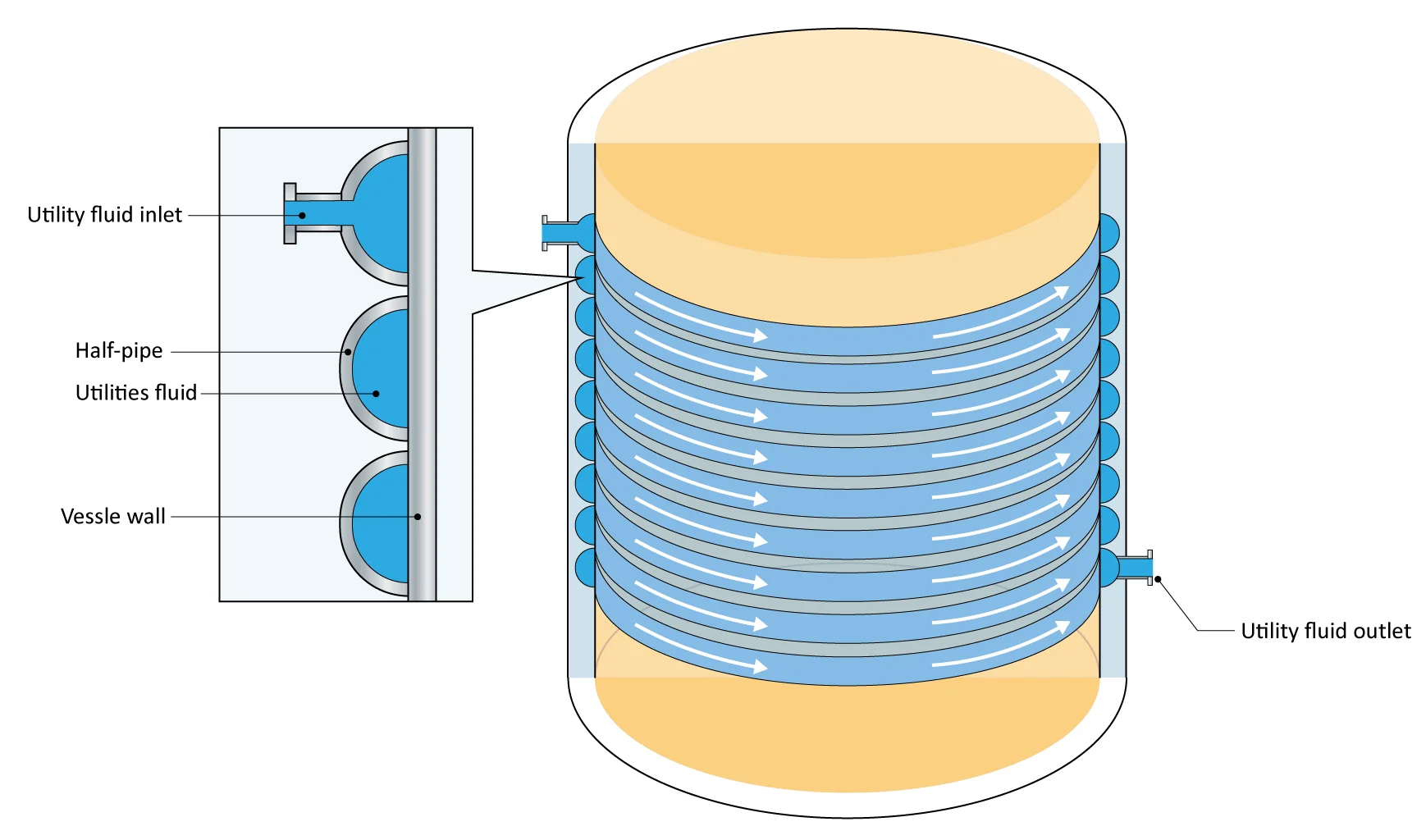
Figure: Halfpipe heating jackets
Some calandrias can also operate using hot water.
Advantages:
- Lower water losses than when steam is used.
- Lower energy requirements if brewhouse has store of high temperature hot water (see energy recovery section later in this lesson) and brewery is set up to use lower temperature superheated water at around 120°C.
Disadvantages:
- Agitation is usually required to ensure boil is sufficiently vigorous if only half pipe jackets are used.
- Requires much larger pipes than when steam is used, resulting in higher capital costs and space requirements.
- Requires a pump whereas steam does not.
- Heat is transferred from condensing steam more effectively than from hot water.
- Higher energy requirements than steam if used at 150-160°C.
Despite these disadvantages the requirement to save energy and water wherever possible means that the use of superheated water (at 120°C) is currently increasing.
Another alternative to steam is thermal fluid. Thermal fluids are oils with very high heat capacities that can be heated to temperatures of up to 345°C. These can be used in jackets or calandrias. Their use is very uncommon today.