
Lesson 4 - Wort Boiling Technology and Process Control
This lesson explores the process of heat transfer during wort boiling, and how it can be controlled. It also considers the design principles of wort boiling systems and how energy use in the brewhouse can be minimised.
Mechanical Vapour Recompression (MVR)
In mechanical vapour recompression (MVR), mechanical energy is applied to the vapour from the boil to increase its pressure and hence temperature. It can then be used as steam in the brewhouse.
When using MVR, the wort is heated to boiling using steam from a boiler and boiled until as much air has been displaced from the kettle as possible. All the vapour produced up to this point is vented to atmosphere. When as much air as possible has been driven off, the flow of vapour is delivered to the MVR. The MVR is a large rotating machine that compresses the vapour, producing a pressure of 0.5 bar above atmospheric pressure. As a result, the vapour’s temperature increases to 120°C. This is hot enough to maintain the boil, so is supplied to the calandria, replacing the steam from the boiler as the source of thermal energy for the boil. The figure below shows the MVR set up.
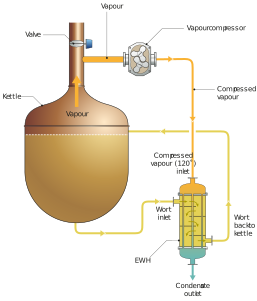
Figure: Mechanical Vapour Recompression
MVR directly recycles the heat of evaporation so uses significantly less energy than boiling using steam from a boiler. However, it uses around 0.7-1 kW of electrical power per hL of wort being boiled in the process. MVR has its disadvantages. It is expensive to buy and maintain and produces high noise levels. Any air entrained into the vapour interferes with its operation and it is very difficult to maintain air free vapour production in most kettles. Once the vapour has been used to boil the wort, the condensate formed usually runs to the effluent plant via a heat exchanger which cools it to a temperature suitable for treatment, reclaiming the energy in the process.