
Lesson 4 - Wort Boiling Technology and Process Control
This lesson explores the process of heat transfer during wort boiling, and how it can be controlled. It also considers the design principles of wort boiling systems and how energy use in the brewhouse can be minimised.
Wort Stripping
It is possible to divide the changes we need to make to wort during the boil into two categories. Those that require heat like hop acid isomerisation and protein coagulation and those that require evaporation like removing volatiles.
Kettles are very good for adding heat but even with the best deflector on the calandria are not particularly effective at removing volatiles. Using a pump or increased steam pressure can increase evaporation but neither are desirable from a cost and quality point of view. Wort stripping is used to achieve volatile removal with the minimum use of energy. It can also reduce kettle residence times.
Using wort stripping means the boil is split into two phases.
- Thermal phase: Wort is held at around 100°C for 30-50 minutes with little evaporation. Depending on the system used, there may also be short vigorous boiling and agitation. All the changes that require heat take place in this phase. The wort is then sent to a settling tank or whirlpool for trub removal.
- Evaporation phase: The clarified wort is supplied to the stripping device where the volatile compounds are removed.
Meura Ecostripper
The Meura Ecostripper is a tall cylindrical vessel (column) filled with packing material. This packing material provides a large surface area for the wort to flow over. After a thermal phase, the boil involves two short periods of intensive boiling and a hot stand of 30-50 mins. After this, wort is clarified and sent to the Ecostripper.
The figure below provides an idea of the equipment used.
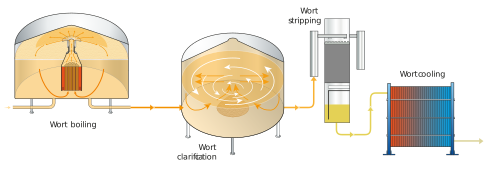
Figure: Process layout including wort stripping
Inside the Ecostripper the wort is preheated through a heat exchanger to boiling temperature. The wort is then distributed via a plate and cascades down the column over the packing material. Steam is injected into the column from the bottom and rises up stripping out the volatiles. At the top of the column, the steam, now saturated with volatile compounds, is condensed and the condensate is run to effluent treatment. Meanwhile, the wort is collected at the bottom, and then pumped to wort cooling.
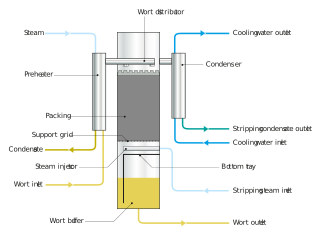
Figure: Vertical section through the Ecostripper
Please use the link below to find out more from the equipment suppliers. Note, this is for illustrative purposes only and is not a recommendation or endorsement of the supplier’s product:
http://www.meura.com/products-and-services/brewhouse/wort-boiling/ecostripper.htm
Krones Steinecker Boreas
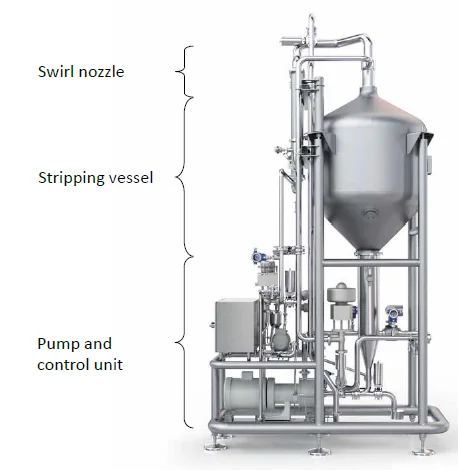
Figure: Krones Steinecker Boreas
The Krones Steinecker Boreas is used for stripping volatiles after wort boiling and clarification. It is especially useful for breweries with very low DMS specifications and where additional DMS formed in the whirlpool may take its level above the limit set for the beer. It is designed to reduce the evaporation required in the boil and hence thermal load on the wort. Krones recommend incorporating a hot stand with minimal evaporation into the boil programme to complete the formation of free DMS and reduce energy use.
The Boreas has a cylindroconical vessel which is fed by an injector that causes the wort to form a swirling film on its inside surface. As the wort swirls down the walls of the vessel, a stripping gas passes up through and drives out the volatiles as they evaporate. The stripping gas can be CO2, nitrogen or air. CO2 or nitrogen would be the safest options for avoiding oxidation of the hot wort but are more expensive. Krones do not include the Boreas as standard in their turnkey brewhouses because their brewhouse packages operate using their Equitherm system (more on this later) which requires 5-6% evaporation in the kettle. Evaporation levels with Boreas are well below this.
Please use the link below to find out more from the equipment suppliers. Note, this is for illustrative purposes only and is not a recommendation or endorsement of the supplier’s product:
Steinecker Boreas - https://www.krones.com/media/downloads/boreas_en.pdf
Kaspar Schulz vacuum expansion evaporator
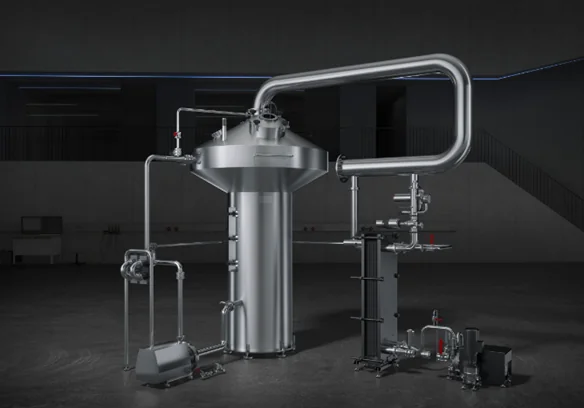
Figure: Kaspar Schulz vacuum expansion evaporator
The Kaspar Schulz vacuum expansion evaporator looks a bit like a large stainless steel mushroom and applies a slight vacuum (300 mbar) to a thin film of wort to strip out volatiles. Before the wort flows to the Kaspar Schulz vacuum expansion evaporator it is boiled with minimal evaporation under circulation and then clarified in a whirlpool. The flow of wort in the vacuum expansion evaporator is similar to that in the Boreas with a thin film swirling around its walls. This is achieved by introducing the wort at a tangent. As the pressure is reduced, the boiling point of the wort is reduced to 65°C. This means that volatiles are stripped and an evaporation of 3.8% of the wort’s volume is achieved.
Inducing a vacuum cools the wort to 80°C which means less cooling is required and less hot water is generated as a result.
The video below provides more details and a sales pitch. Note, this is for illustrative purposes only and is not a recommendation or endorsement of the supplier’s product:
Ziemann Holvrieka vacuum evaporator
Ziemann Holvrieka produce a similar system to Kaspar Schulz but their evaporation vessel looks more like a fermentation vessel than a mushroom. As with the Kaspar Schulz system, a tangential supply of clarified wort produces a thin film that swirls down the sides of the vessel. The vacuum (400 mbar pressure) causes the volatiles to evaporate from the hot wort. The figure below shows the evaporator with a condenser for heat recovery in the foreground.
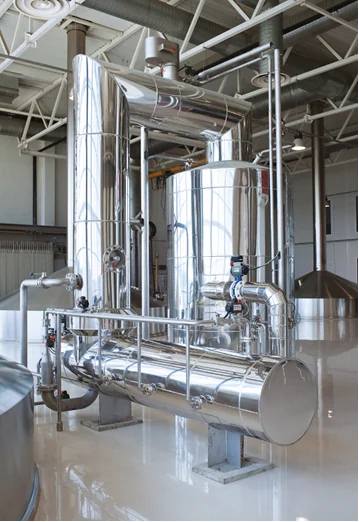
Figure: Ziemann Holvrieka vacuum evaporator
In most wort stripping systems, the heat is recovered from the evaporated wort using heat exchangers. Wort stripping has been reported to reduce the energy used for boiling by up to 50% compared to standard kettles. All the technologies are designed to achieve a lower rate of evaporation than standard kettles. This is typically 4%.
These systems use significantly less energy and provide effective control over unpleasant volatiles like DMS. However, they are relatively complex and the equipment requires maintenance and inspection. They also remove volatiles that we would prefer to leave in the wort like late hop aroma compounds. There are options to add more hop aroma later in the process, but these are not yet able to replicate late hop aroma.
Another system for boiling and evaporation was introduced by Krones Steinecker and known as the Merlin boiling system. We will find out more about this next.