
Lesson 4 - Wort Boiling Technology and Process Control
This lesson explores the process of heat transfer during wort boiling, and how it can be controlled. It also considers the design principles of wort boiling systems and how energy use in the brewhouse can be minimised.
Thermal Vapour Recompression (TVR)
Thermal vapour recompression (TVR) is similar to MVR in that it reuses some of the energy in the vapour. However, TVR uses additional steam to supply the energy required to transform it into usable steam.
As with the MVR, steam from a boiler is used to heat the wort to boiling point and displace air from the kettle. The vapour is then diverted to a thermocompressor to transform it into usable steam. Although the example shown is not used for TVR The video below shows how a thermocompressor works.
Note, this is for illustrative purposes only and is not a recommendation or endorsement of the supplier’s product:
The steam supplied to the thermocompressor must be at least seven bar (and up to 24 bar) above atmospheric pressure. This high pressure steam is fired at high velocity into a venturi, thus reducing the pressure on the inlet connected to the stack and drawing vapour into the venturi. The velocity of this vapour is increased as it combines with the high pressure steam. The vapour/steam mixture flows through a tube where the diameter increases, reducing velocity and increasing pressure. It leaves the thermocompressor as steam at a pressure of around 1.2 - 1.7 bar and flows to the calandria.
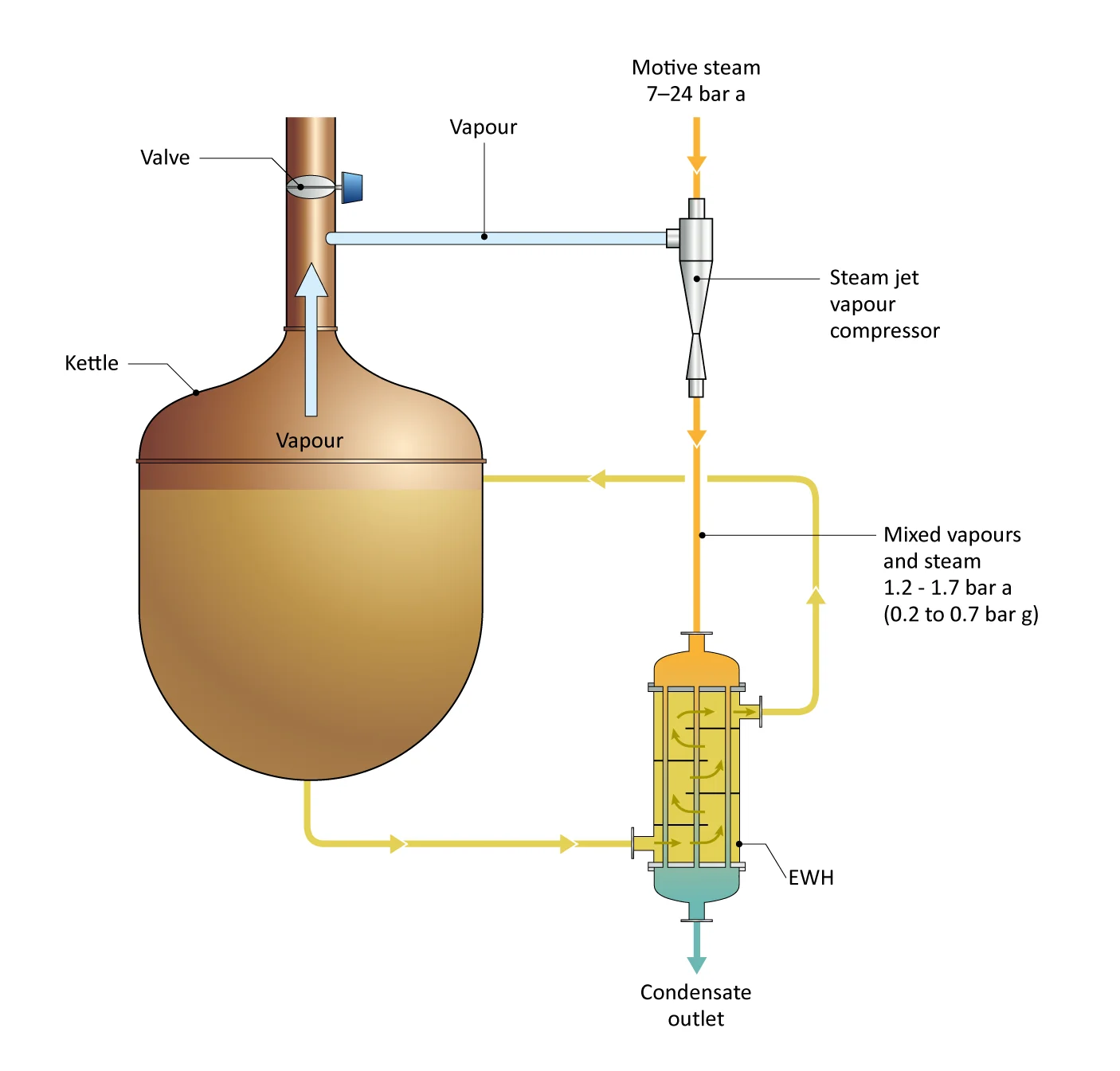
Figure: TVR
Not all of the vapour can be used in TVR (because we are adding extra steam) so the rest is diverted to a vapour condenser or vented to atmosphere. As with MVR, once the steam has been used to boil the wort, the condensate formed usually runs to the effluent plant via a heat exchanger which cools it to a temperature suitable for treatment, reclaiming the energy in the process. A kettle with TVR and a vapour condenser is shown in the figure below.
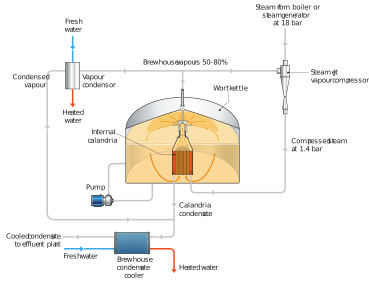
Figure: Wort boiling plant with thermal vapour recompression
TVR is not as efficient as MVR and only recycles around 50% of the boil energy. However, it has a lower capital cost, is less noisy and requires less maintenance.