
Lesson 4 - Wort Boiling Technology and Process Control
This lesson explores the process of heat transfer during wort boiling, and how it can be controlled. It also considers the design principles of wort boiling systems and how energy use in the brewhouse can be minimised.
External Wort Heater (Calandria)
The external calandria is known by at least three names. These are external wort heater (EWH) external wort boiler (EWB) and of course external calandria.
As you would expect, the external calandria is a calandria located outside of the kettle. Wort flows from the bottom of the wort kettle, through the calandria, and back into the kettle. Depending on the design wort is pumped or drawn in due to a thermosyphon.
Like most equipment in brewing, the external calandria has undergone an evolution. Early designs were essentially internal calandrias fitted outside of the kettle with tubes of the same length. Pumps were used throughout boiling which was usually by forced convection.
The next stage of evolution was an increase in the height of the calandria and a move from tubes that passed straight up through the calandria to tubes that looped through the calandria. This meant the wort flowed the length of the calandria three times on each circuit. These also relied on pumps to provide forced convection. A valve was fitted on the pipe attached to the outlet of the calandria and this allowed a back pressure to be applied. Applying pressure means that the wort can be heated to a higher temperature in this case 102°-106°C. Once the wort has passed the valve it returns to atmospheric pressure and a lot of the water vaporises instantaneously. This leads to extensive vapour bubble formation. Systems that require pumped circulation can recirculate the contents of the kettle 7 to 12 times per hour. This high flow rate comes at a cost. The three-pass external calandria requires 0.08 kW/hL of electrical power to maintain flow and subjects the wort to significant shear forces.
The latest version of the external calandria is the Briggs Symphony which has much longer single-pass tubes. These longer tubes mean that nucleate boiling can occur and the thermosyphon that is generated can maintain wort circulation. A pump is used to assist with circulation during heating to the boil, but this only consumes 0.02 kW/hL of electrical power. The longer tubes mean that the heating area is much larger so lower pressure/temperature steam can be used and ΔT is reduced.
External calandrias based on plate heat exchangers with wide channels are currently available from some suppliers for small brewhouses. The suppliers claim that passage through the heat exchanger does not cause shear on trub particles which seems unlikely.
Having an external calandria means that it is possible to set up a whirlpool in the vessel and the kettle can also undertake wort clarification. The wort returning to the kettle is directed on to a deflector cap, fanning it out across the surface of the wort in all designs apart from those intended for use as a kettle whirlpool. In these designs, wort is returned tangentially. In the kettle whirlpool design, two pipes are used to return the wort. One pipe enters at a tangent below the wort’s surface and helps reduce foaming during heating to the boil. The second pipe enters tangentially above the wort’s surface, helping with evaporation during the boiling phase.
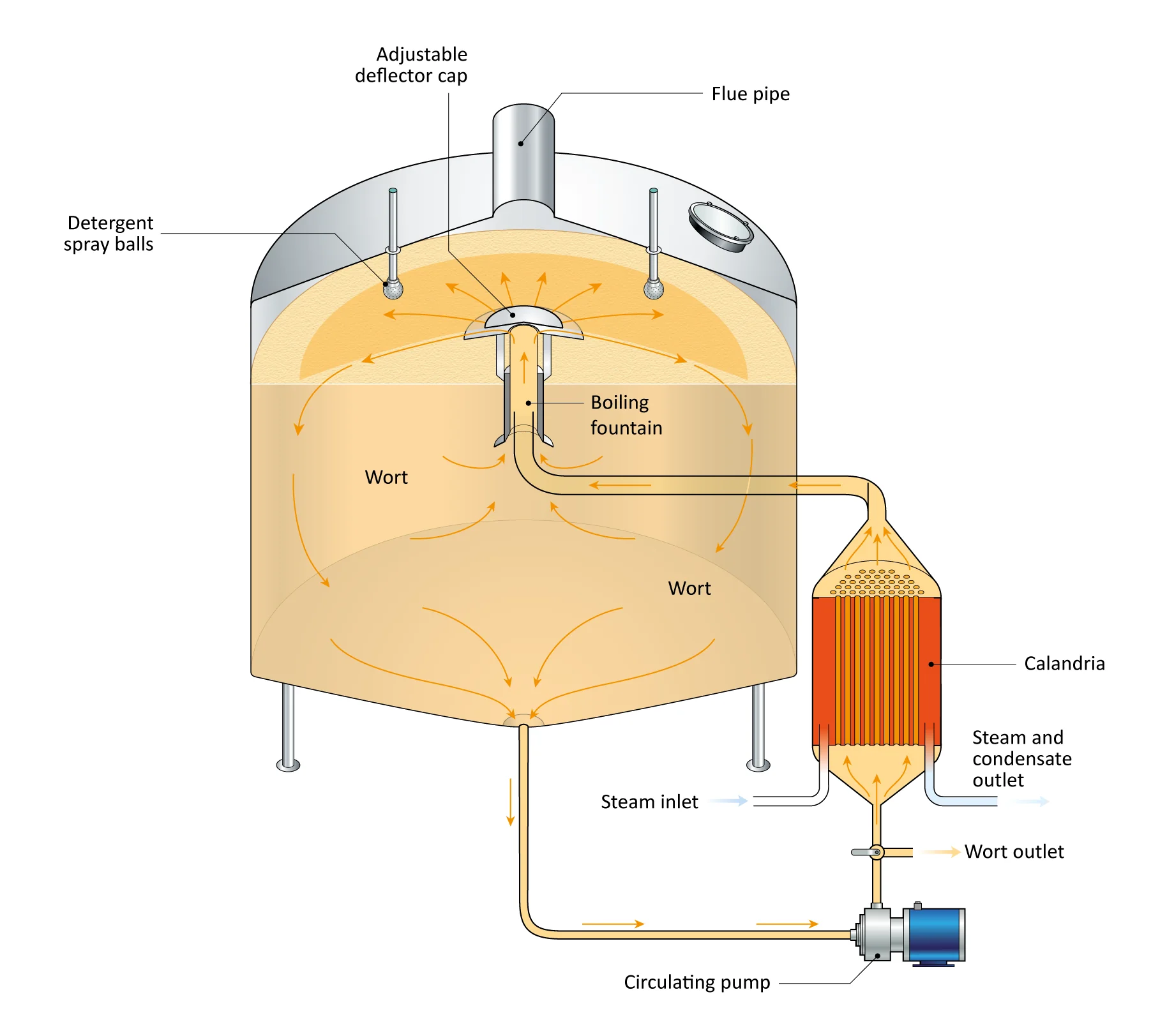
Figure: kettle with external calandria
The advantages of the external calandria include:
- If used, the overpressure and higher temperature allows for reduced boiling time (due to the faster bitterness extraction and trub formation). The same wort quality provided by 10% evaporation per h 90 min boil can be achieved with 5-6% per h evaporation in 60 min.
- Very low steam pressures can be used in long tube versions.
- Wort boiling can start earlier than with an internal calandria. As wort is pumped through the external calandria, as soon as there is enough wort to keep the system flooded, heating to the boil can begin. This saves time and ensures the wort does not cool too much before heating can begin, thus saving energy.
- Foaming is less than in most internal calandrias and heating jacket systems.
- Some external calandrias can be cleaned in place independently of the kettle.
- Optimum heat transfer and turbulent conditions mean a lower rate of fouling than an internal calandria. This increases the number of brews between cleaning.
- Using a combined kettle-whirlpool removes the transfer time between the kettle and whirlpool from the brewhouse cycle time (although the kettle is tied up all the time the wort is clarifying and being cast out to fermentation). It also removes the potential for trub damage during transfer.
The disadvantages of the external calandria include:
- Additional electrical consumption by pump.
- The external calandria needs to be insulated to help prevent heat losses.
- Shear can be high in the pumped circulation versions.
- More equipment to maintain than an internal calandria.