
Lesson 4 - Wort Boiling Technology and Process Control
This lesson explores the process of heat transfer during wort boiling, and how it can be controlled. It also considers the design principles of wort boiling systems and how energy use in the brewhouse can be minimised.
Internal Wort Heater (Calandria)
The internal calandria is probably the most common wort boiling system in larger breweries. As you would expect it’s a calandria that sits inside the kettle!
A calandria is a tall cylindrical shell with hollow tubes inside. Steam (or rarely superheated water or thermal fluid) fills the shell around the tubes. The wort rises through the tubes inside and is heated by the steam surrounding them. As the steam’s heat is transferred into the wort it condenses back into water and flows back to the boiler feed tank ready to be turned back to steam.
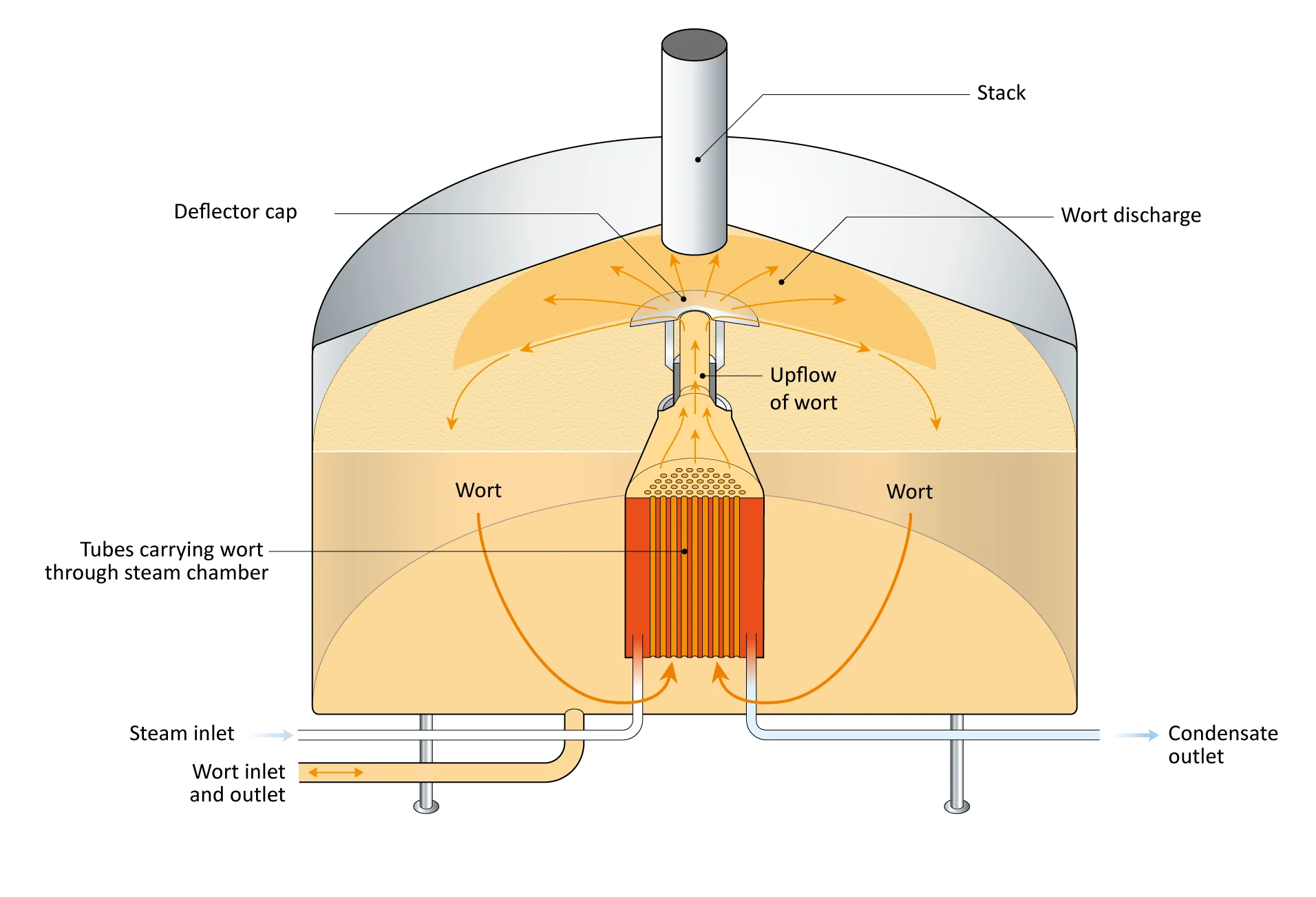
Figure: Wort kettle with internal calandria
The thermosyphon caused by the boil means wort is pulled up through the tubes and flows out of the top at high velocity. Above the top of the calandria there is a deflector cap, or spreader. This deflects the wort across the liquid surface forming a thin fanning stream of wort from the centre of the kettle to the walls. This increases the surface area of wort available for evaporation and helps reduce foaming in the kettle.
Nucleate boiling is important for maintaining the thermosyphon. The steam bubbles produced mean the mixture of wort and steam bubbles at the top of the calandria have a lower density than wort and hence rise up through the wort more rapidly. Another way of looking at it is that any steam bubbles produced rise, creating the flow that takes the wort along for the ride!
Pumps can be used with internal calandrias but this is not common. Where they are used, forced convection may be the heat transfer mode. Alternatively, they may be used to circulate wort while the calandria is not heating the wort to encourage evaporation.
The advantages of internal calandrias are:
- Low investment cost, with little maintenance and wear.
- No electrical energy required.
- No heat losses (all heat produced goes into the wort).
- It is possible to use a low steam pressure (1 bar overpressure).
- Low foam formation.
- Low shear boiling.
- No agitator required.
The disadvantages include:
- Cleaning the calandria tubes is not easy; the kettle may need to be full of cleaning solution in order to clean inside the tubes (leading to high water use and effluent costs).
- Usually needs to be cleaned more frequently than an external calandria.
- Flowrate through the calandria is usually lower than that through an external calandria so wort thermal load, fouling and flavour and colour pickup can be high if ΔT is high.
- Not able to heat wort to boiling until calandria is almost submerged (jackets or a preheater are often required).
- Part brews are not possible (for the same reason). Some modern internal calandrias have shorter tubes to help overcome this problem.
We can now discuss some of the commercially available internal calandrias that do things a little differently.
GEA Jetstar®
The GEA Jetstar® internal calandria is controlled to split boiling into two phases (thermal conversion and then evaporation). During the thermal phase wort is recirculated beneath the surface which improves mixing of the vessel contents. For evaporation wort is recirculated via spreaders that maximise the surface area for evaporation and help to supress foam. The steam flow to the calandria is regulated to achieve the heating requirements of each phase.
Please use the link below to find out more from the equipment suppliers. Note, this is for illustrative purposes only and is not a recommendation or endorsement of the supplier’s product:
https://www.gea.com/en/binaries/JETSTAR_1015_EN_tcm11-12656.pdf
Krones Stromboli
The Krones Stromboli is also controlled to split the boil into different phases. A pump is used to create a venturi effect inside the calandria meaning that recirculation and evaporation can be maintained without significant steam input. It also has two heights of recirculation. One is used while the pump is operating and another used when the thermosyphon is driving flow. It operates in three phases:
- Intensive boiling with a high steam input meaning the calandria drives recirculation. This is for formation of DMS and trub formation.
- A boiling break with low steam input and pumped recirculation. This is for the evaporation of water and volatiles.
- Intensive boiling with both high steam input and pumped recirculation. This is to achieve the target total evaporation and volatile removal.
The Stromboli is available as an internal or external calandria.
Please use the link below to find out more from the equipment suppliers. Note, this is for illustrative purposes only and is not a recommendation or endorsement of the supplier’s product:
https://www.krones.com/media/downloads/stromboli_en.pdf
Ziemann Holvrieka Shark
And finally, the Ziemann Holvrieka Shark internal calandria has two different tube sizes that enable different modes of boiling to be achieved. The tubes towards the centre of the calandria are narrow and those towards the outside are wide. It can be used with steam or superheated water at 140°C. Like the Stromboli, it operates in three phases during the boil.
- Heating up: steam is supplied to both sets of tubes to heat the wort rapidly and minimise fouling.
- Simmering/conversion: steam is only supplied to the tubes towards the centre. The narrowness of these tubes means that the thermosyphon is increased, flow rate and turbulence are high due to the venturi effect and hence fouling is low. This phase is designed to allow the changes in the wort that require heat (like conversion of SMM to DMS) to occur while minimising energy use and evaporation.
- Evaporation: steam is supplied to both sets of tubes and the target evaporation is achieved.
The figures below show the top of the calandria during the simmering and evaporation phases.
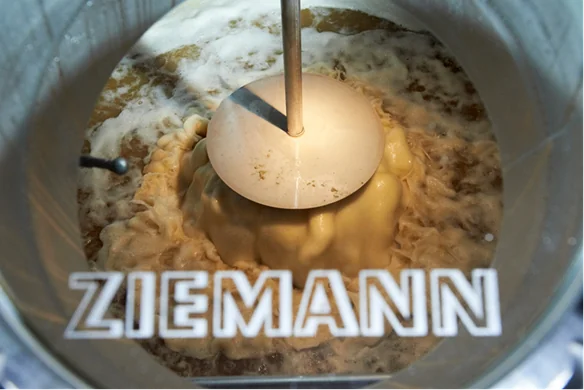
Figure: Ziemann Holvrieka Shark simmering phase
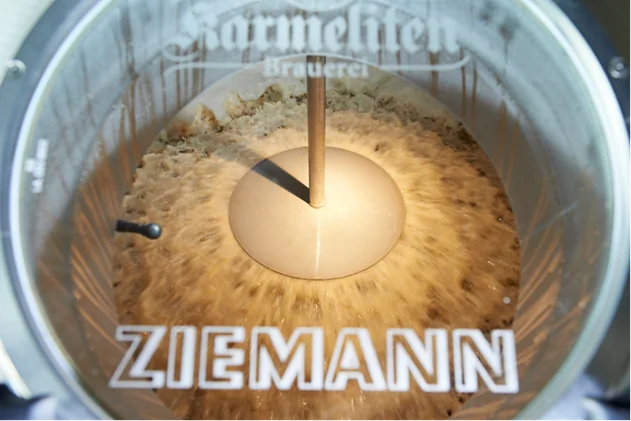
Figure: Ziemann Holvrieka Shark evaporation phase
Please use the link below to find out more from the equipment suppliers. Note, this is for illustrative purposes only and is not a recommendation or endorsement of the supplier’s product:
https://www.ziemann-holvrieka.com/industries/beer/brewhouse/boiling
These are only a few of the internal calandrias on the market so feel free to research some more. When reading the claims of the manufacturers always think back to the principles discussed in this lesson and the wort boiling theory lesson and decide how true they might be!