
Lesson 4 - Wort Boiling Technology and Process Control
This lesson explores the process of heat transfer during wort boiling, and how it can be controlled. It also considers the design principles of wort boiling systems and how energy use in the brewhouse can be minimised.
Wort Boiling Process and Technology Overview
Before we delve into the specifics of wort boiling systems let’s explain the start of the boiling process and introduce the basic equipment used.
Most wort boiling systems feature a kettle. Kettles are also called coppers in some countries. This is because they were traditionally constructed of copper. Kettles receive wort from wort separation or from a pre-run vessel (sometimes also called an underback). Pre-run vessels collect the wort and heat it close to boiling point. They are used to increase brewhouse capacity by reducing the wort’s residence time in the kettle. Some systems have a heat exchanger that uses very hot water to preheat the wort as it flows to the kettle.
If wort is heated to boiling temperature in the kettle, this is usually done at around 1˚C/min. Wort is heated at this rate to avoid a large temperature difference between the heating surface and the wort. If this is too high, the heater’s surface can foul rapidly and off flavours can be produced. This temperature difference should be as low as possible without reducing the effectiveness of the boil. You might think that this process uses minimal energy compared to actually boiling the wort, but in fact, as you will see later, heat energy is applied at a faster rate during the preheating stage.
Once the boil has commenced, the process is monitored. As we saw in the previous lesson most breweries use the time, evaporation or mass of steam supplied to determine when the process is complete. During the boil, various additions can be made and these are usually made at timed intervals.
Equipment
Kettles are designed to contain the wort as it boils. They are equipped to heat the wort to boiling and continue to apply heat as the boil progresses. Over the years the shape of the kettle has changed and there have been some weird and not so wonderful designs with square sides angled bases and curvaceous domed tops. Today most kettles are cylindrical with domed bases and either shallow domed or shallow coned tops. Some advocate a kettle 1:1 ratio of diameter to height. A major brewhouse supplier uses a ratio of 0.6 – 0.9 diameter to the wort level and this is adapted to incorporate the internal calandria. Whatever is used there must be sufficient freeboard (headspace) to contain any foam produced.
The most common heating device in medium and large breweries is a calandria, either inside the vessel (internal calandria), or outside the vessel (external calandria). Kettles also have a chimney (stack) which allows the vapours from the boil to escape. The two figures below show kettles with internal and external calandrias.
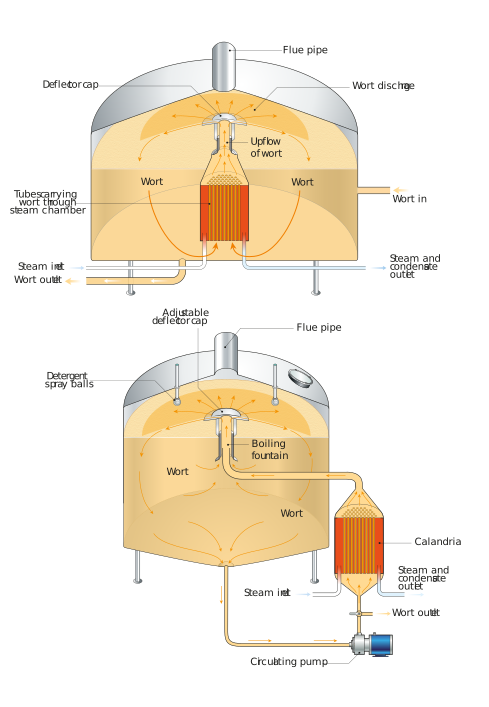
Figure: Kettles with internal and external calandrias
Some kettles do not have a calandria but are heated by jackets on the outside of the vessel or a coil running through the vessel. Some older designs of kettle also feature an agitator to help distribute heat applied to the outside of the vessel by steam jackets or the products of gas or oil combustion.
The kettle stack can be fitted with a heat exchanger. This recovers energy from the hot vapour by condensing it, heating water in the process.
Wort boiling systems also feature pumps to fill and empty the kettle and in the case of external calandrias, circulate the wort through the calandria. Systems can also feature:
- Insulation and cladding
- Flow meters
- Temperature measurement
- Pressure measurement
- Level measurement and overflow protection
- Valve to close off stack to build pressure or divert flow of vapour
- Vapour condenser
- Wort preheater
- Door safety interlocks
- Gravity measurement
- Control system
- Safety alarm
- Operator prompt alarm to notify staff when action is required
- Pressure relief and anti-vacuum valves
- Interconnecting pipework
- Ancillary equipment to pre-heat or strip the wort