
Lesson 4 - Wort Separation Technology
This lesson deals with wort separation technology. The variables of Darcy’s Law are re-visited, to demonstrate how they influence the design of the lauter tun, mash tun, and mash filter. The key design features and control methods of these wort separation devices are identified. Typical operational steps and times are also established for each device.
Mash Filter ‒ Automated Control
The mash filter is provided with sensors to measure key parameters. We can use this data to create a trend and see how the unit is performing.
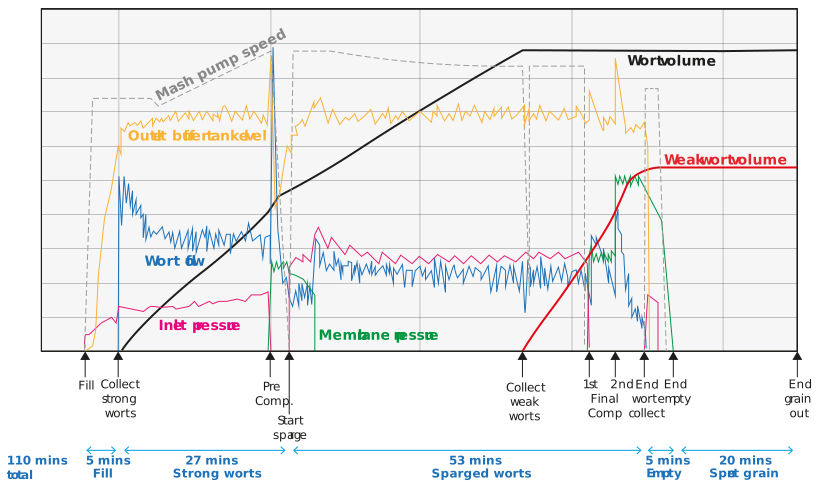
Figure: Mash filter trend chart of operational performance
In the system displayed above, the flow rate of the mash is not available. Thus, the unit relies on measuring the wort flow rate out of the filter. To fill, we set the mash pump at a fixed speed until wort is flowing from the filter. Now we can regulate the pump speed according to the wort outlet flow, maintaining the target flow rate for strong worts.
As stressed earlier, we must not operate the filter above its maximum inlet pressure of 0.5 bar. Inlet pressure is continuously monitored. If the maximum inlet pressure limit is reached, the pump will change to pressure control. Its speed will automatically reduce to keep the inlet pressure within its limit.
When the mash filter pump is running in pressure control, we are running below our target flow rate. This will extend the cycle time.
During strong worts collection, the chambers are accumulating more spent grain. This reduces grain bed permeability and increases resistance to flow. We need to increase the pump speed to maintain the target flow, subject to not exceeding the inlet pressure limit.
The pre-compression can result in a large increase in flow. If we use too high a pre-compression pressure, the outlet buffer tank level control will not be able to respond quickly enough. This will result in the outlet buffer tank overflowing, and in turn wort loss.
Sparge flow is controlled in the same way as wort flow, until the sparge volume is achieved.
Sparged wort collection continues throughout the two phases of final compression, and wort flow gradually stops. We have selected the membrane pressures and times which will result in the correct spent grain moisture.