
Lesson 4 - Wort Separation Technology
This lesson deals with wort separation technology. The variables of Darcy’s Law are re-visited, to demonstrate how they influence the design of the lauter tun, mash tun, and mash filter. The key design features and control methods of these wort separation devices are identified. Typical operational steps and times are also established for each device.
Point of reflection – reconvene
Welcome back. What were your thoughts?
The finer husk particles of the hammer milled grist provide a greater surface area for contact with the sparge water. This is in fact favourable for sparge leaching efficiency. However, the grain bed at 50 mm, is very thin. This reduces the contact time of the sparge water passing through the grain bed, thus reducing sparge leaching efficiency. The lower sparge flow of the mash filter is needed to achieve efficient sparging. However, this is partly off-set by the lower sparge volume used. The residual extract in the spent grain can be removed with lower volumes of sparge water. This enables us to achieve a higher gravity in the kettle, which is beneficial for high gravity brewing.
Final compression (10 min)
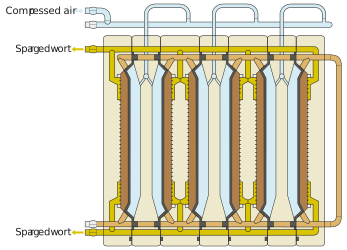
Figure: The mash filter – final compression
With the sparge complete, the sparge supply is closed, and compressed air is used to inflate the membranes. This squeezes the remaining sparged wort out of the spent grain bed. This compression is two phased. The first at a lower pressure, which removes most of the sparged worts. The second is at a higher pressure, which reduces the spent grain moisture to around 70 % w/w.
Empty (5 min)
The inlet pipework is drained down of sparge water and the outlet pipework drained down of sparged worts. If this is not done, when the filter opens, excess water/wort would fall into the spent grain hopper underneath. If our spent grain is too wet, it will be problematic for the spent grain transfer system.
Spent grain discharge (20 min)
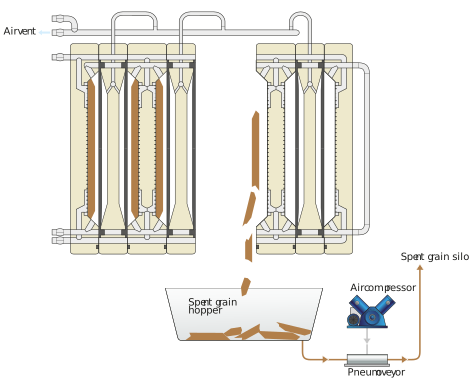
Figure: The mash filter – spent grain removal
The membranes are deflated and the hydraulic ram is withdrawn, so that the plates are free to move. A moving ratchet moves to latch on to the first plate and pulls it away from the rest of the plate pack. This allows the spent grain to drop down into the hopper below. This is then repeated for all the other plates. Depending on the plate design, raw materials used, milling intensity, and moisture content, some intervention may be needed to manually scrape off excessive residual grain from the plates.
After completion of spent grain removal, the hydraulic ram is reapplied to close the plates back together and hold them under tension to ensure no leakage.
The spent grain has been discharged into the spent grain hopper in 20 min. The transfer to spent grain silo will take significantly longer (60-90 min). The pneumoveyor requires a high volume of compressed air to fluidise the spent grain and blow it through the large diameter pipework. There will usually be a dedicated air compressor to meet this demand.