
Lesson 4 - Wort Separation Technology
This lesson deals with wort separation technology. The variables of Darcy’s Law are re-visited, to demonstrate how they influence the design of the lauter tun, mash tun, and mash filter. The key design features and control methods of these wort separation devices are identified. Typical operational steps and times are also established for each device.
Mash Filter Cycle Time
We will now consider how a mash filter achieves a cycle time of 110 min and 13 brews per day, in a bit more detail:
Table: Typical mash filter times to achieve 13 brews per day
|
Operation |
Minutes |
|
Fill |
5 |
|
Fill & filter strong wort |
23 |
|
Pre-compression & filter strong wort |
4 |
|
Sparge & collect sparged worts |
45 |
|
Final compression & collect sparged worts |
8 |
|
Empty |
5 |
|
Spent grain discharge |
20 |
|
Total |
110 |
Filling (5 min)
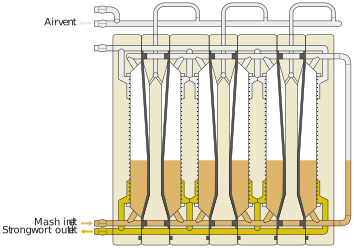
Figure: The mash filter filling
The pumped mash from the mash conversion vessel enters simultaneously to all the filter plate ports. As the mash chambers fill, each membrane is pushed against its plate and the displaced air is vented to atmosphere through the air lines.
Filtration (23 min)
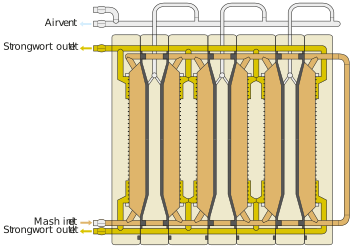
Figure: The mash filter – strong worts filtration
As the chambers become full, the mash also feeds into the top inlets of the filter plates. The filtered wort can now leave by both the top and bottom wort outlets (on the opposite side to the mash inlets).
Pre-compression (4 min)
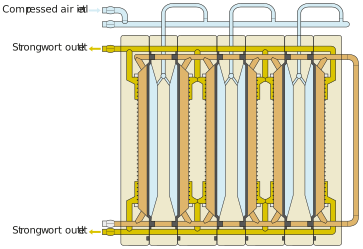
Figure: The mash filter – pre-compression
With mash transfer complete, the mash inlet main is closed off, and compressed air is supplied to inflate the membranes to around 0.5 bar. Strong wort continues to flow as it is squeezed out of the spent grain bed. After four min, flow has reduced by about 50%.
Sparging (45 min)
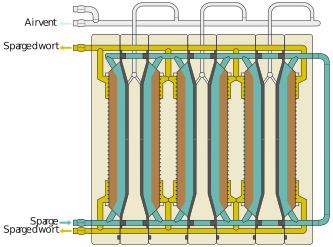
Figure: The mash filter – sparging
Sparge water is supplied to the mash pump and enters the same way as the mash. As the sparge water fill progresses, the pressure behind the membranes is gradually reduced.
It is important to maintain a forward flow during this transition, otherwise the spent grain bed might collapse and/or crack. In which instance, the pumped sparge can take the path of least resistance. If the grain bed is unevenly distributed or cracked, there will be preferential flow through some plates and less flow through others. This will reduce sparge efficiency.
Our sparge flow is at a relatively low rate (roughly 75% of strong worts flow). The mash filter does not take advantage of the reducing viscosity of sparged worts like the lauter tun or mash tun.
Point of reflection: Why do you think this is? Think about the contact time of the sparge water through the grain bed. Give yourself 5-10 min to think about this and then click ‘Next’ to continue this lesson.