
Lesson 4 - Wort Separation Technology
This lesson deals with wort separation technology. The variables of Darcy’s Law are re-visited, to demonstrate how they influence the design of the lauter tun, mash tun, and mash filter. The key design features and control methods of these wort separation devices are identified. Typical operational steps and times are also established for each device.
Mash Tun Design and Operation
We are now going to take a look at the mash tun. It has similarities to the lauter tun but is significantly slower. Why is this so?
Table: Design and operational parameters for the mash tun for 10 t grist
|
|
Lauter Tun |
Mash Tun |
Mash Filter |
|
|
|
Tun diameter (m) |
8 |
5 |
20 (58 chambers) |
|
|
Grain bed loading (kg/m²) |
200 |
500 |
30 |
|
|
Cycle time (min) |
144 |
288 |
110 |
|
|
Brews per day |
10 |
5 |
13 |
|
|
Milling system |
Wet / six-roll dry |
Two / four-roll dry |
Hammer |
|
Q |
Wort flow rate (hL/h) |
889.2 |
378 |
1522.9 |
|
K |
Bed permeability (m²) |
3.084 x 10⁻¹¹ |
9.72 x 10⁻¹¹ |
3.525 x 10⁻¹³ |
|
K |
Relative permeability |
87 |
275 |
1 |
|
DP |
Maximum limit (bar) |
0.1 |
0.1 |
0.3 |
|
A |
Filtration surface area (m²) |
50 |
20 |
330 |
|
µ |
Mash Water (L/kg) |
3.3 |
2.5 |
2.7 |
|
µ |
Sparge water L/kg |
4.0 |
5.0 |
2.8 |
|
µ |
Malt modification |
Less well |
Well |
Less well |
|
µ |
Mash temperature (˚C) |
76 |
65 |
76 |
|
µ |
Wort viscosity (mPa.s) |
1.25 |
1.85 |
1.65 |
|
L |
Grain bed depth (m) |
0.5 |
1.0 |
0.05 |
We must first consider that the mash tun is a dual-purpose vessel. 88 min of the 288 min cycle time, consists of the mashing in time and the mash saccharification time. So, the wort separation takes 200 min. This is still significantly higher than the lauter tun, to which we will now compare.
The table above shows us that the strong worts first flow of the mash tun is only 50% of that of the lauter tun. If we again look at the variables of Darcy’s Law, we can start to understand why.
The surface area A of our mash tun is only 40% of the lauter tun. So, for 10 t of grist, the grain bed loading is 2.5 times higher and the resultant grain bed depth L is 2.5 times deeper. Lower A and higher L will reduce wort flow. The mash tun uses a coarser grist, so its grain bed permeability K is higher. Higher K is favourable to flow. The Mash Tun uses a thick mash with a water:grist ratio of 2.5 L/kg. This produces a higher gravity wort, and the wort separation temperature is lower (at saccharification temperature). Both of these factors increase wort viscosity, which is unfavourable for mash tun flow.
So, let us again return to Darcy’s Law, and substitute the values from the table above:

Table: Using Darcy’s Law to compare the mash tun and lauter tun
|
|
Relative K |
DP (bar) |
A (m²) |
µ (mPa.s) |
L (m) |
Q (hL/h) |
Q Ratio |
|
Mash Tun |
275 |
0.1 |
20 |
1.85 |
1 |
378 |
1 |
|
Lauter Tun |
87 |
0.1 |
50 |
1.25 |
0.5 |
889.3 |
2.3 |
The mash tun flow is favoured by higher grain bed permeability. This advantage is outweighed by the lower cross-sectional area, and deeper depth of the grain bed. It is also hindered by the higher viscosity of its strong worts.
So what does a mash tun look like, and how do we operate it?
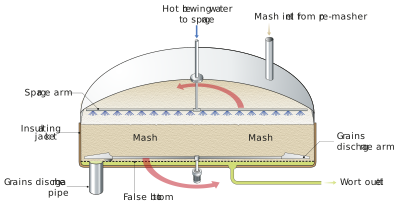
Figure: Main features of the mash tun
The mash tun has similar features to the lauter tun. The most obvious difference between them is that the mash tun does not have a rig and associated rakes. Only the major differences will be covered in this lesson. A coarse grist from the four-roller mill, incomplete saturation of the grist at mashing, and strong worts from the lowest liquor:grist ratio all come together to create a floating deep bed.
The top of the bed is relatively dry. This means it is critical that the sparge is applied evenly over the whole bed for extraction efficiency. This will either be done with a rotating sparge arm, or with spray balls.
Due to the high wort viscosity, we need to start strong worts collection slowly. Sparge is applied quite early during strong worts collection and is set to match the flow rate of the collecting wort. Otherwise the floating bed will settle on the false floor.
As the sparge works its way through the bed the collecting wort temperature will increase and the gravity will decrease. Wort viscosity will decrease. This allows us to speed up the wort collection. The sparge flow needs to at least match wort flow, to avoid the grain bed settling on the false floor. However, eventually, towards the end of run off, the bed settles on the false floor. We need to take great care to not use too high a wort collection flow rate, which will compact the bed on the floor, and severely restrict/stop flow. This is what we call a ‘set mash’. We have no rakes to alleviate this problem; our only option is to underlet with hot water to refloat the grain bed.
The mash tun can only reduce high DP by reducing wort flow.
The False Floor
The false floor is similar to that of the lauter tun. The slots are wider at 1 mm, but there are fewer. This opens up about 5% of the surface area (lauter tun 10-15%) which is sufficient for the slower run off rates.
Spent Grain Removal
We do not have a rig to help us grain out, but at the false floor level there is a spent grain discharge arm. This is stationary during wort collection. When we are ready to grain out, the false floor grain outlet opens to the spent grain discharge chute, and the spent grain arm rotates. The spent grain arm is shaped so that the grain is continually being forced forward and out to the periphery where the spent grain outlet is located.
Cycle Time
Table: Typical mash tun times to achieve five brews per day
|
Operation |
Time (min) |
|
Mash in, mash stand, first worts recirculation |
88 |
|
Strong worts collection |
65 |
|
Sparged worts collection |
110 |
|
Spent grain removal and under-floor jetting |
25 |
|
Total |
288 |
The wort separation time is 200 min, but the mash conversion time adds another 88 min. The mash tun cycle time becomes 288 min. Our capability is five brews per day. We will explore this in more detail later.