
Lesson 4 - Wort Separation Technology
This lesson deals with wort separation technology. The variables of Darcy’s Law are re-visited, to demonstrate how they influence the design of the lauter tun, mash tun, and mash filter. The key design features and control methods of these wort separation devices are identified. Typical operational steps and times are also established for each device.
Controlling the Lauter Tun
In the previous lesson we looked at how the mash is introduced to form the lauter tun grain bed. To operate and control wort collection we need to consider some additional features:
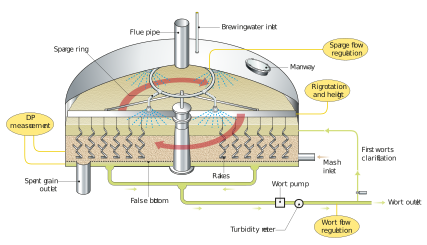
Figure: Control requirements of the lauter tun
We will need an underlet capability to flood, and just submerge, the false floor with hot water before receiving the mash. This is done by introducing hot water by reverse flow through the outlets or from the overhead sparge ring.
We will also need a method of controlling both the wort flow and sparge flow. The rakes will operate at varying speed and height in response to the DP and wort clarity.
As aforementioned, the false floor has a limit as to how much vacuum it can withstand before collapsing. To ensure we never encounter that disaster, the outlet pipework has a metal vent pipe returning to the upper part of the vessel headspace. With DP and under floor vacuum increasing, the wort level drops in the vent, until eventually air is drawn into the outlet pipework to relieve the vacuum. Pulling air into the wort is a very undesirable situation. This vacuum breaker is a fail-safe device, and our normal running must regulate flow so that this does not occur.
If maximum DP is reached, despite raking, we need to stop wort collection and carry out a deep bed rake. The rakes are lowered down close to the false floor level, to loosen up and lift the bed. This activity will allow fines to pass through the false floor. After five min of deep bed raking, when DP returns to a low level, the rakes are raised and another first worts recirculation is carried out to reform the grain filter bed. When wort clarity is again acceptable, we can continue our wort collection.
Cycle Time
Let us now look at a typical lauter tun operation, used to achieve a cycle time of 144 min (10 brews per day).
Table: Typical lauter tun timings for 10 brews per day
|
Operation |
Time (min) |
|
Underlet |
3 |
|
Filling |
10 |
|
First worts recirculation |
6 |
|
Strong worts collection |
30 |
|
Programmed deep bed rake (optional) |
10 |
|
Sparged worts collection |
65 |
|
Bed drain-down |
5 |
|
Spent grain removal and under-floor jetting |
15 |
|
Total |
144 |
- Underlet (3 min) ‒ We flood the plates with hot water to just cover the false floor.
- Filling (10 min) – We now bring in the mash at low level; the spent grain settles out to form the filter bed.
- First worts recirculation (6 min) – The first worts from under the false floor are cloudy, so we return them to the supernatant wort above the grain bed, until clarity is acceptable. Sometimes this is started during the later stages of mash transfer.
- Strong worts collection (30 min) – The strong worts are high in gravity and viscosity, so they need to be run relatively slowly if we are to avoid too high a DP due to grain bed compression. Our rakes are in use to counter any developing DP.
- Start sparge – The timing of this will depend on the technique selected:
- If we use continuous sparging, the overhead sparge sprays will start when the supernatant wort level has dropped to within 25-50 mm of the grain bed surface. The sparge flow will match the flow rate of the wort, and thus maintain a flooded bed until sparge has completed.
- If we use a form of batch sparging, then the start of the sparge will wait until most of the strong worts have been collected. Then we underlet a large volume of water beneath the grain bed. With the rakes rotating at lowest position, the spent grain is resuspended. The reverse flow from the underlet also helps unblock the slots in the false floor. Before wort collection continues, we need to carry out another first worts recirculation until acceptable wort clarity is achieved. This may be repeated several times. This method has lost favour due to the longer time required.
- We can also use a hybrid of continuous and batch sparge. As the wort level gets to within 25-50 mm of the grain bed, we must supply the initial overhead sparge at a very high flow rate until its volume equals that of the wort collected. All flow is then stopped, and we initiate a deep bed rake. This stirs up and loosens the bed, returning the DP to a low level. We must then carry out a wort recirculation until clarity is acceptable. Wort collection recommences with sparge flow matching wort flow. This maintains the supernatant liquid level to the same as that at the start of strong worts collection. The higher liquid head above the bed is beneficial for flow.
- Some breweries use another process where the first worts are run off and then sparge is applied to refill the lauter tun, without resuspending the bed or undertaking a deep rake. This is repeated with set volumes of sparge water and so is also rather confusingly called batch sparging. Deep raking is only initiated if the maximum DP is reached at the target flow rate.
- Sparged worts collection (65 min) – The reducing gravity and wort viscosity mean that wort flow rate and matching sparge flow rate can be ramped up to between 2.5-3.0 times that of the strong worts. Our rakes are used as required to moderate any DP increase.
- Bed drain-down (5 min) ‒ The liquid level left at completion of wort collection should be as close as possible to the false floor without losing clarity or pulling in air. This minimises our effluent volume. A drain-down is needed to ensure that the liquid level is below the spent grain chute opening. This will avoid flooding the spent grain removal system. Our spent grain pneumoveyor would not cope with this.
- Spent grain removal and under-floor jetting (15 min) ‒ The rotating rakes, or plough bar, lower into the bed and push the spent grain towards the discharge outlet. As the spent grain removal is reaching completion, the under-floor high pressure hot water jets are pulsed. This suspends any residual under-floor solids, so that they are flushed down the wort outlet pipework, which is now routed to the drain.
The total time taken is 144 min.
The rig is required to rotate much faster for graining out. This will be roughly seven rpm, compared to a lautering speed of around 0.1 rpm.