
Lesson 4 - Hop Chemistry
Point of reflection – reconvene
Welcome back. So, what were your thoughts?
On the face of it, we would expect that Hop Variety A (with more humulones) would be more bitter, since we know that isohumulones are more bitter than isocohumulones.
However, we know that isocohumulone has a higher solubility due to its higher polarity, than isohumulone. Furthermore, isohumulone levels decrease during the brewing process due to being lost through adsorption to yeast cells and in foam.
This might suggest that at the end of the brewing process, the ratio of isohumulone to isocohumulone may not be the same as the expected levels based on the humulone and cohumulone levels in the raw hops, and that isocohumulone would be favoured.
This is a simplification, as a number of factors can affect overall beer bitterness. However, it demonstrates that bitterness levels in beer might not be as straightforward as assuming that hops with higher α-acids give the most bitterness, we must consider the composition of the α-acids as well!
The other major components of the soft resins are the β-acids. They tend to be present in significantly lower quantities than the α-acids (about four times lower). Due to their relatively poor solubility in water, only trace amounts are found in beer – around 80% of the β-acids added to the wort end up in the trub, while around 20% are converted through wort boiling. However, unlike α-acids, β-acids do not undergo isomerisation during wort boiling, but are converted into products which are formed from the oxidation of β-acids – which also provide bitterness to beer.
α-Acids are isomerised into iso-α-acids during wort boiling, but β-acids are not isomerised during wort boiling. However, both are transformed into substances that provide bitterness during this process.
The figure below shows the chemical structures of the hop β-acids.
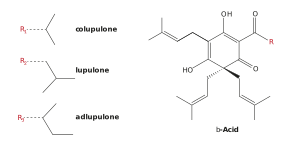
Figure : Chemical structure of the hop β-acids.
When β-acids are oxidised they form, among other things, hulupones. Some brewers also believe that hulupones contribute to beer bitterness even though they are seldom found above their flavour threshold. They believe while they do not contribute significant bitterness alone, they synergise the bitterness of iso-α-acids. On their own in experimental beers, hulupones have been shown to have a shorter-lived and smoother bitterness than iso-α-acids. Hulupones are found as a series of analogues (compounds with a similar molecular structure) similar to lupulones and humulones, as seen in the following figure. Hulupones can be further oxidised into hulupinic acids, which are not bitter.
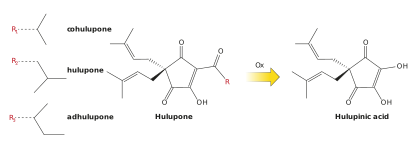
Figure: Chemical structure of hulupones and hulupinic acid
The other fraction of the soft resins that is of interest to the brewer, is the oxidised α-acids, called humulinones. These compounds are readily soluble in beer. Because they are approximately 66% as bitter as iso-α-acids, they can increase a beer’s bitterness during dry hopping.
Finally, in addition to the α-acids and β-acids, there are a collection of other hop compounds grouped under uncharacterised soft resins, making up the soft resins. However, this fraction is of little interest to us and is thus not covered here.
Hard resins
It is generally accepted that the hard resins come about by oxidation of the soft resin. Depending on the amount of oxidation, α-acids and β-acids are converted into uncharacterised soft resins and then into hard resins.
The β-acid derived hard resins (β-hard resin) is the major portion of the total hard resin fraction, of which xanthohumol accounts for the bulk. Only trace amounts of this compound are found in beer, as the majority of it is lost during the normal brewing process (it is also isomerised into isoxanthohumol during wort boiling). It is categorised as a chalcone (an aromatic ketone and an enone), and has also been used to help combat a variety of health problems, such as:
- Cancer
- Inflammation
- Viruses
- Bacteria
- Osteoarthritis
- Diabetes
- Atherosclerosis
- Cellular damage due to free radicals
Although this seems like a great reason to drink more beer, unfortunately the levels found in beer tend to be as low as 0.002 mg/L. To consume sufficient xanthohumol, the volume of beer we would have to drink would mean we were consuming dangerous levels of alcohol!
Other components make up the hard resins, such as other prenylflavanoids, multifidol-glucosides (which are intermediates in α-acid biosynthesis) and other glycoside bound polyphenols. Some of these are regarded as polyphenols but can also be listed under hard resins. Brewing trials have shown that the bitter quality of finished beer is positively influenced by hard resins, and that they also have an additive effect on iso-α-acids. Studies have also shown that hard resins contribute to the foam stabilising properties of hops.
Let’s update the figure below with what we have just learnt.
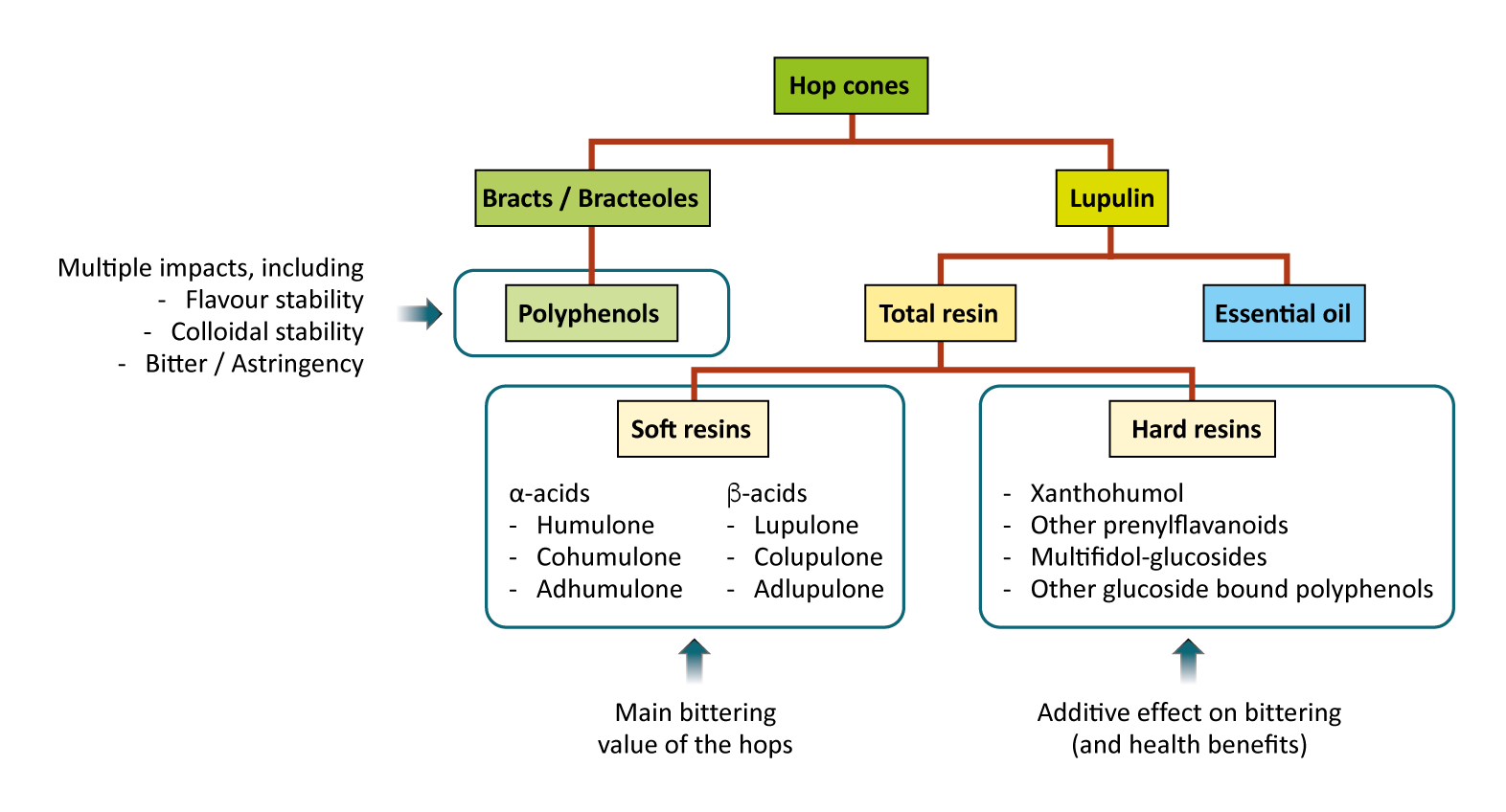
Figure: Hop components
Next, we turn our focus to hop polyphenols.