
Lesson 4 - Hop Chemistry
Total Resins
The total resins are subdivided into soft resins and hard resins.
Soft resins are soluble in hexane. Hard resins are soluble in methanol, but not in hexane.
Soft resins
Soft resins contain the bulk of the bittering potential and antibacterial activity of hops and are split into α-acids, β-acids and uncharacterised components.
To quantify the amount of each component, a test called the lead conductance value of hops is undertaken. This is discussed in lesson 8 of this unit. α-Acids form a yellow precipitate when mixed with lead acetate, and the filtrate contains the β-fraction from which the β-acids may crystallise. The β-fraction is the total soft resins minus the α-acids.
The α-acids are called humulones, which are further split into the following homologs (this means they are of the same chemical type, but differ slightly in structure):
- Humulone
- Cohumulone
- Adhumulone
Similarly, the β-acids are called lupulones and exist as the following homologs:
- Lupulone
- Colupulone
- Adlupulone
Let’s update the figure below with what we have just covered.
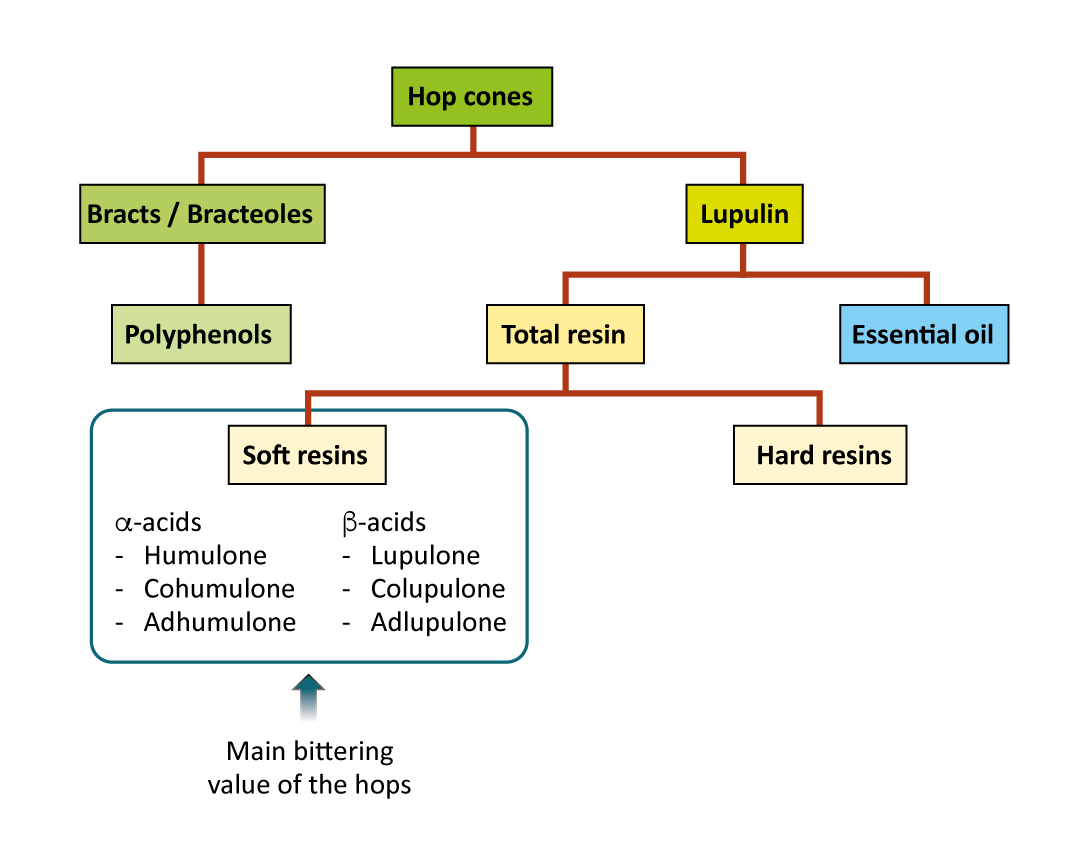
Figure: Hop components
The α-acids are regarded as the most important constituents of the hop resins. Why? Well, these compounds become isomerised (one molecule is transformed into another molecule containing exactly the same atoms, but with a different arrangement) during wort boiling into the more soluble and bitter iso-α-acids. α-Acids themselves are not very bitter or soluble in wort, so isomerisation must take place to provide the required bitterness. Isomerisation of hops occurs in two ways, both involving heat:
- During wort boiling.
- Heating α-acids with a magnesium or potassium salt in an alkaline solution (known as pre-isomerisation, as it is conducted outside of the brewery). This is covered in Hops Lesson 6.
Each α-acid is converted into its isomerised form – for example, the α-acid humulone has become isohumulone and the reaction yields one of two isomers of isohumulone – a cis or a trans isohumulone.
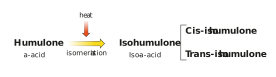
Figure: Isomerisation of humulone
The figure below shows the chemical structures of the hop α-acids before and after isomerisation. It also shows that the ratio of cis to trans is roughly 70:30 in isomerised hops. Cis and trans isomers are called diastereomers because they are not mirror images of each other.
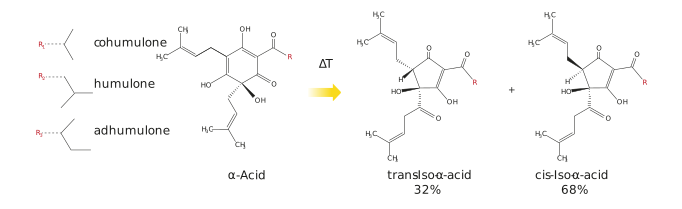
Figure: Chemical structures of the hop α-acids and trans- and cis-iso-α-acids
Figures like this can be quite intimidating, but are important for helping us to visualise the change in hop chemical structure. The table below shows each α-acid and its isomerised form.
Table: α-Acids and their isomerised forms
| α-Acid | Isomerised form |
|
Humulone |
cis-isohumulone |
|
trans-isohumulone |
|
|
Cohumulone |
cis-isocohumulone |
|
trans-isocohumulone |
|
|
Adhumulone |
cis-isoadhumulone |
|
trans-isoadhumulone |
The ratios of the homologs vary from variety to variety, but adhumulone tends to be more constant, with a level of 10-15% of α-acids. Cohumulone and humulone levels vary between 20- 50% of total α-acids.
The solubility of each of these iso-α-acid homologs differs, as does their effects in beer.
Some of the properties of these homologs are as follows:
- Cohumulone solubility and utilisation is the highest due to its more polar character.
Polarity means that a molecule has an area of negative charge on one end and an area of positive charge on another. Water is a polar molecule and a polar solvent. Polar substances dissolve easier in polar solvents. This is why it is easier to dissolve salt in water than it is to dissolve oil in water. As most of wort and beer is water, the same applies to those.
- Isohumulone and isoadhumulone are the least polar, thus more likely to be lost from beer due to adsorption (sticking) onto yeast cells and partitioning (sitting at the gas-liquid interface) into beer foam.
- Cis-isomers are much more stable than the trans-isomers, and thus the ratio can be affected over time.
- Cis-isomers are more bitter than the trans-isomers.
- Isohumulones are more bitter than the isocohumulones.
- There is little difference between cis/trans-isomers’ ability to stabilise foam (but more trans-isomers are found in foam, than cis-isomers).
- More trans-isomers, than cis-isomers, are lost during fermentation.
Hop utilisation
Beer produced using a standard brewing process tends to only have a hop utilisation of around 30-35% – how can we improve that utilisation?
Hop utilisation is calculated using this equation:

If we use isomerised extracts, we would include the mass of iso-α-acids in the bottom line of the equation.
The table below discusses the factors that affect utilisation.
Table: Factors affecting hop utilisation
|
Factor |
Effect |
|
pH |
Hop utilisation is higher at higher pHs. A pH of 8-10 can provide 90% utilisation. At standard wort pH of 5.2, it is only around 35%. For many reasons boiling at pH of 8-10 is not sensible. However, some breweries boil hops in a small vessel at a higher pH to isomerise them before they add them to the main boil. |
|
Boil time |
The longer the wort is boiled with hops added, the greater the utilisation, up to a maximum point of around 4 h. |
|
Wort gravity |
Hop utilisation is greater in lower gravity worts. This makes sense because it is usually harder to dissolve material in more concentrated solutions. |
|
Trub |
Hop acids are not completely soluble in wort so can be adsorbed on trub. The more trub formed, the greater the loss, so avoiding excessive trub formation prevents low hop utilisation. |
|
Temperature |
The higher the temperature of the wort, the more effective the isomerisation (isomerisation drops significantly below 80°C). This point links with the next. |
|
Pressure |
Wort at a higher pressure, boils at a higher temperature. So boiling at a higher pressure increases the rate of hop utilisation. For example, it can take 4 h to fully utilise hops at 100°C, but only 20 min at 120°C. |
|
Hop age |
α-Acid levels decrease as hops are oxidised over time. |
|
Hop product |
The α-acids in hop cones are trapped in the hops’ vegetable material so we need to boil hop cones more vigorously to extract them. Even then their utilisation is not as good as that of hop pellets. In pre-isomerised hops the isomerisation into the more soluble iso-α-acids has already been done so they have a higher utilisation than non-pre-isomerised hops. |
|
Quantity of hops added |
Just like with the effect of wort gravity, the more material that is dissolved in water the harder it becomes to dissolve additional material. The reduction in utilisation with increase bitterness units is largely linear up to the point where the wort is saturated. The nature of the wort (gravity, pH etc.) exerts an influence as well, so we can’t quote a standard utilisation per quantity of hops added. |
|
Wort boiling system |
The vigour of the boil (wort movement and steam bubble formation) affects the rate of hop utilisation. Systems designed to maximise boil vigour provide superior hop utilisation. |
|
Hop α-acid levels |
Hop varieties with higher α-acids levels have higher utilisation than varieties with lower α-acids levels. Lower utilisation from hops with lower α-acids, could be due to increased levels of trub from more hop material or just the difficulty of extracting α-acids from the extra vegetable matter. |
|
Wort composition |
This point relates to two earlier points. Wort pH, the concentration of dissolved material (gravity) and level of trub formation all affect hop utilisation. |
|
Foaming |
As with their loss on trub, the tendency of α-acids and iso-α-acids to come out of solution means that they are also lost on any foam formed in the boil. The foam sticks to the vessel surface and the iso-α-acids are lost. |
So, by optimising the factors above, we can spend less money on hops.
Could we increase the bitterness of a beer using hops with the same overall α-acids level, by selecting specific varieties?
What do you think?
Point of reflection:
Hop analyses shows that Hop Variety A has the following ratio of α-acids:
Humulone – 50%
Cohumulone – 35%
Adhumulone – 15%
And Hop Variety B has the following ratio of α-acids:
Humulone – 35%
Cohumulone – 50%
Adhumulone – 15%
One beer is brewed using only Hop Variety A, and another beer is brewed using only Hop Variety B. Which beer is likely to be more bitter, assuming the hops had the same amount of total α-acids and the same amount of hops are added? (Assume all other brewing conditions were the same.)
Give yourself 5-10 mins to think about this, and then click ‘Next’ to continue with this lesson.