
Lesson 4 - Adjunct Composition and Application
This lesson explores adjuncts, which are sources of fermentable extract other than malted barley. It investigates the different cereals that we can use as a starch source within the brewhouse and examines how these same cereals can produce liquid adjuncts. It also considers other sources of fermentable sugars that we can add either directly into the kettle or later in the brewing process.
Sucrose Syrup
Sucrose is what we commonly refer to as sugar (unless of course you tend to ask your colleagues ‘how many sucroses do you want in your coffee?’). It is produced from sugar cane or sugar beet, through processing.
Sucrose is produced from sugar cane using the following steps:
-
Extracting the juice, by either milling or washing the sucrose out of the ruptured canes using hot water.
-
Adjusting the pH using calcium hydroxide and clarifying the juice to remove suspended solids such as mud, wax, and fibre.
-
Using evaporation to get the juice to a concentration of about 65 °Brix, making it a thick syrup.
-
Clarifying the syrup to remove the finer suspended elements of mud, wax, and fibre.
-
Crystallising the syrup.
-
Centrifuging the mixture of crystals to separate them from the mother liquid.
This process is also is shown in the video below.
Note: this is for illustrative purposes only and is not a recommendation or endorsement of the supplier’s product.
The process for sugar beet is as follows:
-
Cutting the beets into strips (called cossettes).
-
Washing the sucrose out using hot water.
-
Purifying the sugar using calcium hydroxide.
-
Precipitating out the calcium hydroxide by passing carbon dioxide through the juice.
-
Concentrating the juice using evaporation.
-
Crystalising the syrup and drying in a centrifuge.
Two forms of sucrose syrup are available. One is made by dissolving the crystalline sucrose in water and the other is the concentrated liquor resulting from the sugar purification process that takes place before crystallisation.
The sucrose molecule consists of glucose and fructose units, joined together using a glycosidic bond, as shown in the figure below.
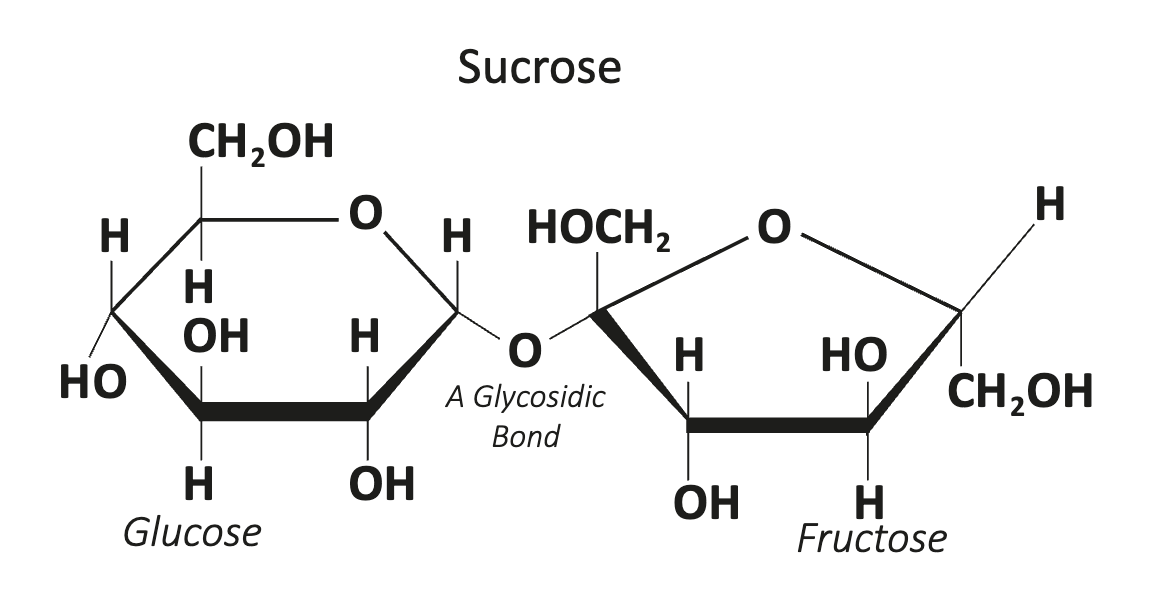
Figure: Sucrose molecule
Yeast does not have a transporter system in its cell membrane for sucrose. It therefore starts to break down sucrose in the wort using the enzyme invertase. Invertase produces glucose and fructose. Glucose is fermented first, followed by fructose.
Since sucrose is a combination of two simple sugars that yeast readily ferments, it is 100% fermentable. Being 100% fermentable, sucrose is often used as a priming sugar for bottle and cask conditioned beers. Some brewers also add granulated sucrose as it is easier to handle. It needs to be added to hot wort under agitation, either into the kettle, or whirlpool, for example.
What have we learned so far about the typical liquid adjuncts used for brewing?
-
A range of sugar syrups are used in brewing. They increase wort gravity without adding colour, protein, or FAN.
-
Starch-derived liquid adjuncts are commercially produced using heat, acid, and enzymes to convert the starch.
-
β-Amylase, in combination with pullulanase (limit dextrinase) is used to produce maltose syrups, while dextrose syrups are produced using amyloglucosidase with pullulanase.
-
Sucrose syrup is produced by a less complex extraction and purification process.
So far, we have discussed the main liquid adjuncts used in brewing. Next, we will briefly cover those that are used more for their effects on flavour and colour, than as a source of extract.