
Lesson 4 - Adjunct Composition and Application
This lesson explores adjuncts, which are sources of fermentable extract other than malted barley. It investigates the different cereals that we can use as a starch source within the brewhouse and examines how these same cereals can produce liquid adjuncts. It also considers other sources of fermentable sugars that we can add either directly into the kettle or later in the brewing process.
Starch-Derived Liquid Adjunct Manufacturing
There are a range of commercial liquid sugar syrups produced by the hydrolysis of cereal starch. They undergo a greater degree of processing than solid adjuncts, and are therefore more costly to purchase.
The process for breaking down the starch during syrup manufacture is relatively similar to that used for processing grits in the brewhouse – only acids and commercially-produced enzymes are used.
Liquid adjuncts are manufactured using one of the following processes:
-
Acid hydrolysis – strong acids are used to hydrolyse the starch.
-
Acid/enzyme starch hydrolysis – acid and enzymes are used in combination to liquefy the starch before more enzymes are added to convert the slurried starch into sugars.
-
Enzyme starch hydrolysis – enzymes are used for both the liquefaction and saccharification of the starch slurry.
The enzymes used help to control the liquid adjunct’s carbohydrate profile. In other words, up to a point, the manufacturer can control the proportion of each form of sugar and amount of non-fermentable material. The figure below illustrates the carbohydrates that can be present in the syrup:
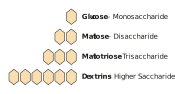
Figure: Sugars found in liquid adjuncts
The figure below illustrates the industrial production of some common liquid adjuncts:
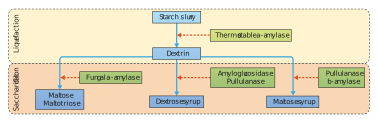
Figure: Industrial processing of starch into sugar syrups