
Lesson 4 - Adjunct Composition and Application
This lesson explores adjuncts, which are sources of fermentable extract other than malted barley. It investigates the different cereals that we can use as a starch source within the brewhouse and examines how these same cereals can produce liquid adjuncts. It also considers other sources of fermentable sugars that we can add either directly into the kettle or later in the brewing process.
Liquid Adjuncts
When buying liquid adjuncts, we receive products where the manufacturer has done the hard work of converting the raw material into sugar for fermentation. We can therefore add them either to the kettle or later on in the brewing process.
It is worth noting that not all brewing sugars come as liquids. They are also available as powders, granules and sold blocks. These can be added to the kettle or whirlpool, or later in the process if dissolved in deoxygenated water.
Liquid adjuncts can be added to the wort during boiling. However, they are more commonly added at the end of boil, to the whirlpool and even dosed into the wort on the way to the wort cooler. The earlier they are added, the greater the loss of extract (in trub or during transfer) and the higher the likelihood of flavour pickup due to non-enzymatic browning. The benefit of adding them to hot wort is that they are sterilised in the process. We discussed the benefits of adjuncts earlier in the lesson, but let’s remind ourselves of those relating specifically to liquid adjuncts now. The benefits are:
-
Increased brewhouse output without increasing the size of the mashing and wort separation equipment.
-
Better control of the wort sugar spectrum and hence fermentability.
-
Precise control of original gravity.
-
Can influence the palate fullness of beers.
-
Can impart novel flavours.
As we described earlier, liquid adjuncts are often delivered and stored hot. Below 50°C, the sugars in syrup can crystalise and fall out of solution. Bulk syrup storage tanks need to be heated and insulated effectively, as well as ventilated with heated, sterile air in order to prevent moisture build-up. Any moisture that forms inside the tank can dilute the surface of the syrup, increasing the risk of microbial spoilage. Syrups need to be above 70% sugar by weight to prevent spoilage by osmophilic (organisms which can grow in solutions with high osmotic pressures) yeast. The tank head space is also fitted with a UV light in order to control microbes. Syrup intake and dosing mains must be effectively insulated and heated by trace heating systems in order to ensure the temperature of the syrup does not fall below the sugar crystallisation temperature. The figure below shows some of the different types of liquid adjunct.
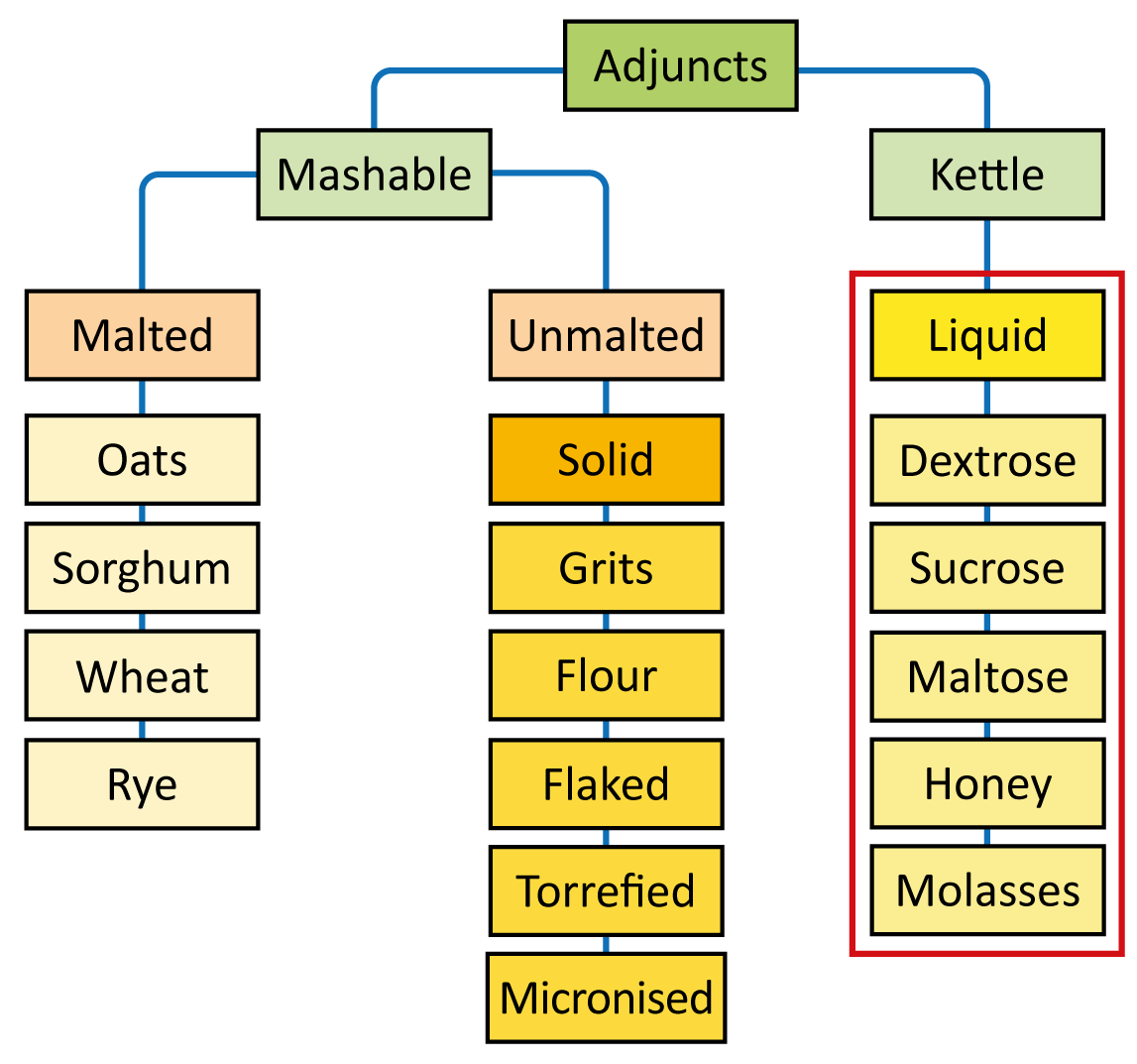
Figure: Liquid adjunct for addition to the wort kettle or beyond