
Lesson 4 - Adjunct Composition and Application
This lesson explores adjuncts, which are sources of fermentable extract other than malted barley. It investigates the different cereals that we can use as a starch source within the brewhouse and examines how these same cereals can produce liquid adjuncts. It also considers other sources of fermentable sugars that we can add either directly into the kettle or later in the brewing process.
Solid Adjuncts – Grits
Grits are coarse milled fragments of starchy endosperm; they are produced from cereal grains. The most common grains used for this are maize (corn), sorghum, and rice.
During grits preparation, the surface layers and embryo are removed, reducing the lipid, ash, and fibre content. The maize grit production process is shown in the figure below.
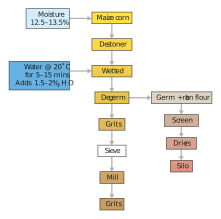
Figure: Production of maize grits
Maize bran and germs are valuable co-products. Maize bran is typically used for animal feed. The germ (embryo) can be processed to extract vegetable oil, for use in the food and cosmetic industry, or as animal feed. Once the bran and germ are removed, the endosperm grits are separated by particle size through sieving. The large endosperm grits are then milled to achieve the correct grit size. The larger grits are commonly used for flaking, to produce breakfast cereals; the smaller grits (0.3 to 1.5 mm) can be used in brewing.
Refined maize grits are made by steeping grits for 30 to 40 hours, then separating and washing the starch several times. Refined maize grits are a purer form of starch, with much lower protein and lipid levels than standard grits. They are also much smaller in size (average grain size 0.5 mm). The smaller size means they flow more easily and it is easier for water to penetrate and gelatinise the starch. Enzyme catalysed liquefaction and saccharification is also faster and easier. Recent research suggests that smaller grit particle size increases formation of stale beer flavour precursors, so larger grits may be favoured going forward. The figure below shows maize grits.
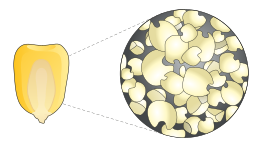
Figure: Maize grits
Rice grits tend to be the by-product of processing rice for food. They are the broken grains of rice that are too small to make the grade for use as food, and are typically less than 2 mm in size. Some breweries do not use grits made from broken grains. Instead, they use whole grains and these can only be polished two weeks before use. They feel that if the grains are polished more than two weeks before use, fatty acids on the surface oxidise which can lead to rancid off-flavour in the beer. The whole grains are milled before use in the brewhouse.
Once the starch is gelatinised through pre-cooking in a cereal cooker, the slurry can be added to the mash conversion vessel for conversion into fermentable sugars. This type of mashing is called ‘double mashing’; we will cover double mashing in more detail in the mashing unit. The figure below shows the temperature of the mash and cereal cooker through a double mashing programme.
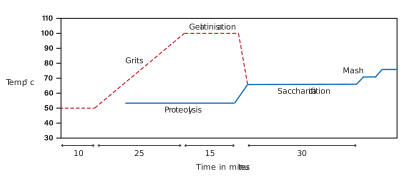
Figure: Double mashing temperature profile
Grits tend to be cheaper to buy than malt, however, in order to use them we need to purchase and operate a cereal cooker. We also need dedicated silos, and in certain cases, a dedicated mill. Of the grits discussed, rice is currently the most costly, as demand for rice as food is high due to continuing population growth. It is important to note that the residual lipid content in stored grits poses a risk, as it oxidises in the presence of oxygen, causing the product to become rancid. Stocks and the supply chain must therefore be managed very carefully to ensure that grits containing lipids are used as soon as possible after their production.
Next, we move on to an adjunct that is in some cases (rice, maize and sorghum) a by-product of the grit production process. The adjunct in question is flour.