
Lesson 4 - Adjunct Composition and Application
This lesson explores adjuncts, which are sources of fermentable extract other than malted barley. It investigates the different cereals that we can use as a starch source within the brewhouse and examines how these same cereals can produce liquid adjuncts. It also considers other sources of fermentable sugars that we can add either directly into the kettle or later in the brewing process.
Unmalted Adjuncts
Unmalted adjuncts are solid cereals that require enzymes to convert their starch into dextrins and fermentable sugars. They are processed to make the starch available for conversion. The cereal’s processing typically involves removing the embryo and any husk material in order to increase the proportion of endosperm material. Some are processed further to increase the proportion of starch, and to make this starch easier to convert in the brewhouse. We will begin our look at unmalted adjuncts by examining those that need to be processed before being added to the mash conversion vessel. But first we will discover the effects of processing.
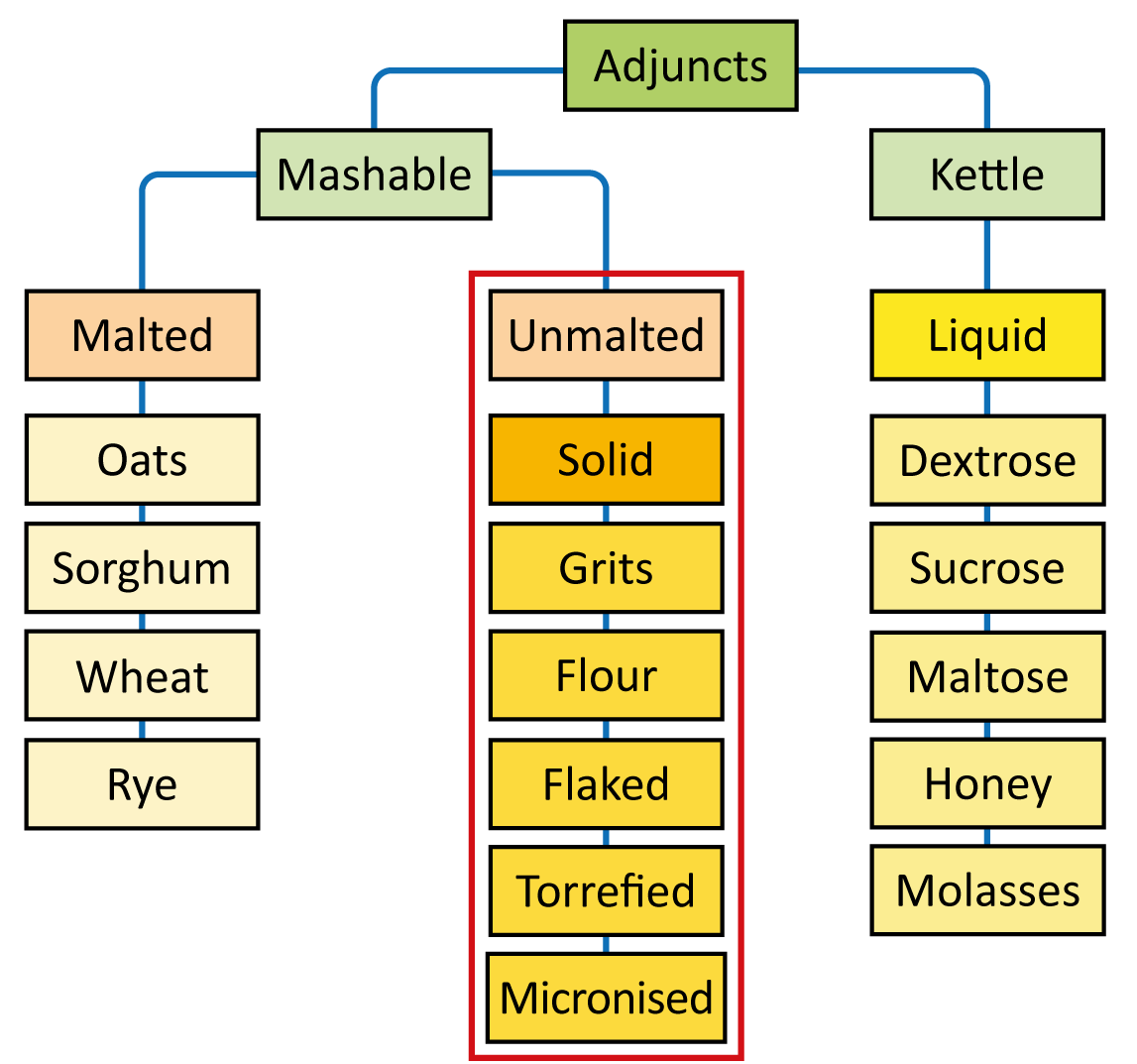
Figure: Solid adjuncts for the brewhouse mash vessel
The table below shows the effects of processing some types of adjuncts.
Table: Percentage composition of non-starch components of solid adjuncts
|
Adjunct |
β-glucan |
Pentosans |
Protein |
Lipids |
|
Barley |
3.5 |
10 |
11 |
3.5 |
|
Wheat |
0.5 |
8.5 |
12 |
3 |
|
Wheat flour |
0.1 |
1 |
9 |
1 |
|
Wheat starch |
0.1 |
0.6 |
0.5 |
0.4 |
|
Maize |
0.2 |
1.6 |
9.8 |
4.9 |
|
Maize grits |
0.1 |
1.5 |
9 |
0.4 |
|
Rice grits |
0.1 |
0.5 |
7 |
0.5 |
|
Sorghum |
0.3 |
2.5 |
11 |
5 |
Looking at the table we can see that the degree of processing affects the composition of the adjunct. For example, removing the germ during maize grit production reduces the lipid content from 4.9 to 0.4%. The impact on protein is less marked, with the level only falling from 9.8 to 9%. The reason for this is that most of the protein in maize is stored in the endosperm. As we saw earlier, wheat starch production achieves a much greater reduction in protein levels than processing into flour. We will discuss these production processes later.
Solid adjuncts are all destined to be processed in the mash conversion vessel. It is here that their starch will be converted into sugar. This conversion can be divided into three steps.
-
Gelatinisation – starch granules unwind to expose individual glucose chains to enzymes. The granules take up water to form a gel, hence the name.
-
Liquefaction – this is the hydrolysis of the starch chains catalysed by enzymes, resulting in the chains of starch going into solution. In effect, the gel turns to a liquid.
-
Saccharification – enzymes catalyse further hydrolysis of the liquefied starches, to produce sugars.
In order to saccharify starch effectively, we first need to gelatinise and liquefy it.
The video below shows starch granules gelatinising under a microscope.
Gelatinisation of starch needs two elements to occur. It requires the presence of moisture/water and the thermal energy to disrupt the starch molecules. The temperature required depends on the nature of the starch, and as a result, different starch granules in different cereals have different gelatinisation temperatures. The gelatinisation temperature of the different starch granules is shown in the table below.
Table: Gelatinisation temperatures for different starch sources
| Cereal | Gelatinisation Temp (℃) | Shape | Granule Size (µm) | ||
| B Type | A Type | B Type | A Type | ||
| Barley | 75-80 | 61-62 | Round/lenticular | 1-5 | 10-25 |
| Wheat | 52-54 | Round/lenticular | 1-5 | 15-25 | |
| Maize (corn) | 70-80 | Round/polygonal | 10-15 | ||
| Rice | 70-80 | Polygonal/compound | 2-8 | 9-30 | |
| Sorghum | 70-80 | Round/polygonal | 10-12 | ||
| Oats | 55-56 | Polygonal/compound | 2-10 | ||
| Rye | 60-65 | Spherical/lenticular | 1-8 | 10-30 | |
The gelatinisation temperature of the starch granules dictates where in the brewing process you can use the adjunct.
Maize, rice, and sorghum will require cereal cooking because at between 70°C and 80°C the gelatinisation temperatures of their starch granules are above the saccharification temperature (around 65°C) in the mash conversion vessel. Some types of rice must be heated to boiling in order to fully gelatinise their starch. A portion of malted barley can be added to the cereal cooker to provide some enzymes that will start the liquefaction of the starch. Alternatively, commercial (exogenous) enzymes can be used. Although the diastatic enzymes will be denatured when exposed to this heat directly, the thick cereal mash protects them, allowing them to reduce the viscosity of the mash. Bacterially-derived exogenous enzymes can be more heat stable than those that come from the malt. The mash is also agitated, as shown in the figure of a cereal cooker below.
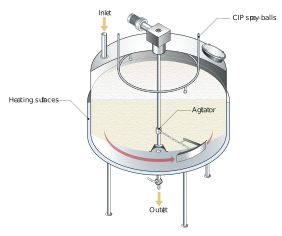
Figure: Cereal cooker
Now we know a little more about how we process solid adjuncts that have not been pre-gelatinised let’s find out about the main form of these used in the brewery, grits.