
Lesson 4 - Adjunct Composition and Application
This lesson explores adjuncts, which are sources of fermentable extract other than malted barley. It investigates the different cereals that we can use as a starch source within the brewhouse and examines how these same cereals can produce liquid adjuncts. It also considers other sources of fermentable sugars that we can add either directly into the kettle or later in the brewing process.
The Disadvantages of Using Adjuncts
So far, it’s all good news about adjuncts. There are, however, some aspects of adjuncts, which unless controlled, can negatively impact the brewing process and/or the beer produced. Let’s discuss what these downsides are.
Reduction in nitrogenous material
The majority of adjuncts do not contribute proteins, polypeptides, or amino acids to the wort. As a result, the more you add, the more you dilute those derived from the malt. Yeast requires free amino nitrogen (FAN) to enable it to grow new cells and ferment wort effectively. A lack of FAN causes slow fermentations and can lead to increased off-flavours in the beer. A yeast nutrient can be added to adjust FAN to the appropriate level in order to support desirable yeast performance. As we learned earlier, increased adjunct use can result in insufficient proteins and polypeptides, which in turn can cause poor foam stability.
Reduction in mash enzyme levels
Malted barley provides sufficient enzymes to convert more starch than it can contribute. This means that 15-20% additional starch can be converted by the barley enzymes. If the level of adjunct use is above this, or if the malt used is low in enzymes, there will be insufficient enzyme activity in the mash to convert all the starch. This can be overcome by adding additional commercially produced enzymes. Due to the process used to produce them, however, these enzyme products may contain small amounts of proteolytic enzymes that can damage the foam potential of the finished beer.
Reduction of beer colour
Aside from coloured sugars or caramel, adjuncts contribute little or no colour to beer. The reduction in wort nitrogen also means that less colour is picked up in the boil through the Maillard reaction. If the adjunct is used to replace malt in the recipe, the shortfall in colour will need to be made up by using coloured malt extract or caramel. The cost of using the additional colour source is unlikely to be anywhere near as much as the saving gained by replacing malt in the recipe. Using adjuncts to replace a portion of the malt results in flavour changes that are less simple to correct. However, there is a wide range of speciality malt products available to assist with the task.
The requirement for additional processing equipment
Some adjuncts require additional, or different, equipment to process them. For example:
-
A cereal cooker is required for some non-pregelatinised adjuncts. We will discuss the use of these later.
-
Sugar syrups are usually delivered and stored at 60-70°C, as they would be too viscous to pump efficiently below that temperature.
-
Flours require different handling and storage equipment to that used for malt.
In the case of all of these adjuncts, there is a cost for purchasing, maintaining, and operating the dedicated equipment. The price the brewery pays for the adjunct versus the price of the malt will determine the payback period of the equipment. In countries where malting barley is not widely available and the cereals used to make the adjuncts are, the payback period will be relatively short.
Safety
It may sound dramatic, but flour and starch products are essentially an ideal fuel for explosions. When handling malt in the brewery, we must do all we can to eliminate dust and prevent explosions. When we purchase flours and starches, we are actually purchasing a form of dust! While correctly designed and properly managed flour handling facilities control the hazard, if you don’t have flour in your brewery, it can’t cause an explosion! The finely divided nature of flours and starches also means that they tend to take up moisture more readily than whole grains or larger particles. This means they are also more prone to fungal spoilage.
Wort separation problems
The husks of the cereals used to make adjuncts are removed during their production process. Therefore, they do not contribute to the filtration bed during wort separation. In addition, some adjuncts (wheat, rye, triticale, and oats) can substantially increase wort viscosity. Both of these factors reduce the rate at which wort can be recovered in the brewhouse. Furthermore, some adjuncts contribute small particles that can block the filter bed, further slowing the rate of wort separation. The figure below shows a lauter tun with filter bed.
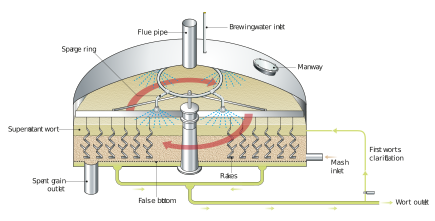
Figure: Lauter tun