
Lesson 4 - Adjunct Composition and Application
This lesson explores adjuncts, which are sources of fermentable extract other than malted barley. It investigates the different cereals that we can use as a starch source within the brewhouse and examines how these same cereals can produce liquid adjuncts. It also considers other sources of fermentable sugars that we can add either directly into the kettle or later in the brewing process.
Preface
For many years, adjuncts have played an important role in brewing. Some brewers see them as a cheap and inferior sugar source, using the German Reinheitsgebot as the ultimate endorsement of adjunct-free brewing. Other brewers use adjuncts to both enhance the quality of the beer they brew and the diversity of beers that they offer the consumer.
In 1516, a purity law called Reinheitsgebot was introduced in Germany. It allows only the use of water, malted barley, and hops to produce beer. Brewers outside of Germany, however, were not restricted by this law and developed different beer styles, often using adjuncts.
Before we explore how adjuncts can be used, let’s look at what an adjunct is.
An adjunct is a supplementary raw material (ingredient) other than malted barley, which provides a source of fermentable sugars. Adjuncts are often cheaper than malted barley and offer several benefits, which we will discuss in this lesson.
Adjuncts can be classified as mash adjuncts or kettle/post kettle adjuncts. Adjuncts that contain starch are added to the mashing vessel, where the starch is then converted into sugar. Adjuncts that contain fermentable sugars can be added either to the kettle or later on in the brewing process. The table below summarises the main types.
Table: Adjunct types
|
Adjunct Type |
Source |
Comments |
|
Basic cereal (unmalted) |
Barley, wheat |
Can be milled as a very small proportion of the malted barley grist. More than a very small percentage will cause wort separation and beer filtration problems. |
|
Raw grits |
Maize, rice, sorghum |
As they are raw, the starch in grits is not gelatinised. The starch has a high gelatinisation temperature and hence grits require cereal cooking. |
|
Flakes |
Maize, rice, barley, oats, wheat |
Starch is gelatinised during flaking. |
|
Torrefied/micronised |
Maize, barley, wheat |
Starch is gelatinised during the processes of torrefaction and micronisation. |
|
Flour/starch |
Maize, wheat, rice, sorghum |
Both of these products are raw, and their starch is not gelatinised. The starch of sorghum, maize, and rice has a high gelatinisation temperature and hence they all require cereal cooking. |
|
Syrup |
Maize, wheat, barley, sucrose |
Fully converted – no starch is present. |
The figure below shows how we will categorise adjuncts within this lesson.
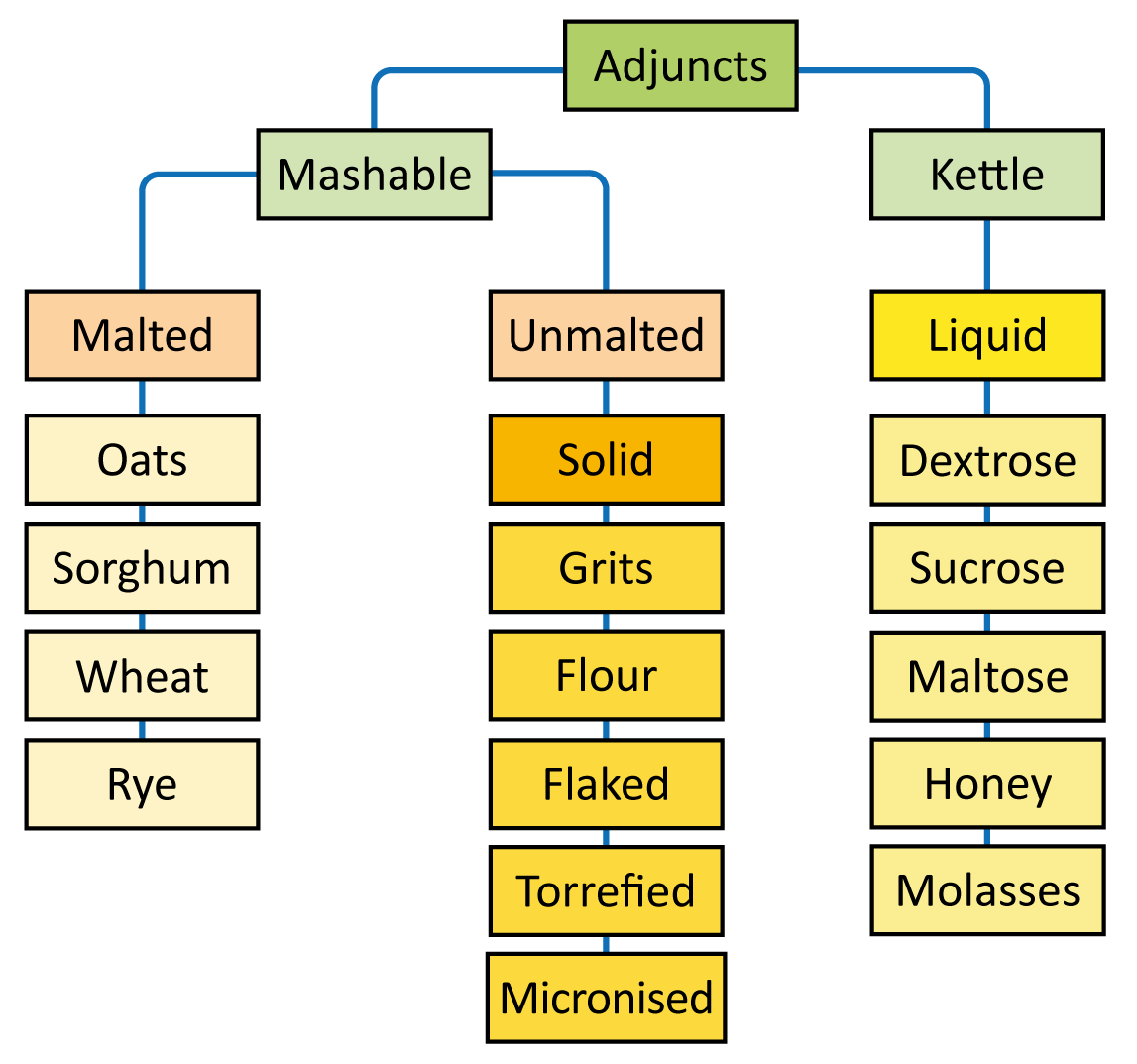
Figure: Categories of adjuncts