
Lesson 2 - Speciality Malt
This lesson deals with speciality malt. Speciality malt is any malted product other than standard pale barley malt. We explore how these malts are made. We discover how using speciality malts or malt extracts, provides different beer flavour, aroma and can also affect colour.
Drum Roaster Operation
Before we move on to discuss speciality malt produced in drum roasters, it makes sense to explain the basis of their operation. Drum roasters used for speciality malt production are very similar to coffee bean roasters, with capacities of up to five tonnes.
A drum roaster consists of a horizontal drum, rotated by a motor. The inside of the drum has curved vanes that ensure the grain is mixed as it is rotated.
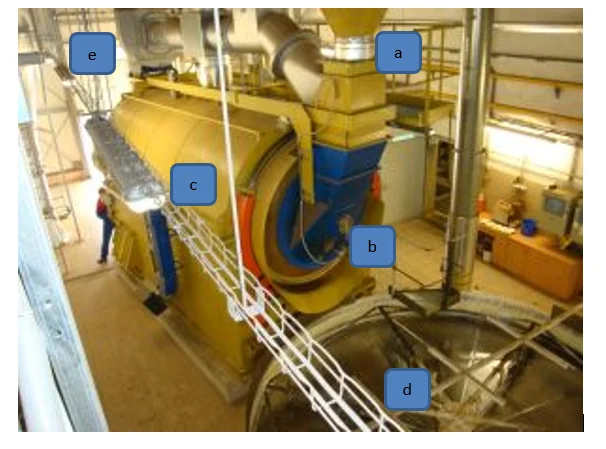
Grain is loaded into the drum (c) via a hopper (a). At the end of the roasting cycle, the front of the roaster (b) is opened to discharge the hot grain into a cooling hopper (d), which contains a perforated false-bottom tray and mixing paddles. Cooling air is drawn through the grain from below to cool the grain, while stirrer paddles mix the contents.
The heating system consists of a gas burner, and we can divert hot air around the exterior of the drum (indirect heating) or through the drum (direct heating) by means of valves and the exhaust fan (e). We use indirect heating to stew the grain and direct heating for roasting. Finally, the grain can be quenched with water to end the roasting cycle.
The video below shows an animation of the direct roasting operation. (Note, this is for illustrative purposes only and is not a recommendation or endorsement of the supplier’s product.)
The figures below illustrate the stewing and roasting processes. Stewing is used in the production of crystal and caramel malts, which we discuss later.
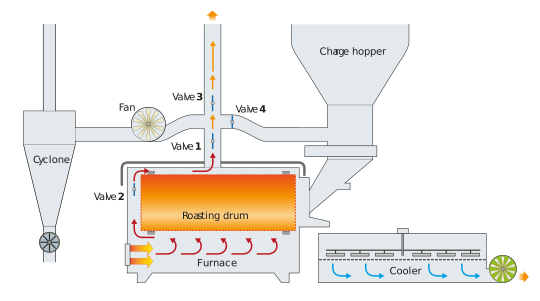
Figure: Indirect roasting
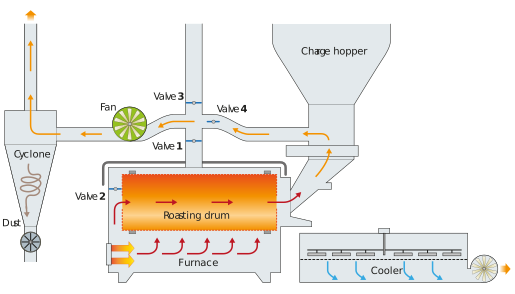
Figure: Direct roasting