
Lesson 2 - Speciality Malt
This lesson deals with speciality malt. Speciality malt is any malted product other than standard pale barley malt. We explore how these malts are made. We discover how using speciality malts or malt extracts, provides different beer flavour, aroma and can also affect colour.
Speciality Malt Categories
Hundreds of speciality malts are available today. The range available and the different names given to each product by malt suppliers can make it difficult to understand what exactly we are buying! No official body polices the names given to malt products. Malt suppliers use different names for the same malt type and different malt suppliers might give the same name to different malt types. Different countries have different naming conventions, and some suppliers make up their own names!
How to think about speciality malts
If malt suppliers all sold malts with the same name, we could shop around and buy that type of malt from the supplier who can meet our specifications at the lowest price. If they give their products exciting sounding names and trademark them, malt suppliers can set the price. This has led to many new products and makes categorising malts difficult. However, all malts are made in a similar way so it is possible to categorise them according to how they are produced. The figure below shows these categories.
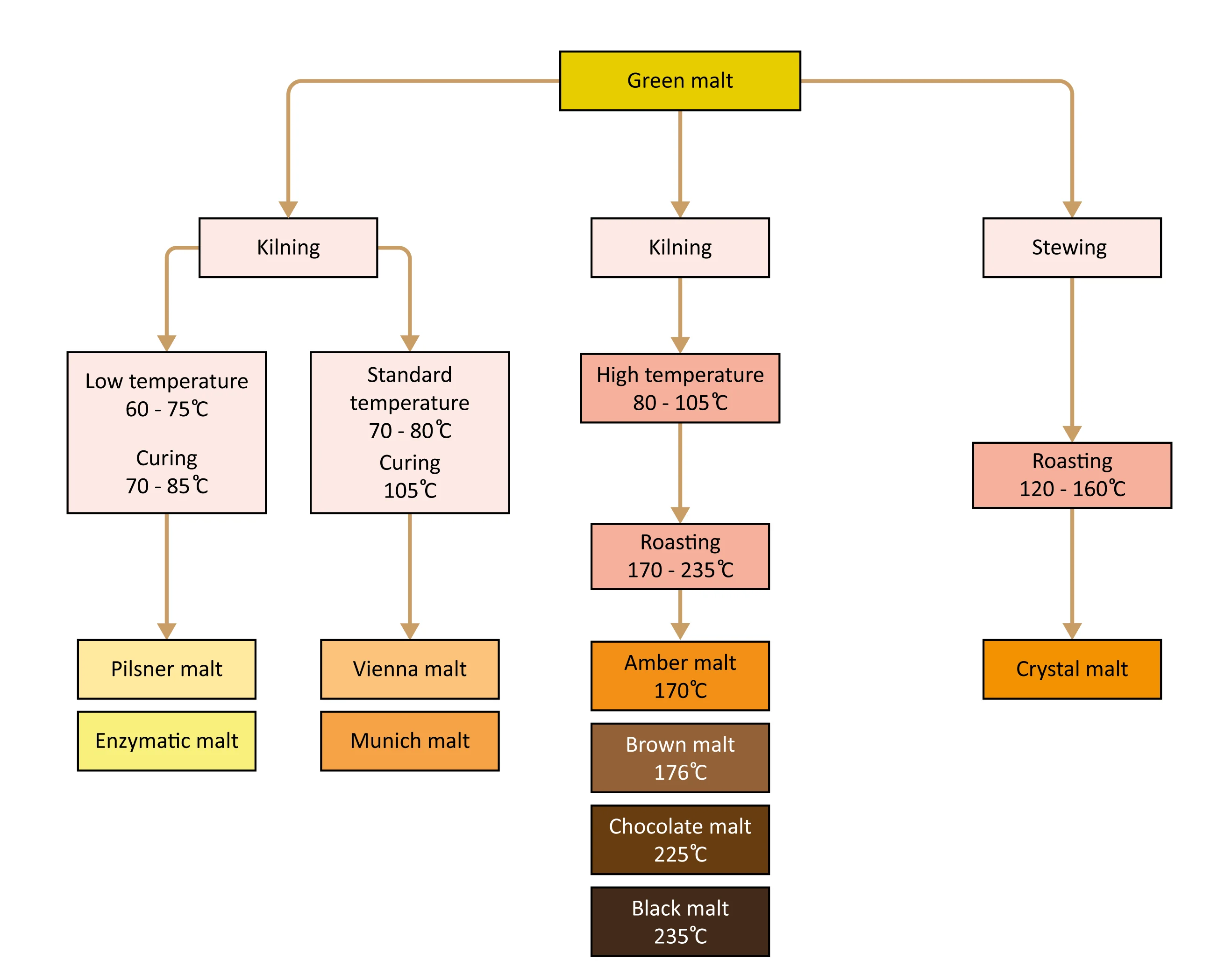
Figure: Categorising speciality malts
As you might expect, not all suppliers use the names above for their malts and some make malts that might not fit categories exactly. Some keep their process secret, so it is impossible to categorise them according to how they are made. Each speciality malt producer has a slightly different method for producing malt and some create malts that are variations on a theme. For example, although we provide “typical” conditions for Munich malt production, there are light, dark and even Belgian and Super Munich malts, all made using different methods. We have tried to give as many details of production parameters as possible. Unfortunately, the more details we give, the more likely it is that what we say does not apply to every malt producer’s standard method.
Although most of this lesson covers barley malt, any cereal can be malted. The most commonly malted cereals apart from barley are wheat, sorghum and rye which we now consider briefly.
Wheat malts
Wheat can provide more extract than malted barley. It also has other benefits such as improved foam stability and flavour different to that of malted barley. Unfortunately, wheat husks are looser than barley husks, so are lost before the grains arrive at the malting plant. This makes it difficult to malt because water uptake in steeping is harder to control and grains clump together more readily. The lack of husk also means that the acrospire is more easily damaged and grains are more susceptible to fungal spoilage. In the brewhouse, the lack of husk means that malted wheat contributes nothing towards the filter bed in the lauter or mash tun. The use of wheat malt can increase wort viscosity. This combined with a thinner filter bed can lead to lautering problems. Lacking a husk is not all bad news. It is the reason why wheat provides more extract than malted barley.
Malting process - wheat
The moisture level after steeping is around 38%, but during germination, this is increased to around 45% with bed sprays and humidified air. Steeping takes 38-55 h and germination is typically five days. The temperature during germination is maintained at 12-15˚C and is raised to 17-20˚C on the last day to promote the breakdown of endosperm cell walls. Wheat is turned more frequently during germination than barley due to its tendency to clump together. Wheat malt destined to be used in wheat beer typically has less protein breakdown than is the case in malted barley. A Kolbach index (KI) of 38-42%, is recommended. Wheat contains slightly more protein than barley, and wheat proteins stabilise beer foam more effectively than those from barley. This effect may be due to the ability of wheat proteins to bind lipids (which otherwise destroy foam) or just the greater provision of undegraded protein. While wheat is great for foam, the opposite is true for beer clarity. This explains why Weissbier is hazy in appearance. A high level of wheat malt in the grist can help when brewing hazy beer styles. Typically, wheat malts are kilned at low temperatures (starting at 40˚C and ending at 60˚C). Using different curing temperatures, the following malts are produced:
- Pale wheat malt – cured at 80˚C with a colour of 2-4 EBC
- Dark wheat malt – cured at 100-110˚C resulting in a colour around 15-18 EBC
An increasing range if other wheat malts is available.
Sorghum malts
Malted sorghum is used to produce traditional beverages and standard beers in Africa. In some countries, sorghum is used because it is illegal to import barley. Sorghum is the world’s fifth most important cereal crop due to its ability to grow in arid regions. As well as its use to make beer, sorghum is also used as food and to make biofuel. Sorghum malt typically has a low diastatic power, low extract and low FAN when compared to barley malt. Sorghum is gluten-free so can be used to make gluten-free beer.
Malting process - sorghum
Steeping takes between 8 and 24 h, with 16-18 h being typical. Because the grain is usually heavily contaminated with microbes this is best carried out in running water and the grain should be well cleaned and preferably washed before steeping. Air rests are used to promote even chitting, and it is especially effective if warm-water steeping (40°C) is used.
Sorghum malting is carried out at higher temperatures than barley malting. Germination lasts for 5-7 days with in-bed grain temperatures of 25-30°C. Rootlet growth during germination is very vigorous and grains must be turned frequently in both germination and kilning to prevent clumping. Low air on temperatures are used in kilning to protect enzymes from being denatured.
Rye malts
Global production of rye is small compared to barley, wheat, rice and maize with a total annual volume of 12-14 million t produced globally. The main producers are European Union and Russia. Rye is commonly consumed in the area it is produced, resulting in a very small trade market. Rye can be very high in extract and has a similar diastatic power to barley. The proteins in rye tend to be more soluble than is the case with barley. Rye pentosans can form gels and using rye significantly increases wort viscosity. This along with the lack of husk means that there is a limit to how much we can use without problems in wort separation. Rye kernels are small and thin, so a different mill setting is often required to process them.
Malting process - rye
As rye has no husk, when malting rye, maltsters are faced with the same challenges as with malting wheat (rapid hydration, damage to kernels and clumping). Steeping rye is relatively rapid but a seven-day germination period is required for complete modification. Standard rye is kilned at a low temperature to protect enzymes and has a colour of around 5 EBC. Crystal ryes are available that are much darker (230 EBC) and provide a red beer colour. Chocolate rye is also available. Some brewers feel that rye malts provide a spicy flavour and can enhance beer fullness.