
Lesson 2 - Speciality Malt
This lesson deals with speciality malt. Speciality malt is any malted product other than standard pale barley malt. We explore how these malts are made. We discover how using speciality malts or malt extracts, provides different beer flavour, aroma and can also affect colour.
Caramel
For centuries, brewers have used caramel to adjust beer colour. Today due to customers preferring clean label products and concerns about caramel’s safety, its use is rare and becoming rarer.
Caramel is made by heating of sugar with acids, alkalis, or sources of nitrogen. The colour in caramel comes from the Maillard reaction, caramelisation and pyrolysis. All feature a multitude of reactions with coloured and flavoured intermediates that form large highly coloured polymers.
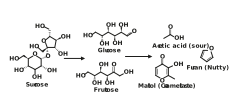
Figure: Caramelisation of sugar
These polymers include caramelans (C12H18O9), caramelens and caramelins.
- 2C12H22O11 = 4H20 C24H36O18 caramelan
- 3C12H22O11 = 8H20 C36H50O25 caramelen
- Continued heating produces caramelin C125H188O80
In some instances, 4-methylimidazole (a potential carcinogen) can be formed during caramel production.
Caramel producers classify caramels into four groups. The table below shows the differences between the products.
Table: Caramel classification
|
Caramel type |
Production process |
Characteristics |
|
E 150a Class I
|
|
|
|
E 150b Class II |
|
|
|
E 150c Class III |
|
|
|
E 150d Class IV |
|
|
For colour adjustment, caramel can be added into a boiling brew in the kettle, or in the beer before packaging. Adding the caramel to the kettle ensures proper mixing and sterilisation. However, the amount added needs to account for losses during the process, by adsorption to trub and yeast. Metered dosing of caramel after filtration minimises losses and enables precise control of colour. There is however a risk of haze formation and if hygienic practices are not used, microbiological contamination.