
Lesson 2 - Speciality Malt
This lesson deals with speciality malt. Speciality malt is any malted product other than standard pale barley malt. We explore how these malts are made. We discover how using speciality malts or malt extracts, provides different beer flavour, aroma and can also affect colour.
Malt Extract
Malt extract is used extensively in food production. It can also be used for brewing. Malt extract is made from malting grade barley, usually by maltsters making malt for brewing!
Malt extract is wort with some of the water removed, so the process used is very similar to that used for wort production. We cover this in detail later in this module. The figure below shows the equipment that can be used for malt extract production.
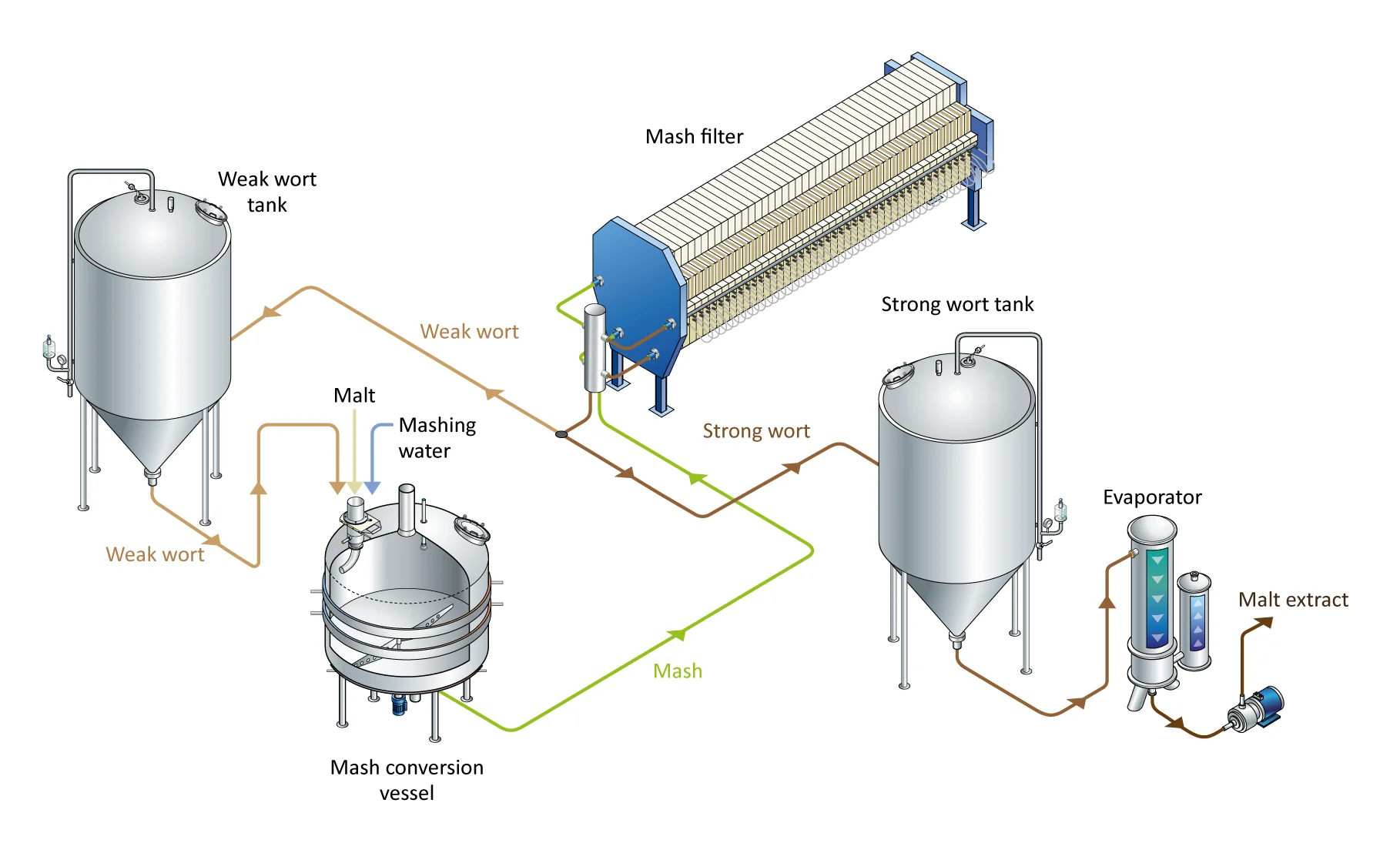
Figure: Malt extract production
When making malt extract, it is necessary to limit the amount of water that must be evaporated when the extract is concentrated. For this reason, the wort collected is more highly concentrated than those collected in a brewery, unless very high gravity brewing is being undertaken. 19-23°P is typical.
Once the wort for the extract is collected, weak worts down to around 1.5°P are sent to a weak wort holding tank. The weak wort is then used as part of the mashing water for subsequent batches. This prevents wasting extract. Many malt extract suppliers use a mash filter. This is because they are the most effective at producing strong worts and have the highest extract efficiency and shortest processing time of all wort separation devices. The extract may be boiled, but this is not essential if hop extracts are used. Filters are used to remove any solid material suspended in the wort if boiling is not carried out. Some malt extracts are diastatic. For diastatic extracts a lower mashing temperature (around 60°C) is used and a lower temperature is used in the evaporators. Obviously, they are not boiled!
The extract is concentrated using a series of falling film evaporators. Falling film evaporators consist of a tall cylindrical shell which is filled with hollow tubes and connected to a separation chamber (separator). The figure below shows a falling film evaporator, with the tubes represented by the vertical lines in the section that is cut away.
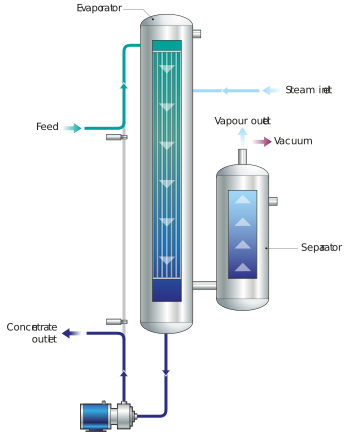
Figure: Falling film evaporator
The space around the tubes is filled with steam. The hollow tubes and the separator are maintained at a pressure below atmospheric pressure by a vacuum pump. Falling film evaporators are constructed from stainless steel and completely sealed to allow the reduced pressure to be maintained. Extract is distributed evenly over the inlet to the tubes and flows down them as a falling film (hence the name). As it flows down the tubes, it is heated as heat from the steam is transferred through the tube. The vapour produced from the extract is pushed down the tubes into the separator where it flows through traps to remove any extract before being drawn off. The flow of vapour down the tube helps to encourage the flow of liquid. The concentrated extract flows from the bottom of the cylinder and the separator and is pumped to the next evaporator or the pasteuriser. The video below shows the liquid and vapour flows through a falling film evaporator.
Note: this is for illustrative purposes only and is not a recommendation or endorsement of the supplier’s product.
One evaporator cannot achieve the required concentration of extract alone, so they are used in series. When there is more than one evaporator in series, they are called effects. The evaporation in each effect produces an increasingly concentrated extract. The extract before the last effect is around 60°P and after it is 65-82°P.
After evaporation, any unboiled extract is pasteurised at around 70°C for around 20 minutes to prevent microbiological spoilage. Diastatic extract is not pasteurised. Dried extracts produced by spray or band drying are also available but are used more in the food industry than in brewing.
Depending on the type of malt and process used to make the extract, a range of colours and flavours is possible. Highly coloured and flavoured extracts are available for use as replacements for caramel for colouring and also for flavour adjustment.
Here is a link to a malt extract supplier’s products. Please note this is for illustrative purposes only.
http://www.aspera-riese.de/fileadmin/pdf/AP_17_02_Produkt_PDFs_2.2_E.pdf
We mentioned caramel a moment ago. While it is used to colour beer like speciality malt and some malt extracts, how it is made is very different. We find out more next.